Hyphantoceras

Uncredited · via Wikidata/Commons. May be a photograph of a specimen, or an artist’s reconstruction — an interpretation of a skeleton, since colour and soft tissue are almost never preserved.
On record
Recorded, not inferred- Sits inside
- NostoceratidaePBDB
- Diet
- carnivorePBDB, for Ammonoidea
- Life habit
- nektonicPBDB, for Ammonoidea
- Motility
- fast-movingPBDB, for Ammonoidea
- Vision
- well-developedPBDB, for Cephalopoda
- Environment
- marinePBDB, for Cephalopoda
Time the record covers
At least 21 million years on record.
The record covers at least 93.9 Mya to 72.2 Mya. No occurrence read is dated outside 100.5 Mya to 66 Mya.
51 occurrences of Hyphantoceras on record, most of them in the Late Cretaceous. Bar height is expected occurrences, not a count: each fossil is spread across the span it is dated to, so a tall narrow bar means tight dating and a low wide one means loose.
When
51 occurrences- Late Cretaceous100%
These are dates about fossils, not the animal: the record can only begin after it arose and end before it died out, so either end may reach further. Shares are expected occurrences: a fossil dated to a span is counted partly in each period it straddles. More on what this infers.
Found in
17 formations
- Lewes Nodular Chalk Formation · Chalk Group6
- Upper Haborogawa Formation · Yezo Group5
- Panoche Formation · Great Valley Group5
- Redding Formation · Pacheco Group4
- Saku Formation4
- Chico Formation2
Loading coastlines…
The named rock units Hyphantoceras has been recovered from, largest first. Drawn where the rock is now, not where it formed. 12 occurrences have no formation on record, which is common for older literature.
Hyphantoceras and its relatives
Late CretaceousWhere Hyphantoceras and its relatives were recorded in the Late Cretaceous.
Found in the same rock
176 taxa- Nostoceras (Eubostrychoceras) saxonicum10 sites
- Scaphites geinitzii10 sites
- Sciponoceras bohemicum9 sites
- Yezoites puerculus9 sites
- Neophylloceras8 sites
- Tetragonites glabrus8 sites
- Gaudryceras (Gaudryceras) denseplicatum7 sites
- Damesites6 sites
- Inoceramus6 sites
- Lewesiceras mantelli6 sites
- Scalarites6 sites
- Subprionocyclus neptuni6 sites
- Longibelus matsumotoi5 sites
- Sphenoceramus naumanni5 sites
- Allocrioceras angustum4 sites
- Allocrioceras billinghursti4 sites
- Damesites ainuanus4 sites
- Gaudryceras4 sites
- Polyptychoceras pseudogaultinum4 sites
- Subprionocyclus branneri4 sites
- Yokoyamaoceras4 sites
- Allocrioceras nodiger3 sites
- Anchura (Helicaulax) condoniana3 sites
- Collignoniceras bravaisianum3 sites
The Paleobiology Database records 51 sites for Hyphantoceras, and this reads all of them. The number is how many of those sites it was catalogued from too. The 24 sharing the most are listed.
This is not a list of everything alive at the time. It is only what has come out of the same ground as this animal and been written down.
Entered from
21 references- Upper Cretaceous ammonites of California. Part III9
- Cretaceous stratigraphy in the Chikubetsu area, Hokaido5
- The ammonites of the English Chalk Rock (Upper Turonian)5
- Kreide-Fossilien in Sachsen, Teil 1, 7. Ammoniten4
- Paleoecological analysis of ammonoid assemblages in the Turonian Scaphites facies of Hokkaido, Japan4
- Map and checklists of Jurassic and Cretaceous macrofossil localities within the San Jose 1:100,000 Quadrangle, California, and discussion of paleontological results3
- Die Oberkreide der Sack-Mulde bei Alfeld (Cenoman-Unter-Coniac) Lithologie, Biostratigraphie und Inoceramen3
- Upper Cretaceous of the Pacific Coast3
- Ammonite faunas, biostratigraphy, and sequence stratigraphy of the Coniacian-Santonian of the Corbières (NE Pyrénées)2
- The Upper Cretaceous cephalopods of Japan, Part I2
- A Late Cretaceous nostoceratid ammonoid, Hyphantoceras orientale (Yabe), exhibiting variation with poorly developed tubercles1
- Late Turonian ammonites from Haute-Normandie, France1
Each of the 51 occurrences read was entered from one of these publications, ordered by how many each accounts for. This is not a search for papers mentioning the name. 9 further references are not listed. Entries link to doi.org where the Paleobiology Database holds an identifier, and to its own record where it does not. Relayed as the Paleobiology Database holds them, not checked against what they resolve to.
Media and terms
Media content2
Picture of Hyphantoceras
- Source
- Wikidata/Commons
- Credit
- nobody named on the record
- Licence
- not stated by the source
- Commercial use
- cannot be read from the licence given — check the record
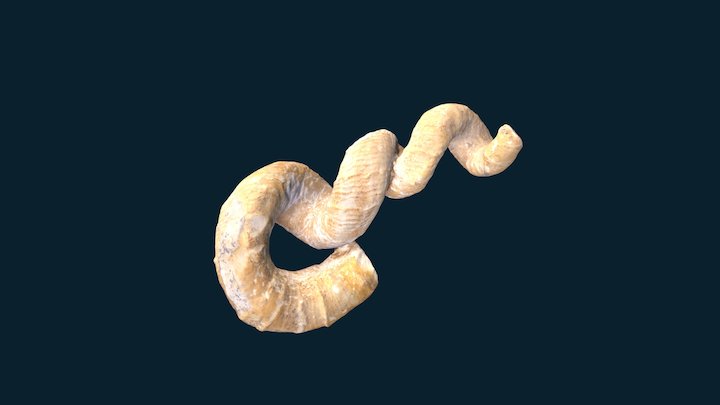
3D model
- Source
- Sketchfab
- Credit
- Shellie Luallin
- Licence
- CC Attribution
- Commercial use
- cannot be read from the licence given — check the record
Smithsonian Open Access and MorphoSource were not reached for this taxon, so this list is what the others held rather than everything there is.
This is what the site found, which is not the same as what exists.
Keep going
What may have been alongside itNostoceratidae through timeFormations of the Late CretaceousThe world it lived on
Occurrence data from the Paleobiology Database, CC BY 4.0. Hyatt 1900