Jurassicorbula
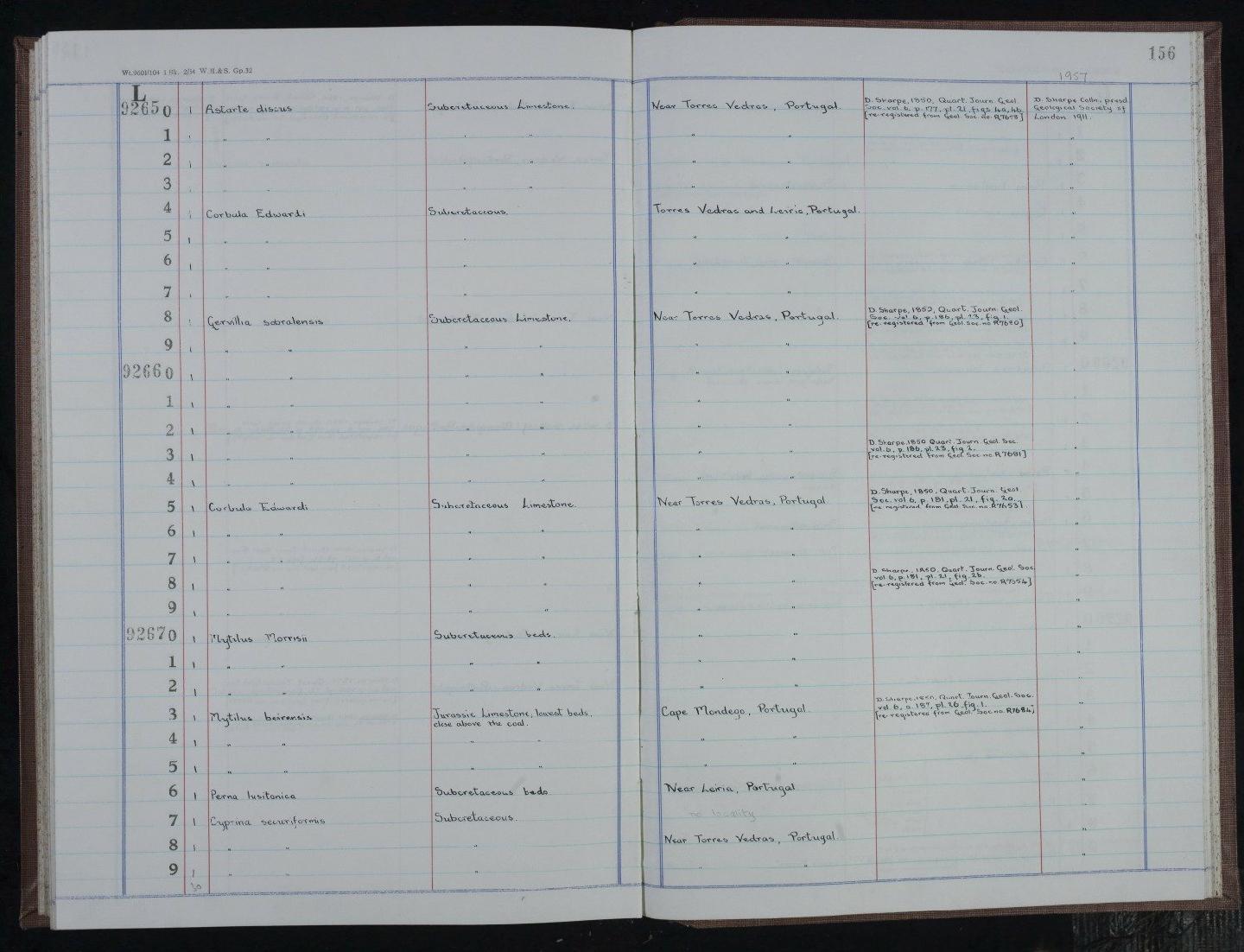
via GBIF · CC0 · via GBIF. May be a photograph of a specimen, or an artist’s reconstruction — an interpretation of a skeleton, since colour and soft tissue are almost never preserved.
On record
Recorded, not inferred- Sits inside
- MyidaPBDB
- Diet
- suspension feederPBDB
- Life habit
- infaunalPBDB
- Motility
- stationaryPBDB
- Vision
- blindPBDB, for Bivalvia
Time the record covers
At least 31 million years on record.
The record covers at least 180.4 Mya to 149.2 Mya. No occurrence read is dated outside 184.2 Mya to 143.1 Mya.
79 occurrences of Jurassicorbula on record, most of them in the Late Jurassic. Bar height is expected occurrences, not a count: each fossil is spread across the span it is dated to, so a tall narrow bar means tight dating and a low wide one means loose.
When
79 occurrencesThese are dates about fossils, not the animal: the record can only begin after it arose and end before it died out, so either end may reach further. Shares are expected occurrences: a fossil dated to a span is counted partly in each period it straddles. More on what this infers.
Found in
7 formations
- Alcobaca Formation39
- Sobral Formation19
- Lourinhã Formation5
- Alcobaça Formation3
- Cabacos Formation2
- Turmiel Formation1
Loading coastlines…
The named rock units Jurassicorbula has been recovered from, largest first. Drawn where the rock is now, not where it formed. 9 occurrences have no formation on record, which is common for older literature.
Jurassicorbula and its relatives
Late JurassicWhere Jurassicorbula and its relatives were recorded in the Late Jurassic.
Found in the same rock
253 taxa- Protocardia39 sites
- Heterodonta33 sites
- Juranomia32 sites
- Nicaniella32 sites
- Corbulomima30 sites
- Eomiodon22 sites
- Protocardia intexta22 sites
- Mesosaccella19 sites
- Arcomytilus18 sites
- Isocyprina18 sites
- Modiolus (Modiolus) imbricatus18 sites
- Camptonectes17 sites
- Pteria17 sites
- Nanogyra (Nanogyra) nana15 sites
- Cerithiidae14 sites
- Gastropoda14 sites
- Modiolus14 sites
- Grammatodon11 sites
- Grammatodon concinnus10 sites
- Myrene10 sites
- Procerithium10 sites
- Inoperna perplicata9 sites
- Liostrea9 sites
- Mytilus9 sites
The Paleobiology Database records 74 sites for Jurassicorbula, and this reads all of them. The number is how many of those sites it was catalogued from too. The 24 sharing the most are listed.
This is not a list of everything alive at the time. It is only what has come out of the same ground as this animal and been written down.
Entered from
9 references- Unpublished data66
- Palökologische und biofazielle Analyse des Kimmeridge (Oberjura) von Consolacao, Mittelportugal [Paleoecological and biofacies analysis of the Kimmeridgian (Upper Jurassic) of Consolacao, central Portugal]3
- Salinity-controlled benthic associations from the Upper Jurassic of Portugal3
- The oldest turtle from Portugal corresponding to the only pre-Kimmeridgian plesiochelyid (basal Eucryptodira) recognized at the generic level2
- Late Triassic–Jurassic bivalves from volcanic sediments of the Lhasa block, Tibet1
- Comparative ecological analysis of Toarcian (Lower Jurassic) benthic faunas from southern France and east-central Spain1
- New species of brackish water Bivalvia from the Upper Jurassic of Portugal1
- Die oberjurassische Korallenfazies von Algarve (Südportugal) [The Upper Jurassic coral facies of Algarve (Southern Portugal)]1
- The Ordovician-Silurian boundary in the Garth area of southwest Powys, Wales1
Each of the 79 occurrences read was entered from one of these publications, ordered by how many each accounts for. This is not a search for papers mentioning the name. Entries link to doi.org where the Paleobiology Database holds an identifier, and to its own record where it does not. Relayed as the Paleobiology Database holds them, not checked against what they resolve to.
Media and terms
Media content1
Picture of Jurassicorbula
- Source
- GBIF
- Credit
- via GBIF
- Licence
- CC0
- Commercial use
- the licence allows it
No 3D scan was found. Smithsonian Open Access, MorphoSource and Sketchfab were all searched.
This is what the site found, which is not the same as what exists.
Keep going
What may have been alongside itMyida through timeFormations of the Late JurassicThe world it lived on
Occurrence data from the Paleobiology Database, CC BY 4.0.