Knightella
Searched as Knightia. The Paleobiology Database treats Knightella as the accepted name.
No picture of Knightella was found. iDigBio and Smithsonian Open Access were searched and had none. Wikipedia and Wikidata have a picture filed under this name, but nothing tied it to Knightella itself, so it was not used. GBIF was asked, and what came back is not recorded: nothing, or a picture this site could not tie to Knightella, or no answer at all. This entry cannot say which.
On record
Recorded, not inferred- Sits inside
- OrthonemidaePBDB
- Life habit
- epifaunalPBDB, for Gastropoda
- Motility
- actively mobilePBDB, for Gastropoda
- Vision
- limitedPBDB, for Gastropoda
Time the record covers
At least 310 million years on record.
The record covers at least 358.86 Mya to 48.07 Mya. No occurrence read is dated outside 372.15 Mya to 23.04 Mya.
20 occurrences of Knightella on record, most of them in the Eocene. Bar height is expected occurrences, not a count: each fossil is spread across the span it is dated to, so a tall narrow bar means tight dating and a low wide one means loose.
When
20 occurrences- Devonian5%
- Carboniferous20%
- Permian20%
- Middle Jurassic5%
- Early Cretaceous5%
- Late Cretaceous5%
- Eocene38%
- Oligocene2%
These are dates about fossils, not the animal: the record can only begin after it arose and end before it died out, so either end may reach further. Shares are expected occurrences: a fossil dated to a span is counted partly in each period it straddles. More on what this infers.
Found in
9 formations
- Green River Formation6
- Akasaka Formation2
- Lower Limestone Formation · Clackmannan Group2
- Dangarfield Formation1
- English River Formation · North Hill Group1
- Zamek Formation1
Loading coastlines…
The named rock units Knightella has been recovered from, largest first. Drawn where the rock is now, not where it formed. 4 occurrences have no formation on record, which is common for older literature.
Knightella and its relatives
EoceneWhere Knightella and its relatives were recorded in the Eocene.
Found in the same rock
280 taxa- Worthenia3 sites
- Eucycloscala2 sites
- Gastropoda2 sites
- Naticopsis2 sites
- Nodozyga rugifera2 sites
- Palaeostylus2 sites
- Palaeozygopleura benniana2 sites
- Protostylus2 sites
- Trachydomia nodosa2 sites
- Warthia2 sites
- Aaptochiton pustulosus1 site
- Acanthactinella bennei1 site
- Achistrum gamma1 site
- Achistrum monochordata1 site
- Acteon1 site
- Acteonina koizumii1 site
- Advenaster1 site
- Aequispirella jurassica1 site
- Akasakiella yabei1 site
- Altotomaria reticulata1 site
- Ampezzalina1 site
- Anematina parva1 site
- Angyomphalus radianodosa1 site
- Anomphalus blancus1 site
The Paleobiology Database records 10 sites for Knightella, and this reads all of them. The number is how many of those sites it was catalogued from too. The 24 sharing the most are listed.
This is not a list of everything alive at the time. It is only what has come out of the same ground as this animal and been written down.
Entered from
15 references- A comparison of fish community structure along several paleoenvironments of Eocene Fossil Lake, Wyoming: a preliminary report3
- Permian (Capitanian) gastropods from the Akasaka Limestone (Gifu Prefecture, Japan)2
- The evolution of conch ontogeny in Mesozoic open sea gastropods2
- A revision of the British Carboniferous Loxonematidae, with descriptions of new forms2
- Middle Permian (Roadian) gastropods from the Khao Khad Formation, central Thailand: Implications for palaeogeography of the Indochina Terrane1
- Late Visean (Carboniferous) gastropods from the Gara El Itima (eastern Anti-Atlas, Morocco)1
- A Green River (Eocene) polychrotid (Squamata, Reptilia) and a re-examination of iguanian systematics1
- The anatomy of the fossil varanid lizard Saniwa ensidens Leidy, 1870, based on a newly discovered complete skeleton1
- Upper Cretaceous floras of King George Island, West Antarctica, and their palaeoenvironmental and phytogeographic implications1
- Carboniferous Mollusca from the Tamworth Belt, New South Wales, Australia1
- Paleontology of the Green River Formation, with a review of the fish fauna1
- Yao et al., 19801
Each of the 20 occurrences read was entered from one of these publications, ordered by how many each accounts for. This is not a search for papers mentioning the name. 3 further references are not listed. Entries link to doi.org where the Paleobiology Database holds an identifier, and to its own record where it does not. Relayed as the Paleobiology Database holds them, not checked against what they resolve to.
Media and terms
Media content2
Synchrotron Imaging scan
- Source
- MorphoSource
- Credit
- Museum of Paleontology
- Licence
- In Copyright
- Commercial use
- cannot be read from the licence given — check the record
- Specimen
- Knightia sp. · ummp:vp:uncat
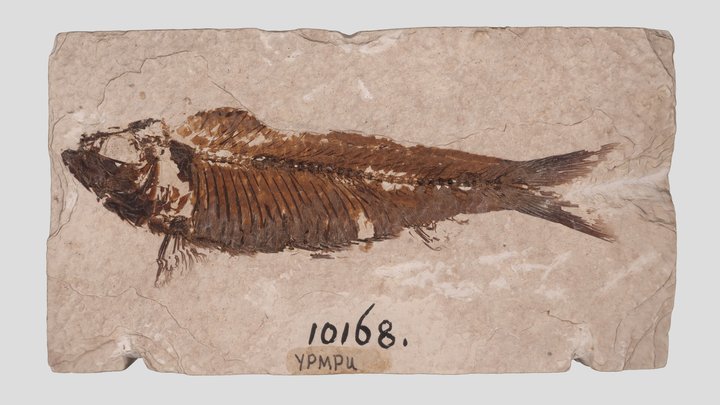
3D model
- Source
- Sketchfab
- Credit
- Yale Peabody Museum
- Licence
- CC Attribution
- Commercial use
- cannot be read from the licence given — check the record
No picture of Knightella was found. iDigBio and Smithsonian Open Access were searched and had none.
Wikipedia and Wikidata have a picture filed under this name, but nothing tied it to Knightella itself, so it was not used.
GBIF was asked, and what came back is not recorded: nothing, or a picture this site could not tie to Knightella, or no answer at all. This entry cannot say which.
This is what the site found, which is not the same as what exists.
Keep going
What may have been alongside itOrthonemidae through timeFormations of the EoceneThe world it lived on
Occurrence data from the Paleobiology Database, CC BY 4.0. Longstaff 1933