Leptothorax
Leptothorax is a genus of small ants with mainly Holarctic distributions. The genus is notable for its widespread social parasitism, i.e. they are dependent on the help of workers from other ant species during a part or the whole of their life cycles.

April Nobile · CC BY 4.0 · via Wikipedia/Commons. May be a photograph of a specimen, or an artist’s reconstruction — an interpretation of a skeleton, since colour and soft tissue are almost never preserved.
On record
Recorded, not inferred- Sits inside
- CrematogastriniPBDB
- Motility
- actively mobilePBDB, for Arthropoda
- Environment
- terrestrialPBDB, for Insecta
Time the record covers
At least 47 million years on record.
The record covers at least 48.07 Mya to 129 ka. No occurrence read is dated outside 56 Mya to 11.7 ka.
4 occurrences of Leptothorax on record, most of them in the Pleistocene. The Paleobiology Database records this as a living group. Bar height is expected occurrences, not a count: each fossil is spread across the span it is dated to, so a tall narrow bar means tight dating and a low wide one means loose.
When
4 occurrences- Eocene25%
- Miocene25%
- Pleistocene50%
These are dates about fossils, not the animal: the record can only begin after it arose and end before it died out, so either end may reach further. Shares are expected occurrences: a fossil dated to a span is counted partly in each period it straddles. More on what this infers.
Found in
3 formations
Loading coastlines…
The named rock units Leptothorax has been recovered from, largest first. Drawn where the rock is now, not where it formed. 1 occurrence has no formation on record, which is common for older literature.
Leptothorax and its relatives
PleistoceneWhere Leptothorax and its relatives were recorded in the Pleistocene.
Found in the same rock
160 taxa- Dyschirius3 sites
- Omaliinae3 sites
- Simplocaria3 sites
- Stenus3 sites
- Acidota quadrata2 sites
- Amara2 sites
- Bembidion2 sites
- Bledius2 sites
- Chrysolina2 sites
- Chrysomelidae2 sites
- Dytiscidae2 sites
- Lathrobium2 sites
- Pterostichus (Lenapterus) vermiculosus2 sites
- ? Oxyelinae indet.1 site
- Acrotrichis1 site
- Aegialia1 site
- Aegialia (Psammoporus) terminalis1 site
- Agabus1 site
- Agabus (Agabus) bifarius1 site
- Agathidium1 site
- Agonum1 site
- Agonum (Europhilus) consimile1 site
- Aleocharinae1 site
- Apion1 site
The Paleobiology Database records 4 sites for Leptothorax, and this reads all of them. The number is how many of those sites it was catalogued from too. The 24 sharing the most are listed.
This is not a list of everything alive at the time. It is only what has come out of the same ground as this animal and been written down.
Entered from
4 references- New amber deposit provides evidence of early Paleogene extinctions, paleoclimates, and past distributions1
- Palaeoentomology of the Kap København Formation, a Plio-Pleistocene sequence in Peary Land, North Greenland1
- Pre-Vashon fossil Coleoptera of Fraser age from the Fraser Lowland, British Columbia1
- A Pliocene flora and insect fauna from the Bering Strait region1
Each of the 4 occurrences read was entered from one of these publications, ordered by how many each accounts for. This is not a search for papers mentioning the name. Each entry links to doi.org. Relayed as the Paleobiology Database holds them, not checked against what they resolve to.
Media and terms
Media content2
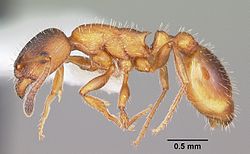
Picture of Leptothorax
- Source
- Wikipedia/Commons
- Credit
- April Nobile
- Licence
- CC BY 4.0
- Commercial use
- the licence allows it
Photogrammetry
- Source
- MorphoSource
- Licence
- not stated by the source
- Commercial use
- cannot be read from the licence given — check the record
- Specimen
- Leptothorax Leptothorax interruptus · ETHZ:ENT:0575956
The description on this site
- Source
- Wikipedia, “Leptothorax”
- Licence
- CC BY-SA 4.0
This is what the site found, which is not the same as what exists.
Keep going
What may have been alongside itCrematogastrini through timeFormations of the PleistoceneThe world it lived on
Occurrence data from the Paleobiology Database, CC BY 4.0. Mayr 1855