Mauremys mutica
The yellow pond turtle, is a medium-sized, semiaquatic turtle in the family Geoemydidae. This species has a characteristic broad yellow stripe extending behind the eye and down the neck; the carapace ranges in color from grayish brown to brown, and the plastron is yellow or orange with black blotches along the outer edges. It is native to East Asia, ranging from central Vietnam and Laos, north through the coastal provinces of south and central China, with insular populations known from Taiwan, Hainan and the Ryukyu Islands. Although populations in the southern Ryukyus are thought to be native, populations in the northern and central Ryukyus, as well as central Japan, are believed to have been introduced as a result of imports from Taiwan.

Uncredited · via Wikipedia/Commons. May be a photograph of a specimen, or an artist’s reconstruction — an interpretation of a skeleton, since colour and soft tissue are almost never preserved.
On record
Recorded, not inferred- Also called
- yellow pond turtlePBDB
- Sits inside
- MauremysPBDB
- Diet
- omnivorePBDB, for Cryptodira
- Life habit
- aquaticPBDB, for Cryptodira
- Motility
- actively mobilePBDB, for Osteichthyes
- Environment
- freshwaterPBDB, for Cryptodira
Time the record covers
At most 1.8 million years on record.
The one occurrence read is dated to somewhere between 5.333 Mya and 3.6 Mya, which is a dating window rather than a span.
1 occurrence of Mauremys mutica on record, most of them in the Pliocene. The Paleobiology Database records this as a living group, and the chart stops with its fossils rather than at the present. Bar height is expected occurrences, not a count: each fossil is spread across the span it is dated to, so a tall narrow bar means tight dating and a low wide one means loose.
When
1 occurrences- Pliocene100%
These are dates about fossils, not the animal: the record can only begin after it arose and end before it died out, so either end may reach further. Shares are expected occurrences: a fossil dated to a span is counted partly in each period it straddles. More on what this infers.
Found in
1 formation
- Tomori Formation · Shimajiri Group1
Loading coastlines…
The named rock units Mauremys mutica has been recovered from, largest first. Drawn where the rock is now, not where it formed.
Mauremys mutica and its relatives
PlioceneWhere Mauremys mutica and its relatives were recorded in the Pliocene.
Found in the same rock
The Paleobiology Database records no fossil sites for Mauremys mutica, so there is nothing to compare it with.
Entered from
1 referenceEach of the 1 occurrence read was entered from one of these publications, ordered by how many each accounts for. This is not a search for papers mentioning the name. Each entry links to the Paleobiology Database's own record for the work.
Media and terms
Media content1
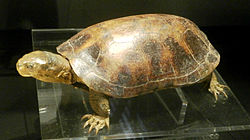
Picture of Mauremys mutica
- Source
- Wikipedia/Commons
- Credit
- nobody named on the record
- Licence
- not stated by the source
- Commercial use
- cannot be read from the licence given — check the record
No 3D scan of Mauremys mutica was found in Sketchfab.
Smithsonian Open Access and MorphoSource were not reached for this taxon, so this list is what the others held rather than everything there is.
The description on this site
- Licence
- CC BY-SA 4.0
This is what the site found, which is not the same as what exists.
Keep going
What may have been alongside itMauremys through timeFormations of the PlioceneThe world it lived on
Occurrence data from the Paleobiology Database, CC BY 4.0. (Cantor 1842)