Mecoptera
Mecoptera is an order of insects in the superorder Holometabola with about six hundred species in nine families worldwide. Mecopterans are sometimes called scorpionflies after their largest family, Panorpidae, in which the males have enlarged genitals raised over the body that look similar to the stingers of scorpions, and long beaklike rostra. The Bittacidae, or hangingflies, are another prominent family and are known for their elaborate mating rituals, in which females choose mates based on the quality of gift prey offered to them by the males. A smaller group is the snow scorpionflies, family Boreidae, adults of which are sometimes seen walking on snowfields. In contrast, the majority of species in the order inhabit moist environments in tropical locations.

Richard Bartz , Munich aka Makro Freak Image:MFB.jpg · CC BY-SA 2.5 · via Wikipedia/Commons. May be a photograph of a specimen, or an artist’s reconstruction — an interpretation of a skeleton, since colour and soft tissue are almost never preserved.
On record
Recorded, not inferred- Also called
- scorpionflyPBDB
- Sits inside
- AntliophoraPBDB
- Motility
- actively mobilePBDB, for Arthropoda
- Environment
- terrestrialPBDB, for Insecta
Time the record covers
At least 286 million years on record.
The record covers at least 293.52 Mya to 7.246 Mya. No occurrence read is dated outside 298.9 Mya to 5.333 Mya.
1,226 occurrences of Mecoptera on record, most of them in the Permian. The Paleobiology Database records this as a living group, and the chart stops with its fossils rather than at the present. Bar height is expected occurrences, not a count: each fossil is spread across the span it is dated to, so a tall narrow bar means tight dating and a low wide one means loose.
When
1,226 occurrences- Permian37%
- Early Triassicunder 1%
- Middle Triassic10%
- Late Triassic6%
- Early Jurassic14%
- Middle Jurassic6%
- Late Jurassic11%
- Early Cretaceous6%
- Late Cretaceous2%
- Paleoceneunder 1%
- Eocene7%
- Oligoceneunder 1%
- Mioceneunder 1%
These are dates about fossils, not the animal: the record can only begin after it arose and end before it died out, so either end may reach further. Shares are expected occurrences: a fossil dated to a span is counted partly in each period it straddles. More on what this infers.
Found in
134 formations
- Iva-Gora Beds Formation101
- Daohugou Formation99
- Madygen Formation66
- Mitina Formation55
- Croudace Bay Formation · Newcastle Coal Measures Group48
- Yanchang Formation46
Loading coastlines…
The named rock units Mecoptera has been recovered from, largest first. Drawn where the rock is now, not where it formed. 110 further formations hold fewer occurrences each and are not listed. 211 occurrences have no formation on record, which is common for older literature.
Mecoptera and its relatives
PermianWhere Mecoptera and its relatives were recorded in the Permian.
Found in the same rock
7,417 taxa- Coleoptera14 sites
- Orthophlebia liassica13 sites
- Blattodea10 sites
- Panorpidium geinitzi10 sites
- Heterophlebia buckmani9 sites
- Mesochorista australica9 sites
- Petromantis rossica9 sites
- Panorpidium minima8 sites
- Ampliceps furcitibia7 sites
- Heterothemis brodiei7 sites
- Liassothrips crassipes7 sites
- Mesobaetis sibirica7 sites
- Necrotaulius parvulus7 sites
- Neuroptera7 sites
- Odonata7 sites
- Orthoptera7 sites
- Oxycorynoides (Oxycorynoides) similis7 sites
- Protoscelis jurassica7 sites
- Agetopanorpa6 sites
- Agetopanorpa ornata6 sites
- Archirhyphus asiaticus6 sites
- Campterophlebiidae6 sites
- Coleopteron6 sites
- Eorpa ypsipeda6 sites
The Paleobiology Database records 379 sites for Mecoptera, and this reads 240 of them. Of that, one read hit the database's own return limit, so every count below is a floor rather than a total. The number is how many of those sites it was catalogued from too. The 24 sharing the most are listed.
This is not a list of everything alive at the time. It is only what has come out of the same ground as this animal and been written down.
Entered from
259 references- Materialy po evolyutsii Mecoptera107
- Paleozoiskie nasekomye kuznetskogo basseina102
- Permian fossil Insects from the Arkhangelsk district. Part I. The order Mecoptera34
- Yurskie skorpionnitsy yuzhnoj Sibiri i zapadnoy Mongolii28
- Die Insektenfauna des Ostniedersachsischen Oberen Lias28
- Fossil mecopteroid insects from the Upper Permian of New South Wales26
- New Triassic Scorpionflies (Insecta, Mecoptera)24
- Neue Untersuchungen über die fossilen Insekten mit Ergänzungen und Nachträgen sowie Ausblicken auf phylogenetische, palaeogeographische und allgemein biologische Probleme. II Teil24
- The Panorpoid complex in the British Rhaetic and Lias22
- Jurassic scorpionflies (Mecoptera) with swollen first metatarsal segments suggesting sexual dimorphism20
- New and little known Permian scorpion flies (Insecta, Mecoptera = Panorpida) of the family Agetopanorpidae from Perm and Arkhangel'sk oblasts20
- New Triassic scorpionflies (Insecta, Mecoptera) from Kyrgyzstan18
Each of the 1,226 occurrences read was entered from one of these publications, ordered by how many each accounts for. This is not a search for papers mentioning the name. 247 further references are not listed. Entries link to doi.org where the Paleobiology Database holds an identifier, and to its own record where it does not. Relayed as the Paleobiology Database holds them, not checked against what they resolve to.
Media and terms
Media content1
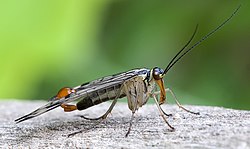
Picture of Mecoptera
- Source
- Wikipedia/Commons
- Credit
- Richard Bartz , Munich aka Makro Freak Image:MFB.jpg
- Licence
- CC BY-SA 2.5
- Commercial use
- the licence allows it
No 3D scan was found. Smithsonian Open Access, MorphoSource and Sketchfab were all searched.
The description on this site
- Source
- Wikipedia, “Mecoptera”
- Licence
- CC BY-SA 4.0
This is what the site found, which is not the same as what exists.
Keep going
What may have been alongside itAntliophora through timeFormations of the PermianThe world it lived on
Occurrence data from the Paleobiology Database, CC BY 4.0. Packard 1886