Megachilidae
Megachilidae is a cosmopolitan family of mostly solitary bees. Characteristic traits of this family include the restriction of the pollen-carrying scopa to the entire ventral surface of the abdomen and their typically elongated labra. Megachilid genera are most commonly known as mason bees and leafcutter bees, reflecting the materials from which they build their nest cells ; a few collect plant or animal hairs and fibers, and are called carder bees, while others use plant resins in nest construction and are correspondingly called resin bees. All species feed on nectar and pollen, but a few are kleptoparasites, feeding on pollen collected by other megachilid bees. Parasitic species do not possess scopae. A megachilid bee collects pollen by rapidly tapping its abdomen against the floral reproductive structures, packing the pollen into its scope.

Bruce Marlin · CC BY-SA 2.5 · via Wikipedia/Commons. May be a photograph of a specimen, or an artist’s reconstruction — an interpretation of a skeleton, since colour and soft tissue are almost never preserved.
On record
Recorded, not inferred- Also called
- mason beePBDB
- Sits inside
- AnthophilaPBDB
- Motility
- actively mobilePBDB, for Arthropoda
- Environment
- terrestrialPBDB, for Insecta
Time the record covers
At least 59 million years on record.
The record covers at least 59.24 Mya to 210 ka. No occurrence read is dated outside 61.66 Mya to 14 ka.
80 occurrences of Megachilidae on record, most of them in the Eocene. The Paleobiology Database records this as a living group, and the chart stops with its fossils rather than at the present. Bar height is expected occurrences, not a count: each fossil is spread across the span it is dated to, so a tall narrow bar means tight dating and a low wide one means loose.
When
80 occurrences- Paleocene1%
- Eocene80%
- Oligocene5%
- Miocene13%
- Pleistocene1%
These are dates about fossils, not the animal: the record can only begin after it arose and end before it died out, so either end may reach further. Shares are expected occurrences: a fossil dated to a span is counted partly in each period it straddles. More on what this infers.
Found in
10 formations
- Florissant Formation13
- Upper Freshwater-Molasse Formation5
- Rott Formation3
- Shanwang Formation2
- Menat Formation1
- Latah Formation1
Loading coastlines…
The named rock units Megachilidae has been recovered from, largest first. Drawn where the rock is now, not where it formed. 51 occurrences have no formation on record, which is common for older literature.
Megachilidae and its relatives
EoceneWhere Megachilidae and its relatives were recorded in the Eocene.
Found in the same rock
4,099 taxa- Glyptapis fuscula7 sites
- Ctenoplectrella viridiceps6 sites
- Prosphyracephala succini6 sites
- Glyptapis mirabilis5 sites
- Prenolepis henschei5 sites
- Succinapis micheneri5 sites
- Tetraponera simplex5 sites
- Yantaromyrmex geinitzi5 sites
- Anisoptera4 sites
- Apidae4 sites
- Archaea paradoxa4 sites
- Archipseudophasma4 sites
- Archipseudophasmatidae4 sites
- Balticophasma4 sites
- Balticoroma serafinorum4 sites
- Coleoptera4 sites
- Gesomyrmex hoernesi4 sites
- Gnamptogenys europaea4 sites
- Lype sericea4 sites
- Plagiolepis klinsmanni4 sites
- Plectrocnemia lata4 sites
- Prodinapsis succinalis4 sites
- Protobombus (Protobombus) hirsutus4 sites
- Raptophasma kerneggeri4 sites
The Paleobiology Database records 40 sites for Megachilidae, and this reads all of them. Of that, one read hit the database's own return limit, so every count below is a floor rather than a total. The number is how many of those sites it was catalogued from too. The 24 sharing the most are listed.
This is not a list of everything alive at the time. It is only what has come out of the same ground as this animal and been written down.
Entered from
35 references- A monograph of the Baltic amber bees and evolution of the Apoidea (Hymenoptera)29
- A monograph on fossil bees (Hymenoptera: Apoidea)7
- Fossil Hymenoptera from Florissant, Colorado6
- Descriptions of Hymenoptera from Baltic amber5
- New genera of melikertine bees with facial modifications in Baltic amber (Hymenoptera: Apidae)2
- Three bees from Baltic amber2
- A new species of the bee genus Ctenoplectrella in middle Eocene Baltic amber (Hymenoptera, Megachilidae)1
- A new species of Ctenoplectrella in Baltic amber (Hymenoptera: Megachilidae)1
- The oldest fossil of a melittid bee (Hymenoptera: Apiformes) from the early Eocene of Oise (France)1
- An Eocene Bee in Rovno Amber, Ukraine (Hymenoptera: Megachilidae)1
- Notes on a megachiline bee (Hymenoptera: Megachilidae) from the Miocene of Idaho1
- Systematik, Phylogenie, Taphonomie und Paläoökologie der Insekten aus dem Mittel-Eozän des Eckfelder Maares, Vulkaneifel1
Each of the 80 occurrences read was entered from one of these publications, ordered by how many each accounts for. This is not a search for papers mentioning the name. 23 further references are not listed. Entries link to doi.org where the Paleobiology Database holds an identifier, and to its own record where it does not. Relayed as the Paleobiology Database holds them, not checked against what they resolve to.
Media and terms
Media content1
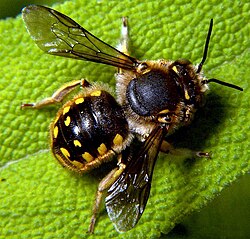
Picture of Megachilidae
- Source
- Wikipedia/Commons
- Credit
- Bruce Marlin
- Licence
- CC BY-SA 2.5
- Commercial use
- the licence allows it
No 3D scan was found. Smithsonian Open Access, MorphoSource and Sketchfab were all searched.
The description on this site
- Licence
- CC BY-SA 4.0
This is what the site found, which is not the same as what exists.
Keep going
What may have been alongside itAnthophila through timeFormations of the EoceneThe world it lived on
Occurrence data from the Paleobiology Database, CC BY 4.0. Latreille 1802