Microthyriaceae
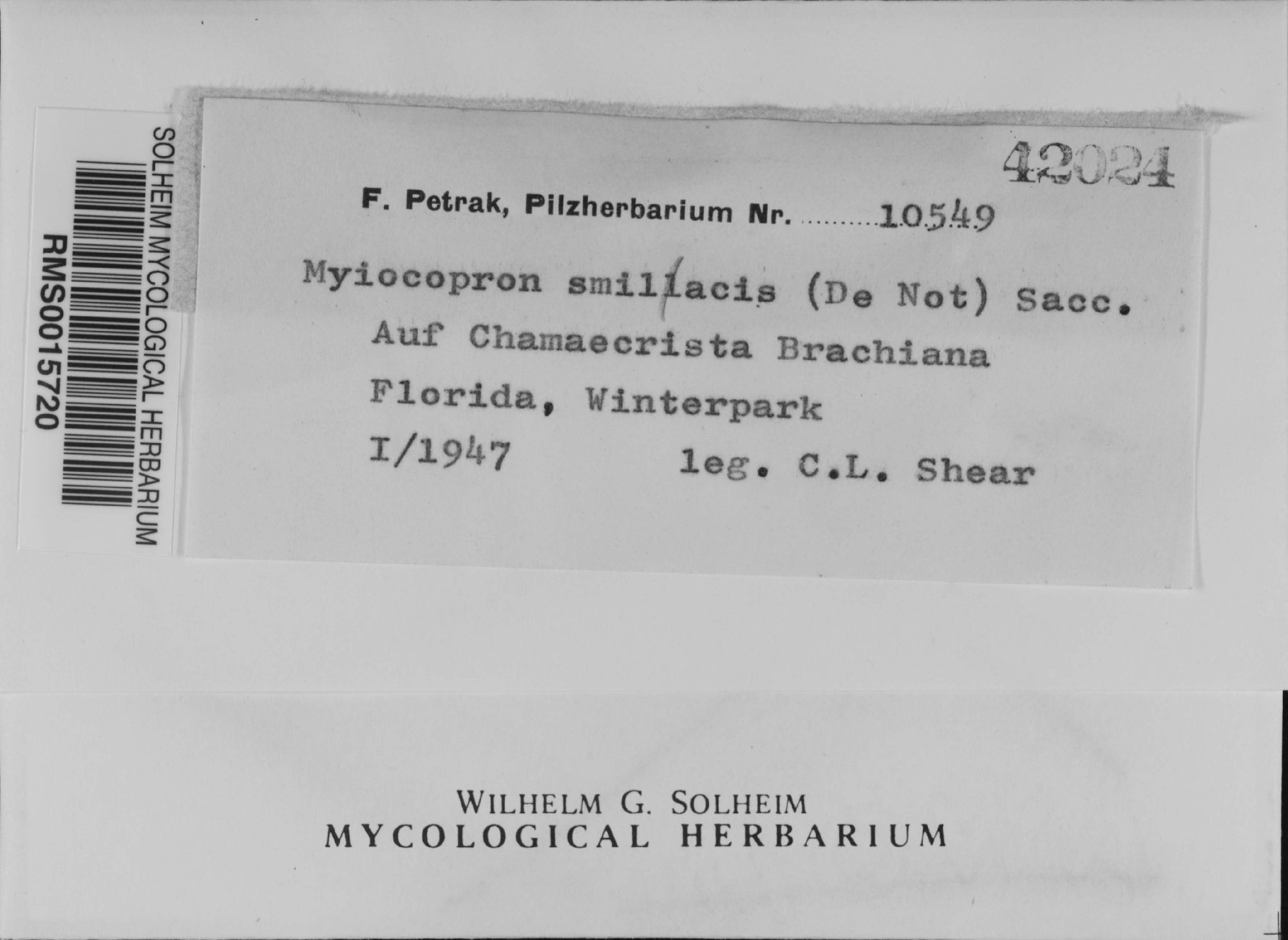
via iDigBio · CC BY-NC-SA · via iDigBio. May be a photograph of a specimen, or an artist’s reconstruction — an interpretation of a skeleton, since colour and soft tissue are almost never preserved.
On record
Recorded, not inferred- Sits inside
- MicrothyrialesPBDB
Time the record covers
At least 125 million years on record.
The record covers at least 125.77 Mya to 11.7 ka. No occurrence read is dated outside 143.1 Mya to 0 Mya.
30 occurrences of Microthyriaceae on record, most of them in the Late Cretaceous. The Paleobiology Database records this as a living group. Bar height is expected occurrences, not a count: each fossil is spread across the span it is dated to, so a tall narrow bar means tight dating and a low wide one means loose.
When
30 occurrences- Early Cretaceous3%
- Late Cretaceous53%
- Paleocene7%
- Eocene12%
- Oligoceneunder 1%
- Miocene20%
- Holocene3%
These are dates about fossils, not the animal: the record can only begin after it arose and end before it died out, so either end may reach further. Shares are expected occurrences: a fossil dated to a span is counted partly in each period it straddles. More on what this infers.
Found in
13 formations
- Zarga-Ghazal Formation · Darfur Group6
- Lameta Formation2
- Huitrera Formation2
- Baraka Formation · Darfur Group2
- Palana Formation2
- Warkalli Formation2
Loading coastlines…
The named rock units Microthyriaceae has been recovered from, largest first. Drawn where the rock is now, not where it formed. 6 occurrences have no formation on record, which is common for older literature.
Microthyriaceae and its relatives
Late CretaceousWhere Microthyriaceae and its relatives were recorded in the Late Cretaceous.
Found in the same rock
497 taxa- Callimothallus11 sites
- Botryococcus6 sites
- Tricolpites6 sites
- Triorites6 sites
- Gemmatriletes5 sites
- Araucariacites australis4 sites
- Chomotriletes minor4 sites
- Gabonisporis vigourouxii4 sites
- Plantae4 sites
- Polypodiaceaesporites4 sites
- Syncolporites4 sites
- Tricolporites4 sites
- Botryococcus braunii3 sites
- Distaverrusporites3 sites
- Fungi3 sites
- Grimsdalea magnaclavata3 sites
- Hexacolpites3 sites
- Monocolpites3 sites
- Phragmothyrites eocaenica3 sites
- Phyllocladidites mawsonii3 sites
- Podocarpidites3 sites
- Proteacidites sigalii3 sites
- Retitricolporites3 sites
- Scabratriporites simpliformis3 sites
The Paleobiology Database records 24 sites for Microthyriaceae, and this reads all of them. The number is how many of those sites it was catalogued from too. The 24 sharing the most are listed.
This is not a list of everything alive at the time. It is only what has come out of the same ground as this animal and been written down.
Entered from
11 references- Late Cretaceous spore-pollen zonation of the Central African Rift System (CARS), Kaikang Trough, Muglad Basin, South Sudan: angiosperm spread and links to the Elaterates Province10
- A Catalogue of Indian Fossil Plants7
- Maastrichtian palaeoenvironments and palaeoclimate reconstruction in southern South America (Patagonia, Argentina) based on fossil fungi and algae using open data resources2
- Fungi in dinosaurian (Isisaurus) coprolites from the Lameta Formation (Maastrichtian) and its reflection on food habit and environment2
- Palynostratigraphy of the Paleogene Huitrera Formation in N-W Patagonia, Argeyesina2
- Miocenska Flora ze Starych Gliwic na Slasku (Miocene Flora of Stare Gliwice in Upper Silesia)2
- Nothofagus and the associated palynoflora from the Late Cretaceous of Vega Island, Antarctic Peninsula1
- Exceptionally well preserved late Quaternary plant and vertebrate fossils from a blue hole on Abaco, The Bahamas1
- Early Cretaceous (Neocomian) flora and fauna of the Lower Strzelecki Group, Gippsland Basin, Victoria1
- Miocene communities and paleoenvironments of Southern Costa Rica1
- Geological Reconnaissance of northeastern Ellesmere Island, District of Franklin1
Each of the 30 occurrences read was entered from one of these publications, ordered by how many each accounts for. This is not a search for papers mentioning the name. Entries link to doi.org where the Paleobiology Database holds an identifier, and to its own record where it does not. Relayed as the Paleobiology Database holds them, not checked against what they resolve to.
Media and terms
Media content1
Picture of Microthyriaceae
- Source
- iDigBio
- Credit
- via iDigBio
- Licence
- CC BY-NC-SA
- Commercial use
- the licence does not allow it
No 3D scan of Microthyriaceae was found in Sketchfab.
Smithsonian Open Access and MorphoSource were not reached for this taxon, so this list is what the others held rather than everything there is.
This is what the site found, which is not the same as what exists.
Keep going
What may have been alongside itMicrothyriales through timeFormations of the Late CretaceousThe world it lived on
Occurrence data from the Paleobiology Database, CC BY 4.0.