Mursia
Mursia is a genus of crabs in the family Calappidae, containing the following species:

Uncredited · via Wikipedia/Commons. May be a photograph of a specimen, or an artist’s reconstruction — an interpretation of a skeleton, since colour and soft tissue are almost never preserved.
On record
Recorded, not inferred- Sits inside
- CalappidaePBDB
- Diet
- carnivorePBDB, for Decapoda
- Life habit
- semi-infaunalPBDB, for Calappidae
- Motility
- actively mobilePBDB, for Malacostraca
- Vision
- well-developedPBDB, for Malacostraca
Time the record covers
At least 31 million years on record.
The record covers at least 33.9 Mya to 2.58 Mya. No occurrence read is dated outside 37.71 Mya to 1.8 Mya.
40 occurrences of Mursia on record, most of them in the Miocene. The Paleobiology Database records this as a living group, and the chart stops with its fossils rather than at the present. Bar height is expected occurrences, not a count: each fossil is spread across the span it is dated to, so a tall narrow bar means tight dating and a low wide one means loose.
When
40 occurrences- Eocene5%
- Oligocene28%
- Miocene55%
- Pliocene8%
- Pleistocene5%
These are dates about fossils, not the animal: the record can only begin after it arose and end before it died out, so either end may reach further. Shares are expected occurrences: a fossil dated to a span is counted partly in each period it straddles. More on what this infers.
Found in
12 formations
- Pysht Formation5
- Blakeley Formation4
- Dainichi Formation · Kakegawa Group2
- Ten-no Formation · Kakegawa Group2
- Culebra Formation2
- Hoko River Formation2
Loading coastlines…
The named rock units Mursia has been recovered from, largest first. Drawn where the rock is now, not where it formed. 17 occurrences have no formation on record, which is common for older literature.
Mursia and its relatives
MioceneWhere Mursia and its relatives were recorded in the Miocene.
Found in the same rock
265 taxa- Calappa heberti4 sites
- Callianassa4 sites
- Callianassa munieri4 sites
- Lucanthonisia eotvoesi4 sites
- Macrocheira teglandi4 sites
- Matuta brocchii4 sites
- Pilumnus mediterraneus4 sites
- Solemya (Acharax) dalli4 sites
- Xantho moldavicus4 sites
- Acila (Acila) gettysburgensis3 sites
- Asthenognathus cornishorum3 sites
- Callianassa kerepesiensis3 sites
- Katherinella arnoldi3 sites
- Liracassis apta3 sites
- Macoma (Macoma) twinensis3 sites
- Pachygrapsus hungaricus3 sites
- Parthenope szaboi3 sites
- Parthenope tetenyensis3 sites
- Petrochirus priscus3 sites
- Pisa oroszyi3 sites
- Turritella3 sites
- Actumnus telegdii2 sites
- Albunea asymmetrica2 sites
- Anapagurus miocenicus2 sites
The Paleobiology Database records 26 sites for Mursia, and this reads all of them. The number is how many of those sites it was catalogued from too. The 24 sharing the most are listed.
This is not a list of everything alive at the time. It is only what has come out of the same ground as this animal and been written down.
Entered from
12 references- Decapod crustaceans from the Miocene Kukinaga Group, Tanegashima Island, Kyushu, Japan11
- Cenozoic Decapod Crustacea from Southwest Japan6
- Fossil decapod crustaceans from the late Oligocene to early Miocene Pysht Formation and late Oligocene Quimper Sandstone, Olympic Peninsula, Washington5
- Decapod crustacea of the Badenian4
- New species of calappid crabs from Western North American and reconsideration of the Calappidae sensu lato3
- The fossil stalk-eyed Crustacea of the Pacific slope of North America3
- Paleontology of the Marine Tertiary formations of Oregon and Washington2
- Decapod crustaceans from the Panama region2
- Crostacei decapodi del Veneto occidentale (Vicenza, Italia Settentrionale)1
- An Early Miocene deep-water decapod crustacean faunule from the Vienna Basin (western Carpathians, Slovakia)1
- Miocene and Pleistocene Crabs (Crustacea, Decapoda) from Sabah and Sarawak1
- Mursia takahashii n. sp. (Brachyura) from Goishi in the Sendai Area1
Each of the 40 occurrences read was entered from one of these publications, ordered by how many each accounts for. This is not a search for papers mentioning the name. Entries link to doi.org where the Paleobiology Database holds an identifier, and to its own record where it does not. Relayed as the Paleobiology Database holds them, not checked against what they resolve to.
Media and terms
Media content2

Picture of Mursia
- Source
- Wikipedia/Commons
- Credit
- nobody named on the record
- Licence
- not stated by the source
- Commercial use
- cannot be read from the licence given — check the record
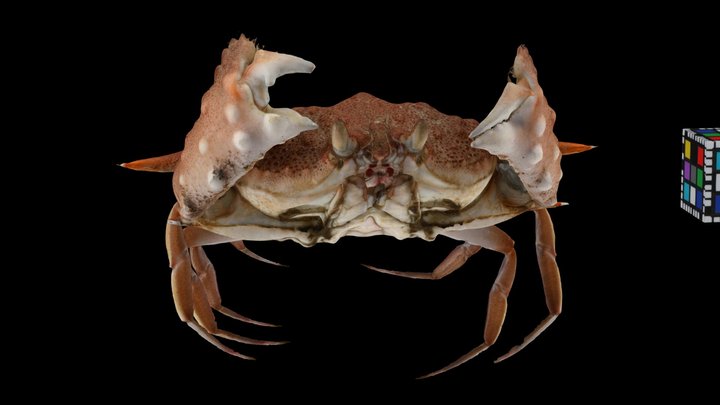
3D model
- Source
- Sketchfab
- Licence
- CC0 Public Domain
- Commercial use
- the licence allows it
Smithsonian Open Access and MorphoSource were not reached for this taxon, so this list is what the others held rather than everything there is.
The description on this site
- Source
- Wikipedia, “Mursia”
- Licence
- CC BY-SA 4.0
This is what the site found, which is not the same as what exists.
Keep going
What may have been alongside itCalappidae through timeFormations of the MioceneThe world it lived on
Occurrence data from the Paleobiology Database, CC BY 4.0. Leach 1823