Mygalomorphae
The Mygalomorphae, or mygalomorphs, are an infraorder of spiders, and comprise one of three major groups of living spiders with over 3,000 species, found on all continents except Antarctica. Many members are known as trapdoor spiders due to their creation of trapdoors over their burrows. Other prominent groups include Australian funnel web spiders and tarantulas, with the latter accounting for around one third of all mygalomorphs.

Fir0002 · GFDL 1.2 · via Wikipedia/Commons. May be a photograph of a specimen, or an artist’s reconstruction — an interpretation of a skeleton, since colour and soft tissue are almost never preserved.
On record
Recorded, not inferred- Sits inside
- OpisthothelaePBDB
- Life habit
- solitaryPBDB, for Arachnida
- Motility
- actively mobilePBDB, for Arachnida
- Environment
- terrestrialPBDB, for Arachnida
Time the record covers
At least 245 million years on record.
The record covers at least 245.19 Mya to 11.7 ka. No occurrence read is dated outside 247 Mya to 0 Mya.
97 occurrences of Mygalomorphae on record, most of them in the Late Cretaceous. The Paleobiology Database records this as a living group. Bar height is expected occurrences, not a count: each fossil is spread across the span it is dated to, so a tall narrow bar means tight dating and a low wide one means loose.
When
97 occurrencesThese are dates about fossils, not the animal: the record can only begin after it arose and end before it died out, so either end may reach further. Shares are expected occurrences: a fossil dated to a span is counted partly in each period it straddles. More on what this infers.
Found in
11 formations
- Crato Formation · Santana Group8
- Grès à Voltzia Formation3
- Dzun-Bain Formation · Bon Tsaagan Group3
- Foulden Hills Diatomite Formation2
- Grès à Meules Formation1
- Florissant Formation1
Loading coastlines…
The named rock units Mygalomorphae has been recovered from, largest first. Drawn where the rock is now, not where it formed. 74 occurrences have no formation on record, which is common for older literature.
Mygalomorphae and its relatives
Late CretaceousWhere Mygalomorphae and its relatives were recorded in the Late Cretaceous.
Found in the same rock
4,090 taxa- Clostes priscus8 sites
- Archaea paradoxa7 sites
- Bradoponera meieri7 sites
- Tetraponera simplex7 sites
- Ummidia7 sites
- Adorator hispidus6 sites
- Balticoroma serafinorum6 sites
- Ctenobethylus goepperti6 sites
- Gesomyrmex hoernesi6 sites
- Lasius schiefferdeckeri6 sites
- Nylanderia pygmaea6 sites
- Prenolepis henschei6 sites
- Prosphyracephala succini6 sites
- Yantaromyrmex geinitzi6 sites
- Ablator triguttatus5 sites
- Araneae5 sites
- Cretadiplura ceara5 sites
- Gnamptogenys europaea5 sites
- Hersiliidae5 sites
- Lasaeola infulata5 sites
- Pachycondyla succinea5 sites
- Plagiolepis kuenowi5 sites
- Plagiolepis solitaria5 sites
- Prodinapsis succinalis5 sites
The Paleobiology Database records 52 sites for Mygalomorphae, and this reads all of them. Of that, one read hit the database's own return limit, so every count below is a floor rather than a total. The number is how many of those sites it was catalogued from too. The 24 sharing the most are listed.
This is not a list of everything alive at the time. It is only what has come out of the same ground as this animal and been written down.
Entered from
33 references- The fossil mygalomorph spiders (Araneae) in Baltic and Dominican amber and about extant members of the family Micromygalidae14
- New and already described fossil spiders (Araneae) of 20 families in mid and Late Cretaceous Burmese ambers, with notes on spider phylogeny, evolution and classification8
- Mygalomorph spiders (Araneae: Dipluridae) from the Lower Cretaceous Crato Lagerstätte, Araripe basin, north-east Brazil7
- Die fossilen Spinnen im dominikanischen Bernstein7
- New mid‐Cretaceous macrothelids showing a similar living mode to extant Macrothelidae (Araneae: Mygalomorphae)5
- New and rare fossil spiders (Araneae) in mid Cretaceous amber from Myanmar (Burma), including the description of new extinct families of the suborders Mesothelae and Opisthothelae, as well as notes on the taxonomy, the evolution and the biogeography of the Mesothelae5
- On the evolution and the classification of spiders, the Mesozoic spider faunas, and descriptions of new Cretaceous taxa mainly in amber from Myanmar (Burma) (Arachnida: Araneae)5
- Some fossil spiders (Araneae) in Eocene European ambers5
- Zwei neue Arten der Familie Falltürspinnen (Araneae: Ctenizidae) aus dem Baltischen Bernstein5
- A Triassic mygalomorph spider from the northern Vosges, France4
- First Mesozoic mygalomorph spiders from the Lower Cretaceous of Siberia and Mongolia, with notes on the system and evolution of the infraorder Mygalomorphae (Chelicerata: Araneae)4
- The dominance of ancient spider families of the Araneae: Haplogynae in the Cretaceous, and the late diversification of advanced ecribellate spiders of the Entelegynae after the Cretaceous-Tertiary boundary extinction events, with descriptions of new families3
Each of the 97 occurrences read was entered from one of these publications, ordered by how many each accounts for. This is not a search for papers mentioning the name. 21 further references are not listed. Entries link to doi.org where the Paleobiology Database holds an identifier, and to its own record where it does not. Relayed as the Paleobiology Database holds them, not checked against what they resolve to.
Media and terms
Media content1
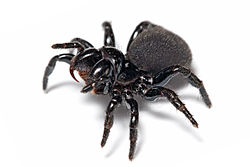
Picture of Mygalomorphae
- Source
- Wikipedia/Commons
- Credit
- Fir0002
- Licence
- GFDL 1.2
- Commercial use
- the licence allows it
No 3D scan of Mygalomorphae was found in MorphoSource and Sketchfab.
Smithsonian Open Access was not reached for this taxon, so this list is what the others held rather than everything there is.
The description on this site
- Licence
- CC BY-SA 4.0
This is what the site found, which is not the same as what exists.
Keep going
What may have been alongside itOpisthothelae through timeFormations of the Late CretaceousThe world it lived on
Occurrence data from the Paleobiology Database, CC BY 4.0. Pocock 1892