Nassarius (Niotha)
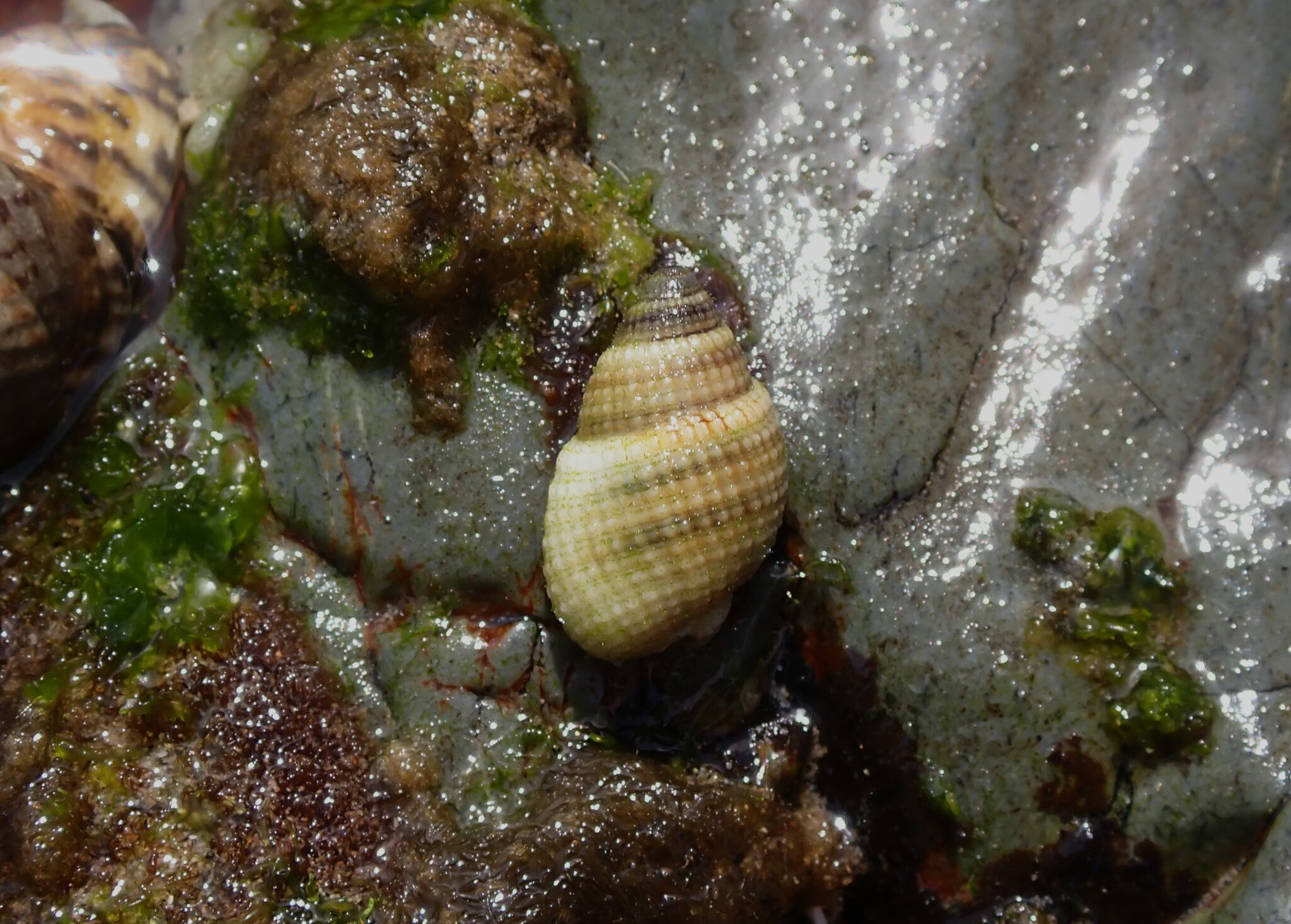
Adrian Gale · CC BY-NC 4.0 · via GBIF. May be a photograph of a specimen, or an artist’s reconstruction — an interpretation of a skeleton, since colour and soft tissue are almost never preserved.
On record
Recorded, not inferred- Sits inside
- NassariusPBDB
- Diet
- carnivorePBDB, for Nassarius
- Life habit
- semi-infaunalPBDB, for Nassarius
- Motility
- slow-movingPBDB, for Nassarius
- Vision
- limitedPBDB, for Gastropoda
Time the record covers
At least 11 million years on record.
The record covers at least 11.63 Mya to 129 ka. No occurrence read is dated outside 15.98 Mya to 0 Mya.
43 occurrences of Nassarius (Niotha) on record, most of them in the Pliocene. The Paleobiology Database records this as a living group. Bar height is expected occurrences, not a count: each fossil is spread across the span it is dated to, so a tall narrow bar means tight dating and a low wide one means loose.
When
43 occurrences- Miocene21%
- Pliocene44%
- Pleistocene35%
These are dates about fossils, not the animal: the record can only begin after it arose and end before it died out, so either end may reach further. Shares are expected occurrences: a fossil dated to a span is counted partly in each period it straddles. More on what this infers.
Found in
14 formations
- Toshima Sand Formation · Toyohashi Group4
- Shimajiri Formation2
- Upper Kalibeng Formation2
- Nagura Gravel Formation · Sakishima Group1
- Cabatuan Formation1
- Abbas Formation1
Loading coastlines…
The named rock units Nassarius (Niotha) has been recovered from, largest first. Drawn where the rock is now, not where it formed. 24 occurrences have no formation on record, which is common for older literature.
Nassarius (Niotha) and its relatives
PlioceneWhere Nassarius (Niotha) and its relatives were recorded in the Pliocene.
Found in the same rock
887 taxa- Conus9 sites
- Strombus (Labiostrombus)7 sites
- Nassarius (Zeuxis)6 sites
- Natica6 sites
- Terebra6 sites
- Anadara5 sites
- Anadara (Anadara) antiquata5 sites
- Cardita5 sites
- Sydaphera5 sites
- Tellina5 sites
- Tritia5 sites
- Turbo (Turbo) petholatus5 sites
- Turris5 sites
- Vexillum5 sites
- Arcopagia4 sites
- Barbatia (Barbatia) lacerata4 sites
- Chlamys4 sites
- Conus arenatus4 sites
- Dentalium4 sites
- Dosinia (Dosinella)4 sites
- Hyotissa hyotis4 sites
- Inquisitor4 sites
- Solecurtus4 sites
- Spondylus4 sites
The Paleobiology Database records 19 sites for Nassarius (Niotha), and this reads all of them. The number is how many of those sites it was catalogued from too. The 24 sharing the most are listed.
This is not a list of everything alive at the time. It is only what has come out of the same ground as this animal and been written down.
Entered from
19 references- Cenozoic fossil mollusks from Western Pacific Islands; Gastropods (Eratoidae through Harpidae)10
- Tertiary and Quaternary Gastropoda of Okinawa: A comparison of the late Miocene, Pliocene, and Pleistocene Gastropoda of Okinawa with related faunas of East Asia together with a resume of the geological setting of the fossiliferous deposits8
- Summary of the geology and paleontology of the Atsumi Peninsula, Aichi Prefecture, Japan4
- Types of Cenozoic Mollusca from Java in the Martin Collection of Naturalis2
- Age refinement of the Sonde molluscan fauna, East Java, Indonesia2
- Cenozoic fossil mollusks from Western Pacific Islands; Gastropods (Volutidae through Terebridae)2
- Fossiles Néogénes et Quaternaires des Nouvelles-Hébrides2
- Molluschi delle spiagge emerse del Mar Rosso e dell'Oceano Indiano, introduzione e parte I (gasteropodi) [Mollusks from raised beaches bordering the Red Sea and the Indian Ocean, introduction and part I (gastropods)]2
- An Early Pleistocene molluscan assemblage from Fiji: gastropod faunal composition, paleoecology and biogeography1
- Molluscan faunas of the Early Pleistocene Point Allen Formation and Burnham limestone, South Australia1
- Pleistocene molluscan fauna of the Sakishima Formation, Shima Peninsula, central Japan1
- Catalogue of Australian Tertiary Mollusca (except chitons)1
Each of the 43 occurrences read was entered from one of these publications, ordered by how many each accounts for. This is not a search for papers mentioning the name. 7 further references are not listed. Entries link to doi.org where the Paleobiology Database holds an identifier, and to its own record where it does not. Relayed as the Paleobiology Database holds them, not checked against what they resolve to.
Media and terms
Media content1
Picture of Nassarius (Niotha)
- Source
- GBIF
- Credit
- Adrian Gale
- Licence
- CC BY-NC 4.0
- Commercial use
- the licence does not allow it
No 3D scan was found. Smithsonian Open Access, MorphoSource and Sketchfab were all searched.
This is what the site found, which is not the same as what exists.
Keep going
What may have been alongside itNassarius through timeFormations of the PlioceneThe world it lived on
Occurrence data from the Paleobiology Database, CC BY 4.0. (Adams and Adams 1853)