Nassellaria
Nassellaria is an order of Rhizaria belonging to the class Radiolaria. The organisms of this order are characterized by a skeleton cross link with a cone or ring.

Frank Fox, www.mikro-foto.de · CC BY-SA 3.0 de · via Wikipedia/Commons. May be a photograph of a specimen, or an artist’s reconstruction — an interpretation of a skeleton, since colour and soft tissue are almost never preserved.
On record
Recorded, not inferred- Sits inside
- PolycystineaPBDB
Time the record covers
At least 353 million years on record.
The record covers at least 358.86 Mya to 5.333 Mya. No occurrence read is dated outside 372.15 Mya to 3.6 Mya.
12,000+ occurrences of Nassellaria on record. The Paleobiology Database records this as a living group, and the chart stops with its fossils rather than at the present. Bar height is expected occurrences, not a count: each fossil is spread across the span it is dated to, so a tall narrow bar means tight dating and a low wide one means loose.
When
12,000 occurrences read- Devonianunder 1%
- Carboniferousunder 1%
- Early Triassicunder 1%
- Middle Triassic3%
- Late Triassic3%
- Early Jurassic8%
- Middle Jurassic19%
- Late Jurassic25%
- Early Cretaceous33%
- Late Cretaceous7%
- Paleoceneunder 1%
- Eocene1%
- Oligoceneunder 1%
- Mioceneunder 1%
- Plioceneunder 1%
These are dates about fossils, not the animal: the record can only begin after it arose and end before it died out, so either end may reach further. Shares are expected occurrences: a fossil dated to a span is counted partly in each period it straddles. The read hit its cap, so every figure above is a floor and the shares are of the occurrences read. More on what this infers.
Found in
at least 86 formations
- Maiolica Formation2,479
- Scaglia Bianca Formation657
- Ameghino Formation518
- Oberalmer Schichten Formation439
- Taman Formation399
- Wahrah Formation373
Loading coastlines…
The named rock units Nassellaria has been recovered from, largest first. Drawn where the rock is now, not where it formed. The read hit its cap, so each count is a floor. 62 further formations hold fewer occurrences each and are not listed. 2,769 occurrences have no formation on record, which is common for older literature.
Found in the same rock
820 taxa- Pseudoeucyrtis32 sites
- Paronaella29 sites
- Tethysetta boesii25 sites
- Orbiculiforma24 sites
- Stichomitra23 sites
- Acastea diaphorogona22 sites
- Emiluvia pessagnoi22 sites
- Gorgansium22 sites
- Parvicingula22 sites
- Praeparvicingula22 sites
- Windalia22 sites
- Spongiomma21 sites
- Praeconocaryomma20 sites
- Sethocapsa leiostraca19 sites
- Thanarla brouweri19 sites
- Udalia plana19 sites
- Canoptum columbiaense18 sites
- Pantanellium18 sites
- Angulobracchia portmanni17 sites
- Charlottea weedensis17 sites
- Napora17 sites
- Parvicingula colemani17 sites
- Podobursa triacantha triacantha17 sites
- Udalia dennisoni17 sites
The Paleobiology Database records at least 110 sites for Nassellaria, and this reads 110 of them. The number is how many of those sites it was catalogued from too. The 24 sharing the most are listed.
This is not a list of everything alive at the time. It is only what has come out of the same ground as this animal and been written down.
Entered from
at least 117 references- Early Cretaceous Radiolarian Biostratigraphy of Umbria-Marche Apennines (Italy), Southern Alps (Italy and Switzerland) and Hawasina Nappes (Oman)2,479
- Palökologische Verwertbarkeit oberjurassisch-unterkretazischer Radiolarienfaunen mit Beispielen aus Antarktis, Oman und Südalpen885
- Faunal change of Early - Middle Jurassic radiolarians611
- Systematik, Stratigraphie und Palökologie der Radiolarien des Oberjura-Unterkreide-Grenzbereiches im Osterhorn-Tirolikum (Nördliche Kalkalpen, Salzburg und Bayern)585
- Biochronology an Paleontology of Mid-Cretaceous Radiolarians from Northern Apennines (Italy) and Betic Cordillera (Spain)557
- Late Jurassic radiolarians from the Antarctic Peninsula495
- Taxonomic studies of Upper Jurassic (Tithonian) Radiolaria from the Taman Formation, east-central Mexico373
- The Radiolarian biotic response during OAE2. A high resolution study across the Bonarelli Level at Bottaccione (Gubbio, Italy)277
- Lower cretaceous radiolarian biostratigraphy of the Great Valley sequence and Franciscan complex, California coast ranges245
- Die paläogeographische Stellung des Watzmann Blockes in den Berchtesgadener Kalkalpen - Neuergebnisse auf der Basis der Analyse der Trias- und Jura-Entwicklung242
- Upper Jurassic Tethyan and Southern Boreal radiolarians from western North America235
- Jurassic radiolaria from the Josephine ophiolite and overlying strata, Smith River subterrane (Klamath Mountains), northwestern California and southwestern Oreg216
Each of the 12,000 occurrences read was entered from one of these publications, ordered by how many each accounts for. This is not a search for papers mentioning the name. That read hit its cap, so each count is a floor. 105 further references are not listed. Entries link to doi.org where the Paleobiology Database holds an identifier, and to its own record where it does not. Relayed as the Paleobiology Database holds them, not checked against what they resolve to.
Media and terms
Media content2

Picture of Nassellaria
- Source
- Wikipedia/Commons
- Credit
- Frank Fox, www.mikro-foto.de
- Licence
- CC BY-SA 3.0 de
- Commercial use
- the licence allows it
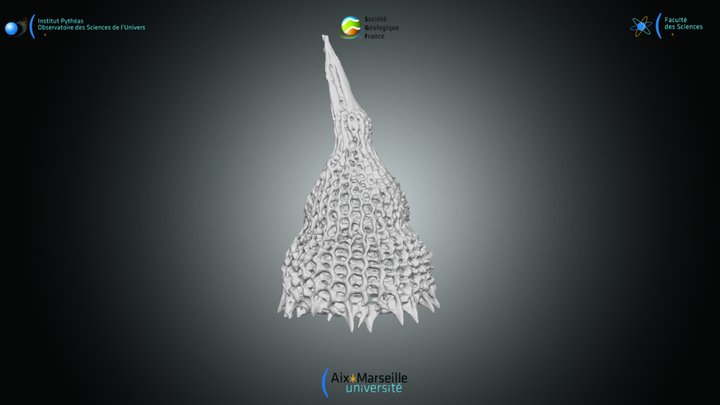
3D model
- Source
- Sketchfab
- Licence
- CC Attribution-NonCommercial-ShareAlike
- Commercial use
- the licence does not allow it
The description on this site
- Source
- Wikipedia, “Nassellaria”
- Licence
- CC BY-SA 4.0
This is what the site found, which is not the same as what exists.
Keep going
What may have been alongside itPolycystinea through timeThe world it lived on
Occurrence data from the Paleobiology Database, CC BY 4.0. (Ehrenberg 1875)