Neoasaphus ludibundus
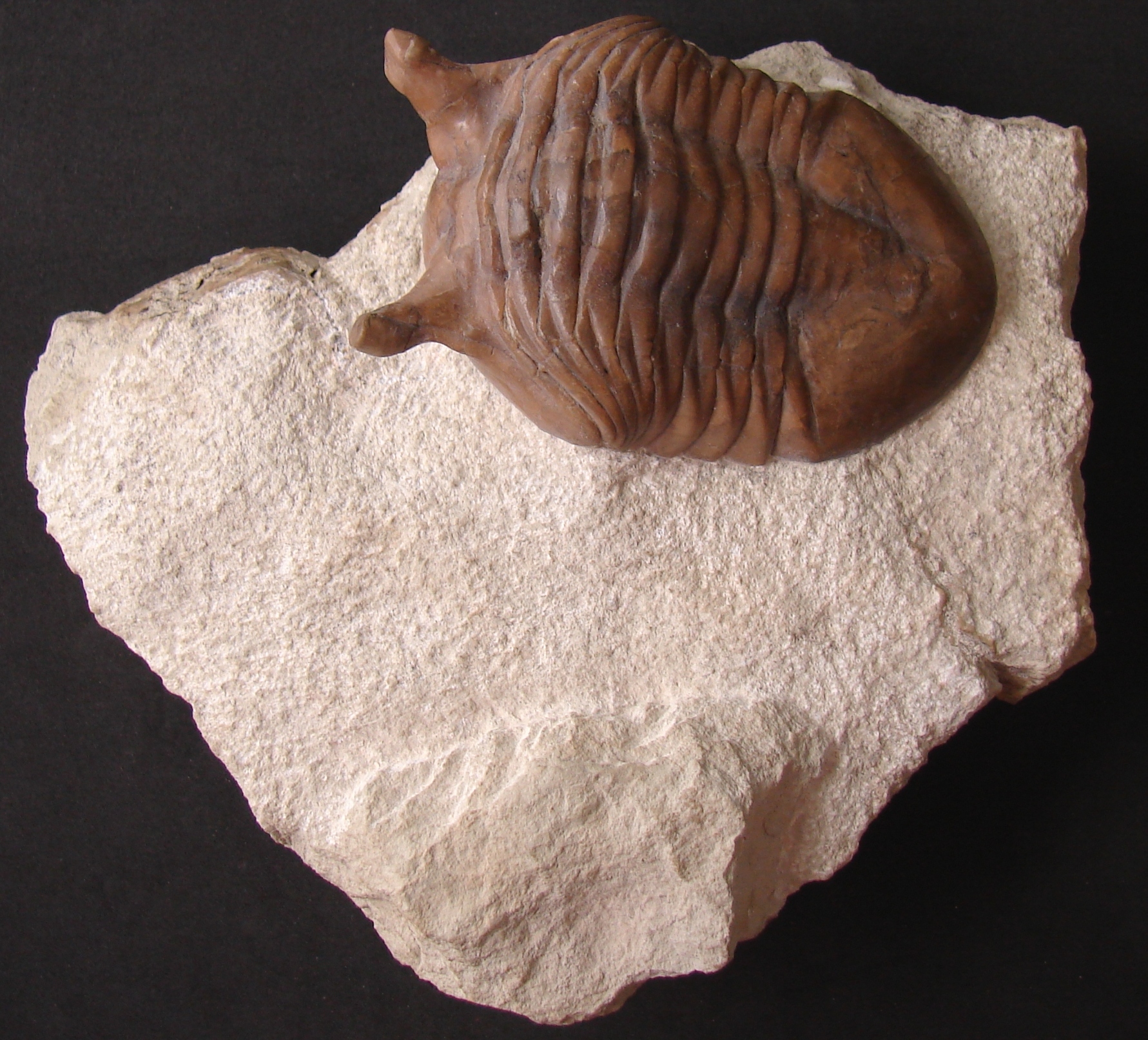
étiquette jointe ETIQ · CC0 · via GBIF. May be a photograph of a specimen, or an artist’s reconstruction — an interpretation of a skeleton, since colour and soft tissue are almost never preserved.
On record
Recorded, not inferred- Sits inside
- NeoasaphusPBDB
- Diet
- carnivorePBDB, for Trilobita
- Life habit
- low-level epifaunalPBDB, for Asaphida
- Motility
- fast-movingPBDB, for Asaphida
- Vision
- well-developedPBDB, for Asaphidae
- Environment
- marinePBDB, for Trilobita
Time the record covers
At least 2.9 million years on record.
The record covers at least 456.8 Mya to 453.9 Mya. No occurrence read is dated outside 458.2 Mya to 449.5 Mya.
38 occurrences of Neoasaphus ludibundus on record, most of them in the Ordovician. Bar height is expected occurrences, not a count: each fossil is spread across the span it is dated to, so a tall narrow bar means tight dating and a low wide one means loose.
When
38 occurrences- Ordovician100%
These are dates about fossils, not the animal: the record can only begin after it arose and end before it died out, so either end may reach further. Shares are expected occurrences: a fossil dated to a span is counted partly in each period it straddles. More on what this infers.
Found in
9 formations
- Dalby Formation10
- Dalby Limestone Formation7
- Arnestad Formation5
- Vollen Formation4
- Frognerkilen Formation4
- Ludibundus Formation1
Loading coastlines…
The named rock units Neoasaphus ludibundus has been recovered from, largest first. Drawn where the rock is now, not where it formed. 4 occurrences have no formation on record, which is common for older literature.
Neoasaphus ludibundus and its relatives
OrdovicianWhere Neoasaphus ludibundus and its relatives were recorded in the Ordovician.
Found in the same rock
98 taxa- Heliocrinites granatum5 sites
- Conchoprimitia4 sites
- Onniella4 sites
- Vogdesella4 sites
- Heliocrinites angustiporus3 sites
- Remopleurides3 sites
- Steusloffia3 sites
- Climacograptus2 sites
- Diplograptus2 sites
- Haplosphaeronis bratterudensis2 sites
- Lonchodomas2 sites
- Lonchodomas rostratus2 sites
- Ogmasaphus praetextus2 sites
- Palaeostrophomena2 sites
- Pyxion2 sites
- Acanthambonia1 site
- Actinochilina1 site
- Alwynella osloensis1 site
- Angelinoceras1 site
- Asaphus (Neoasaphus) heintzi1 site
- Beloitoceras stoermeri1 site
- Biernatia holmi1 site
- Broeggeroceras contractum1 site
- Chasmops1 site
The Paleobiology Database records 38 sites for Neoasaphus ludibundus, and this reads all of them. The number is how many of those sites it was catalogued from too. The 24 sharing the most are listed.
This is not a list of everything alive at the time. It is only what has come out of the same ground as this animal and been written down.
Entered from
5 references- Untersuchungen über baltoskandische Asaphiden I Revision der mittelordovizischen Asaphiden des Siljan-Gebietes in Dalarna17
- The Middle Ordovician of the Oslo Region, Norway 13. Trilobites of the Family Asaphidae13
- The Chasmops Series of the Kullatorp Core5
- The Viruan (Middle Ordovician) of Kinnekulle and northern Billingen, Vastergotland2
- Legend of the Central European series of sheets of the State Geological Map of the Russian Federation, scale 1:1,000,000 (third generation)1
Each of the 38 occurrences read was entered from one of these publications, ordered by how many each accounts for. This is not a search for papers mentioning the name. Each entry links to the Paleobiology Database's own record for the work.
Media and terms
Media content1
Picture of Neoasaphus ludibundus
- Source
- GBIF
- Credit
- étiquette jointe ETIQ
- Licence
- CC0
- Commercial use
- the licence allows it
No 3D scan of Neoasaphus ludibundus was found in MorphoSource and Sketchfab.
Smithsonian Open Access was not reached for this taxon, so this list is what the others held rather than everything there is.
This is what the site found, which is not the same as what exists.
Keep going
What may have been alongside itNeoasaphus through timeFormations of the OrdovicianThe world it lived on
Occurrence data from the Paleobiology Database, CC BY 4.0. (Törnquist 1884)