Nycticorax megacephalus
The Rodrigues night heron is an extinct species of heron that was endemic to the Mascarene island of Rodrigues in the Indian Ocean. The species was first mentioned as "bitterns" in two accounts from 1691–1693 and 1725–1726, and these were correlated with subfossil remains found and described in the latter part of the 19th century. The bones showed that the bird was a heron, first named Ardea megacephala in 1873, but moved to the night heron genus Nycticorax in 1879 after more remains were described. The specific name megacephala is Greek for "great-headed". Two related extinct species from the other Mascarene islands have also been identified from accounts and remains: the Mauritius night heron and the Réunion night heron.

Alphonse Milne-Edwards. Published by G. Masson in Paris, France · Public Domain · via Wikipedia/Commons. May be a photograph of a specimen, or an artist’s reconstruction — an interpretation of a skeleton, since colour and soft tissue are almost never preserved.
On record
Recorded, not inferred- Also called
- Rodrigues night heronPBDB
- Sits inside
- NycticoraxPBDB
- Diet
- piscivorePBDB, for Ardeidae
- Life habit
- volantPBDB, for Ardeidae
- Motility
- actively mobilePBDB, for Theropoda
- Environment
- terrestrialPBDB, for Ardeidae
Time the record covers
At most 12 thousand years on record.
Every occurrence read is dated to somewhere between 11.7 ka and 0 Mya, and nothing in the dating separates them, so that window is what the record shows rather than a span.
4 occurrences of Nycticorax megacephalus on record, most of them in the Holocene. Bar height is expected occurrences, not a count: each fossil is spread across the span it is dated to, so a tall narrow bar means tight dating and a low wide one means loose.
When
4 occurrences- Holocene100%
These are dates about fossils, not the animal: the record can only begin after it arose and end before it died out, so either end may reach further. Shares are expected occurrences: a fossil dated to a span is counted partly in each period it straddles. More on what this infers.
Nycticorax megacephalus and its relatives
HoloceneWhere Nycticorax megacephalus and its relatives were recorded in the Holocene.
Found in the same rock
15 taxa- Necropsar rodericanus4 sites
- Nesoenas rodericana4 sites
- Erythromachus leguati3 sites
- Necropsittacus rodricanus2 sites
- Otus murivorus2 sites
- Pezophaps solitaria2 sites
- Acrocephalus rodericanus1 site
- Alectroenas payandeei1 site
- Alexandrinus exsul1 site
- Cylindraspis1 site
- Hypsipetes cowlesi1 site
- Phaethon lepturus1 site
- Sula sula1 site
- Testudo1 site
- Testudo indica1 site
The Paleobiology Database records 4 sites for Nycticorax megacephalus, and this reads all of them. The number is how many of those sites it was catalogued from too.
This is not a list of everything alive at the time. It is only what has come out of the same ground as this animal and been written down.
Entered from
4 references- Systematics, morphology, and ecological history of the Mascarene starlings (Aves: Sturnidae) with the description of a new genus and species from Mauritius1
- Systematics, morphology, and ecology of pigeons and doves (Aves: Columbidae) of the Mascarene Islands, with three new species1
- The extinct birds of Rodriguez1
- Recherches sur la faune ancienne des Iles Mascareignes1
Each of the 4 occurrences read was entered from one of these publications, ordered by how many each accounts for. This is not a search for papers mentioning the name. Entries link to doi.org where the Paleobiology Database holds an identifier, and to its own record where it does not. Relayed as the Paleobiology Database holds them, not checked against what they resolve to.
Media and terms
Media content1
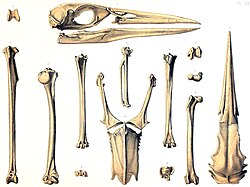
Picture of Nycticorax megacephalus
- Source
- Wikipedia/Commons
- Credit
- Alphonse Milne-Edwards. Published by G. Masson in Paris, France
- Licence
- Public Domain
- Commercial use
- the licence allows it
No 3D scan of Nycticorax megacephalus was found in Sketchfab.
Smithsonian Open Access and MorphoSource were not reached for this taxon, so this list is what the others held rather than everything there is.
The description on this site
- Licence
- CC BY-SA 4.0
This is what the site found, which is not the same as what exists.
Keep going
What may have been alongside itNycticorax through timeFormations of the HoloceneThe world it lived on
Occurrence data from the Paleobiology Database, CC BY 4.0. (Milne-Edwards 1874)