Olea
Olea is a genus of flowering plants in the family Oleaceae. It includes 11 species accepted by Plants of the World Online native to warm temperate and tropical regions of the Middle East, southern Europe, Africa, southern Asia, and Australasia. They are evergreen trees and shrubs, with small, opposite, entire leaves. The fruit is a drupe. Leaves of Olea contain trichosclereids.

Rodrigo Nuno Bragança da Cunha · CC BY-SA 3.0 · via Wikipedia/Commons. May be a photograph of a specimen, or an artist’s reconstruction — an interpretation of a skeleton, since colour and soft tissue are almost never preserved.
On record
Recorded, not inferred- Also called
- olivePBDB
- Sits inside
- OleaceaePBDB
- Diet
- "photoautotroph"PBDB, for Angiospermae
Time the record covers
At least 41 million years on record.
The record covers at least 41.03 Mya to 11.7 ka. No occurrence read is dated outside 66 Mya to 0 Mya.
79 occurrences of Olea on record, most of them in the Pleistocene. The Paleobiology Database records this as a living group. Bar height is expected occurrences, not a count: each fossil is spread across the span it is dated to, so a tall narrow bar means tight dating and a low wide one means loose.
When
79 occurrencesThese are dates about fossils, not the animal: the record can only begin after it arose and end before it died out, so either end may reach further. Shares are expected occurrences: a fossil dated to a span is counted partly in each period it straddles. More on what this infers.
Found in
5 formations
- Olduvai Formation · Vogel River Series Group7
- Elandsfontyn Formation2
- Varswater Formation1
- Headon Beds Formation1
- Deccan Intertrappean Formation1
Loading coastlines…
The named rock units Olea has been recovered from, largest first. Drawn where the rock is now, not where it formed. 67 occurrences have no formation on record, which is common for older literature.
Olea and its relatives
PleistoceneWhere Olea and its relatives were recorded in the Pleistocene.
Found in the same rock
901 taxa- Poaceae65 sites
- Chenopodiaceae56 sites
- Cyperaceae40 sites
- Quercus39 sites
- Pinus37 sites
- Taraxacum36 sites
- Aster33 sites
- Isoetes33 sites
- Plantago32 sites
- Artemisia31 sites
- Ericaceae31 sites
- Podocarpus29 sites
- Brassicaceae28 sites
- Asteraceae26 sites
- Urticaceae25 sites
- Celtis23 sites
- Acacia22 sites
- Macaranga22 sites
- Trema22 sites
- Dodonaea21 sites
- Eucalyptus21 sites
- Mallotus21 sites
- Monolete21 sites
- Rapanea21 sites
The Paleobiology Database records 72 sites for Olea, and this reads all of them. The number is how many of those sites it was catalogued from too. The 24 sharing the most are listed.
This is not a list of everything alive at the time. It is only what has come out of the same ground as this animal and been written down.
Entered from
22 references- A complete pollen record of the last 230 ka from Lynch's Crater, north-eastern Australia13
- Site U13868
- Site U13898
- A Late Pleistocene and Holocene pollen diagram from Lynch’s Crater, northeastern Queensland, Australia8
- Site U13876
- Site U13855
- Site U13905
- Site U13914
- Geology of the Olduvai Gorge4
- Olduvai Gorge, Parts I-Iv: The Skulls, Endocasts, and Teeth of Homo Habilis3
- Desert paleoenvironmental data from cave speleothems with examples from the Chihuahuan3
- Palynological and lithological evidence for the Miocene palaeoenvironment in the Saldanha region (South Africa)2
Each of the 79 occurrences read was entered from one of these publications, ordered by how many each accounts for. This is not a search for papers mentioning the name. 10 further references are not listed. Entries link to doi.org where the Paleobiology Database holds an identifier, and to its own record where it does not. Relayed as the Paleobiology Database holds them, not checked against what they resolve to.
Media and terms
Media content1
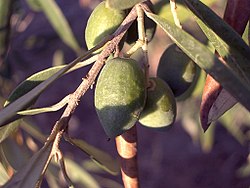
Picture of Olea
- Source
- Wikipedia/Commons
- Credit
- Rodrigo Nuno Bragança da Cunha
- Licence
- CC BY-SA 3.0
- Commercial use
- the licence allows it
No 3D scan of Olea was found in Sketchfab.
Smithsonian Open Access and MorphoSource were not reached for this taxon, so this list is what the others held rather than everything there is.
The description on this site
- Source
- Wikipedia, “Olea”
- Licence
- CC BY-SA 4.0
This is what the site found, which is not the same as what exists.
Keep going
What may have been alongside itOleaceae through timeFormations of the PleistoceneThe world it lived on
Occurrence data from the Paleobiology Database, CC BY 4.0. Linnaeus 1753