Orthis callactis
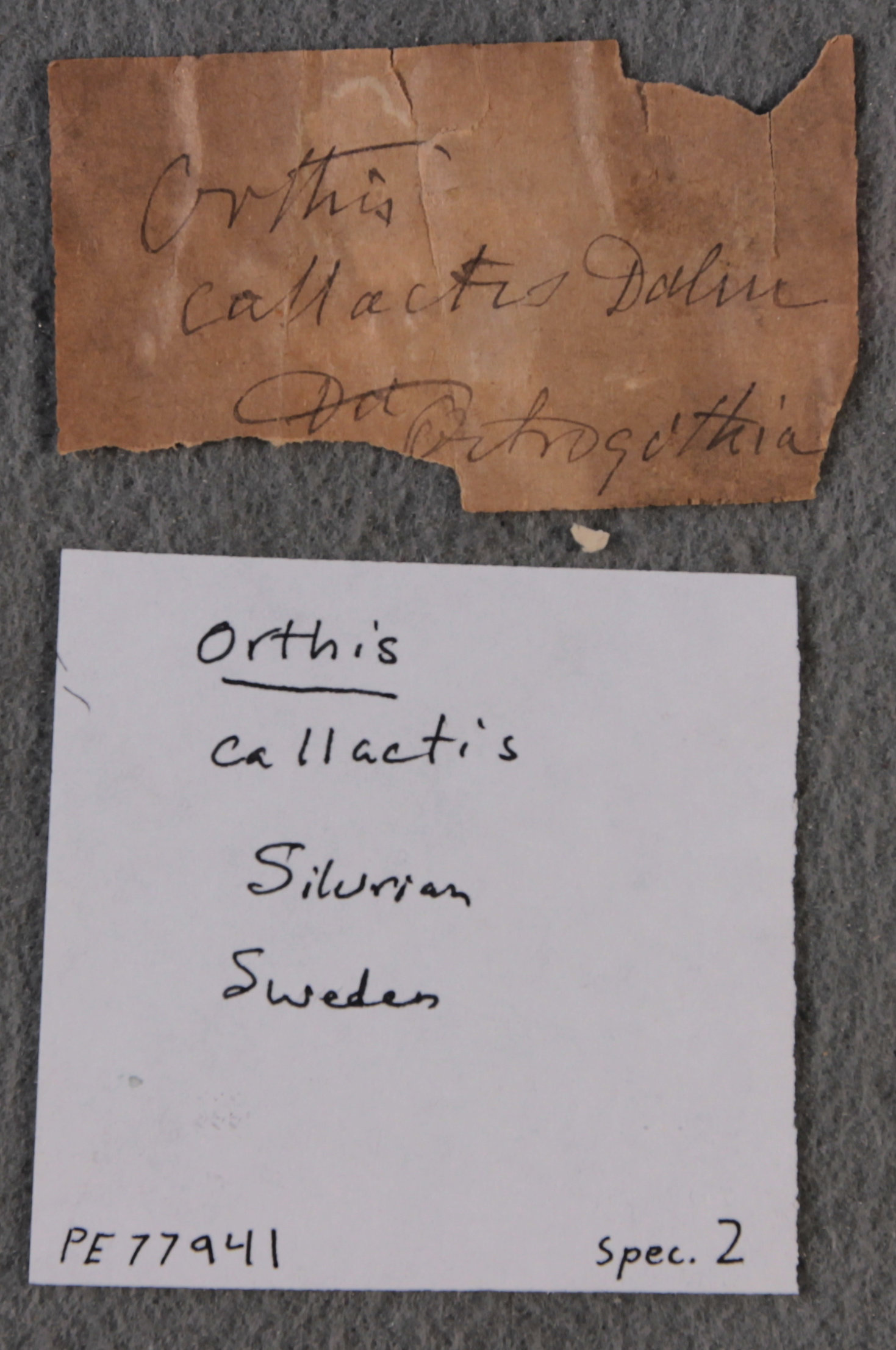
via iDigBio · via iDigBio. May be a photograph of a specimen, or an artist’s reconstruction — an interpretation of a skeleton, since colour and soft tissue are almost never preserved.
On record
Recorded, not inferred- Sits inside
- OrthisPBDB
- Diet
- suspension feederPBDB, for Orthida
- Life habit
- epifaunalPBDB, for Orthida
- Motility
- stationary, attachedPBDB, for Orthida
- Vision
- blindPBDB, for Rhynchonellata
- Environment
- marinePBDB, for Lophophorata
Time the record covers
At most 13 million years on record.
Every occurrence read is dated to somewhere between 477.1 Mya and 464.3 Mya, and nothing in the dating separates them, so that window is what the record shows rather than a span.
45 occurrences of Orthis callactis on record, most of them in the Ordovician. Bar height is expected occurrences, not a count: each fossil is spread across the span it is dated to, so a tall narrow bar means tight dating and a low wide one means loose.
When
45 occurrences- Ordovician100%
These are dates about fossils, not the animal: the record can only begin after it arose and end before it died out, so either end may reach further. Shares are expected occurrences: a fossil dated to a span is counted partly in each period it straddles. More on what this infers.
Found in
7 formations
- Lynna Formation10
- Sillaoru Formation9
- Sillaoru Formation4
- Mytton Flags Formation3
- Holen Formation2
- Volkhov Formation2
Loading coastlines…
The named rock units Orthis callactis has been recovered from, largest first. Drawn where the rock is now, not where it formed. 14 occurrences have no formation on record, which is common for older literature.
Orthis callactis and its relatives
OrdovicianWhere Orthis callactis and its relatives were recorded in the Ordovician.
Found in the same rock
89 taxa- Hemipronites imbricata12 sites
- Gonambonites11 sites
- Megistaspis (Megistaspidella) acuticauda11 sites
- Inversella10 sites
- Linguloidea10 sites
- Paurorthis10 sites
- Lycophoria9 sites
- Apomatella ingrica8 sites
- Lonchodomas volborthi8 sites
- Syntrophiidina8 sites
- Ingriops intermedius7 sites
- Porambonites planus6 sites
- Productorthis eminens6 sites
- Antigonambonites planus5 sites
- Cyrtometopus clavifrons5 sites
- Metopolichas5 sites
- Nicolella5 sites
- Palaeoneumania5 sites
- Ujukella fastigata5 sites
- Asaphus expansus4 sites
- Ingria4 sites
- Nothortis sp.4 sites
- Paralenorthis orbicularis4 sites
- Asaphus (Asaphus) fallax3 sites
The Paleobiology Database records 45 sites for Orthis callactis, and this reads all of them. The number is how many of those sites it was catalogued from too. The 24 sharing the most are listed.
This is not a list of everything alive at the time. It is only what has come out of the same ground as this animal and been written down.
Entered from
9 references- Resolving early Mid-Ordovician (Kundan) bioevents in the East Baltic based on brachiopods13
- Brachiopod macrofaunal distribution through the upper Volkhov - lower Kunda (Low Ordovician) rocks, Lynna River, St. Petersburg region10
- Brakhiopody nadsemejstv Orthacea, Dalmanellacea i Syntrophiacea iz nizhnego ordovika Pribaltiki [Lower Ordovician brachiopods of the superfamilies Orthacea, Dalmanellacea and Syntrophiacea of the Eastern Baltic]6
- Rukovodyashchaya fauna brakhiopod ordovikskikh otlozhenij severo-sapadnoy chasti russkoj platformy5
- Orthambonites and related Ordovician brachiopod genera3
- Description of the upper portion of the drill-core from Finngrundet in the South Bothnian Bay3
- Ordovician Brachiopoda from the Shelve District, Shropshire3
- Locality 4 : 2 Ontika Clint1
- The Asaphus Limestone in northernmost Öland1
Each of the 45 occurrences read was entered from one of these publications, ordered by how many each accounts for. This is not a search for papers mentioning the name. Entries link to doi.org where the Paleobiology Database holds an identifier, and to its own record where it does not. Relayed as the Paleobiology Database holds them, not checked against what they resolve to.
Media and terms
Media content1
Picture of Orthis callactis
- Source
- iDigBio
- Credit
- via iDigBio
- Licence
- not stated by the source
- Commercial use
- cannot be read from the licence given — check the record
No 3D scan was found. Smithsonian Open Access, MorphoSource and Sketchfab were all searched.
This is what the site found, which is not the same as what exists.
Keep going
What may have been alongside itOrthis through timeFormations of the OrdovicianThe world it lived on
Occurrence data from the Paleobiology Database, CC BY 4.0. Dalman 1827