Pachyrukhos
Pachyrukhos is an extinct genus of hegetotheriid notoungulate from the Early to Middle Miocene of Argentina and Chile. Fossils of this genus have been found in the Collón Curá, Sarmiento and Santa Cruz Formations of Argentina and the Río Frías Formation of Chile.

William John Sinclair (1877–1935) · Public Domain · via Wikipedia/Commons. May be a photograph of a specimen, or an artist’s reconstruction — an interpretation of a skeleton, since colour and soft tissue are almost never preserved.
On record
Recorded, not inferred- Sits inside
- PachyrukhiniPBDB
- Diet
- herbivorePBDB, for Notoungulata
- Life habit
- scansorialPBDB, for Eutheria
- Motility
- actively mobilePBDB, for Osteichthyes
- Environment
- terrestrialPBDB, for Eutheria
Time the record covers
At least 2 million years on record.
The record covers at least 17.5 Mya to 15.5 Mya. No occurrence read is dated outside 21 Mya to 11 Mya.
22 occurrences of Pachyrukhos on record, most of them in the Miocene. Bar height is expected occurrences, not a count: each fossil is spread across the span it is dated to, so a tall narrow bar means tight dating and a low wide one means loose.
When
22 occurrences- Miocene100%
These are dates about fossils, not the animal: the record can only begin after it arose and end before it died out, so either end may reach further. Shares are expected occurrences: a fossil dated to a span is counted partly in each period it straddles. More on what this infers.
Found in
7 formations
- Santa Cruz Formation10
- Sarmiento Formation4
- Collón Cura Formation3
- Cura-Mallín Formation1
- Río Frías Formation1
- Río Frias Formation1
Loading coastlines…
The named rock units Pachyrukhos has been recovered from, largest first. Drawn where the rock is now, not where it formed. 1 occurrence has no formation on record, which is common for older literature.
Pachyrukhos and its relatives
MioceneWhere Pachyrukhos and its relatives were recorded in the Miocene.
Found in the same rock
197 taxa- Protypotherium8 sites
- Prolagostomus7 sites
- Acarechimys6 sites
- Acarechimys minutus6 sites
- Hegetotherium mirabile6 sites
- Sipalocyon gracilis6 sites
- Cladosictis patagonica5 sites
- Nesodon5 sites
- Palaeothentes minutus5 sites
- Perimys5 sites
- Propalaehoplophoridae5 sites
- Protypotherium australe5 sites
- Protypotherium praerutilum5 sites
- Thoatherium minusculum5 sites
- Acarechimys minutissimus4 sites
- Acdestis oweni4 sites
- Adinotherium4 sites
- Hapalops4 sites
- Homalodotherium4 sites
- Interatherium4 sites
- Microbiotherium tehuelchum4 sites
- Pliolagostomus4 sites
- Prothylacynus patagonicus4 sites
- Prozaedyus4 sites
The Paleobiology Database records 18 sites for Pachyrukhos, and this reads all of them. The number is how many of those sites it was catalogued from too. The 24 sharing the most are listed.
This is not a list of everything alive at the time. It is only what has come out of the same ground as this animal and been written down.
Entered from
14 references- The record of the typothere Pachyrukhos (Mammalia, Notoungulata) and the Chinchillid Prolagostomus (Mammalia, Rodentia) in the Santa Cruz Formation (early–middle Miocene) south to the Río Coyle, Patagonia, Argentina.4
- Paleobiology of Santacrucian native ungulates (Meridiungulata: Astrapotheria, Litoptera and Notoungulata)3
- New middle Miocene (Langhian - Serravallian) vertebrate localities in northwestern Patagonia, Argentina: A contribution to high latitude south american land mammal ages sequence2
- Notoungulata and Astrapotheria (Mammalia, Meridiungulata) of the Santa Cruz Formation (Early-Middle Miocene) Along the Río Santa Cruz, Argentine Patagonia2
- Re-assessment of the Oligocene genera Prosotherium and Propachyrucos (Hegetotheriidae, Notoungulata)2
- Un pueblo olvidado y su resurgimiento: primeros registros fósiles del Cenozoico de Cabo Raso (Chubut, Argentina) y sus implicancias paleobioestratigráficas1
- A new pachyrukhine (Notoungulata: Typotheria) from the late Early Miocene of south-central Chile1
- Fossil vertebrates of the early-middle Miocene Cerro Boleadoras Formation, northwestern Santa Cruz Province, Patagonia, Argentina1
- Sedimentology and fossil vertebrates of the Santa Cruz formation (early Miocene) in Lago Posadas, southwestern Patagonia, Argentina1
- Systematic revision of Hegetotherium and Pachyrukhos (Hegetotheriidae, Notoungulata) and a new phylogenetic analysis of Hegetotheriidae1
- Marco geológico-tectónico, contenido fosilífero y cronología de lo yacimientos cenozoicos pre-pleistocénicos de mamíferos terrestres fósiles de Chile1
- A new mammal fauna at the top of the Gran Barranca sequence and its biochronological significance1
Each of the 22 occurrences read was entered from one of these publications, ordered by how many each accounts for. This is not a search for papers mentioning the name. 2 further references are not listed. Entries link to doi.org where the Paleobiology Database holds an identifier, and to its own record where it does not. Relayed as the Paleobiology Database holds them, not checked against what they resolve to.
Media and terms
Media content2
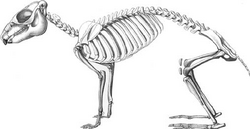
Picture of Pachyrukhos
- Source
- Wikipedia/Commons
- Credit
- William John Sinclair (1877–1935)
- Licence
- Public Domain
- Commercial use
- the licence allows it
Photogrammetry
- Source
- MorphoSource
- Licence
- not stated by the source
- Commercial use
- cannot be read from the licence given — check the record
- Specimen
- Pachyrukhos moyani · NHMUK:PAL:PV M 5700
The description on this site
- Source
- Wikipedia, “Pachyrukhos”
- Licence
- CC BY-SA 4.0
This is what the site found, which is not the same as what exists.
Keep going
What may have been alongside itPachyrukhini through timeFormations of the MioceneThe world it lived on
Occurrence data from the Paleobiology Database, CC BY 4.0. Ameghino 1885