Pachystrophia devexa
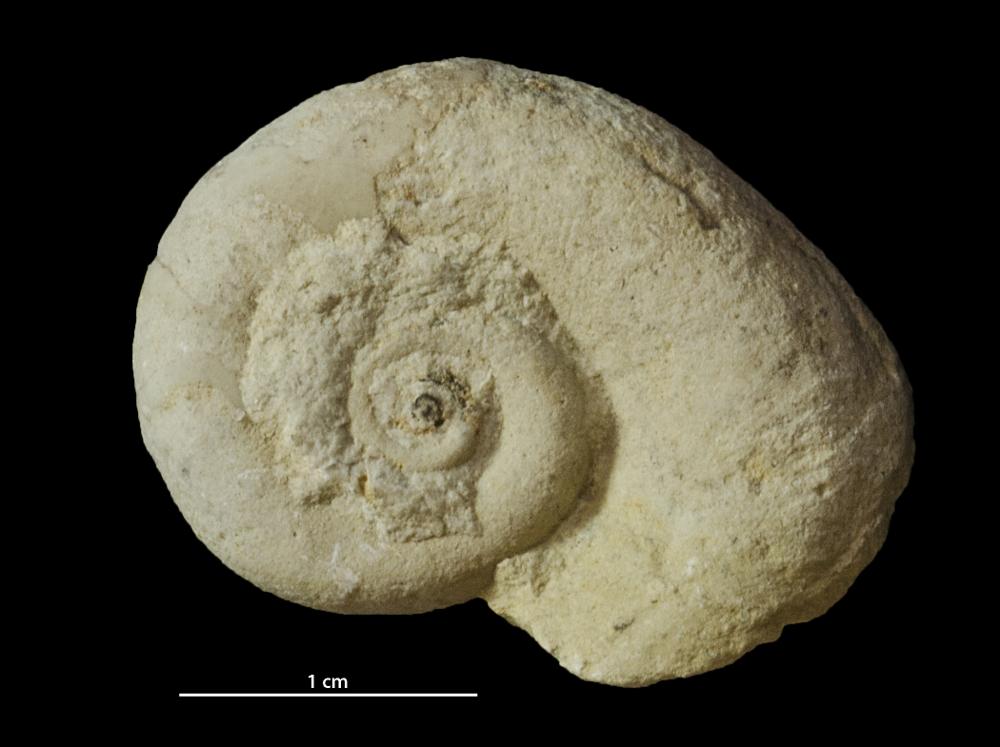
Hints, Olle · CC BY-NC 4.0 · via GBIF. May be a photograph of a specimen, or an artist’s reconstruction — an interpretation of a skeleton, since colour and soft tissue are almost never preserved.
On record
Recorded, not inferred- Sits inside
- PachystrophiaPBDB
- Diet
- suspension feederPBDB, for Pachystrophia
- Life habit
- epifaunalPBDB, for Pachystrophia
- Motility
- stationaryPBDB, for Pachystrophia
- Vision
- limitedPBDB, for Gastropoda
Time the record covers
At least 10 million years on record.
The record covers at least 459.7 Mya to 449.5 Mya. No occurrence read is dated outside 471.3 Mya to 443.1 Mya.
13 occurrences of Pachystrophia devexa on record, most of them in the Ordovician. Bar height is expected occurrences, not a count: each fossil is spread across the span it is dated to, so a tall narrow bar means tight dating and a low wide one means loose.
When
13 occurrences- Ordovician100%
These are dates about fossils, not the animal: the record can only begin after it arose and end before it died out, so either end may reach further. Shares are expected occurrences: a fossil dated to a span is counted partly in each period it straddles. More on what this infers.
Found in
8 formations
- Kangaroo Creek Formation5
- Väo Formation2
- Telsitna Formation1
- Table Point Formation · Table Head Group1
- Bønsnes Formation1
- Viivikonna Formation1
Loading coastlines…
The named rock units Pachystrophia devexa has been recovered from, largest first. Drawn where the rock is now, not where it formed.
Pachystrophia devexa and its relatives
OrdovicianWhere Pachystrophia devexa and its relatives were recorded in the Ordovician.
Found in the same rock
153 taxa- Lophospira perangulata5 sites
- Ectomaria callahanensis4 sites
- Maclurites4 sites
- Mestoronema marginalis4 sites
- Donaldiella derwiduii3 sites
- Helicotoma griffinorum3 sites
- Liospira modesta3 sites
- Lophospira milleri3 sites
- Paraliospira angulata3 sites
- Paraliospira mundula3 sites
- Paraliospira planata3 sites
- Boucotspira carinifer2 sites
- Boucotspira fimbriata2 sites
- Cyclonema2 sites
- Deacheospira elliptica2 sites
- Ectomaria prisca2 sites
- Holopea elizabethi2 sites
- Megalomphala contorta2 sites
- Paraliospira gradata2 sites
- Paraliospira helena2 sites
- Alaskodiscus donensis1 site
- Amblysiphonella grossa1 site
- Amblysiphonelloides reticulata1 site
- Amblysiphonelloides tubulara1 site
The Paleobiology Database records 13 sites for Pachystrophia devexa, and this reads all of them. The number is how many of those sites it was catalogued from too. The 24 sharing the most are listed.
This is not a list of everything alive at the time. It is only what has come out of the same ground as this animal and been written down.
Entered from
5 references- Ordovician - Devonian Gastropoda from the Klamath Mountains, California5
- Koken and Perner, 19255
- Middle Ordovician (Whiterockian) gastropods of western Newfoundland: Macluritoidea and Euomphaloidea1
- Upper Ordovician Gastropoda from west-central Alaska1
- Stratigrafia viruskoy i kharjuskoy seriy (ordovik) Sevemoy Estonii. [Stratigraphy of the Viruan and Harjuan Series (Ordovician) in North Estonia]1
Each of the 13 occurrences read was entered from one of these publications, ordered by how many each accounts for. This is not a search for papers mentioning the name. Entries link to doi.org where the Paleobiology Database holds an identifier, and to its own record where it does not. Relayed as the Paleobiology Database holds them, not checked against what they resolve to.
Media and terms
Media content1
Picture of Pachystrophia devexa
- Source
- GBIF
- Credit
- Hints, Olle
- Licence
- CC BY-NC 4.0
- Commercial use
- the licence does not allow it
No 3D scan of Pachystrophia devexa was found in MorphoSource and Sketchfab.
Smithsonian Open Access was not reached for this taxon, so this list is what the others held rather than everything there is.
This is what the site found, which is not the same as what exists.
Keep going
What may have been alongside itPachystrophia through timeFormations of the OrdovicianThe world it lived on
Occurrence data from the Paleobiology Database, CC BY 4.0. (d'Eichwald 1859)