Penaeidae
Penaeidae is a family of marine crustaceans in the suborder Dendrobranchiata, which are often referred to as penaeid shrimp or penaeid prawns. The Penaeidae contain many species of economic importance, such as the tiger prawn, whiteleg shrimp, Atlantic white shrimp, and Indian prawn. Many prawns are the subject of commercial fishery, and farming, both in marine settings, and in freshwater farms. Lateral line–like sense organs on the antennae have been reported in some species of Penaeidae. At 210 metres per second (760 km/h), the myelinated giant interneurons of pelagic penaeid shrimp have the world record for impulse conduction speed in any animal.

self · CC BY-SA 3.0 · via Wikipedia/Commons. May be a photograph of a specimen, or an artist’s reconstruction — an interpretation of a skeleton, since colour and soft tissue are almost never preserved.
On record
Recorded, not inferred- Sits inside
- PenaeoideaPBDB
- Diet
- carnivorePBDB
- Life habit
- semi-infaunalPBDB
- Motility
- actively mobilePBDB, for Penaeoidea
- Vision
- well-developedPBDB, for Malacostraca
Time the record covers
At least 221 million years on record.
The record covers at least 248.6 Mya to 27.3 Mya. No occurrence read is dated outside 250.8 Mya to 23.04 Mya.
104 occurrences of Penaeidae on record, most of them in the Late Cretaceous. The Paleobiology Database records this as a living group, and the chart stops with its fossils rather than at the present. Bar height is expected occurrences, not a count: each fossil is spread across the span it is dated to, so a tall narrow bar means tight dating and a low wide one means loose.
When
104 occurrences- Early Triassic9%
- Middle Triassic9%
- Late Triassic19%
- Early Jurassic4%
- Middle Jurassicunder 1%
- Late Jurassic25%
- Early Cretaceous2%
- Late Cretaceous26%
- Paleocene2%
- Eoceneunder 1%
- Oligocene3%
These are dates about fossils, not the animal: the record can only begin after it arose and end before it died out, so either end may reach further. Shares are expected occurrences: a fossil dated to a span is counted partly in each period it straddles. More on what this infers.
Found in
24 formations
- Dolomia di Forni Formation10
- Liegende Bankkalk Formation10
- Argilliti di Riva di Solto Formation7
- Grès à Voltzia Formation6
- Solnhofen Formation6
- Ahlen Formation5
Loading coastlines…
The named rock units Penaeidae has been recovered from, largest first. Drawn where the rock is now, not where it formed. 36 occurrences have no formation on record, which is common for older literature.
Penaeidae and its relatives
Late CretaceousWhere Penaeidae and its relatives were recorded in the Late Cretaceous.
Found in the same rock
499 taxa- Antrimpos atavus7 sites
- Dusa longipes7 sites
- Euestheria minuta6 sites
- Lingularia tenuissima6 sites
- Archaeopalinurus levis5 sites
- Eoscorpiidae5 sites
- Palaeoxyris regularis5 sites
- Acanthochirana norica4 sites
- Antrimpos colettoi4 sites
- Caridea4 sites
- Chondrostei4 sites
- Euthycarcinus kessleri4 sites
- Halicyne ornata4 sites
- Homomya impressa4 sites
- Ifasya madagascariensis4 sites
- Ifasya straeleni4 sites
- Myophoria vulgaris4 sites
- Penaeus4 sites
- Carpopenaeus callirostris3 sites
- Clytiopsis argentoratense3 sites
- Isaura3 sites
- Limulitella bronnii3 sites
- Notahomarus hakelensis3 sites
- Palaeolimnadia alsatica3 sites
The Paleobiology Database records 55 sites for Penaeidae, and this reads all of them. The number is how many of those sites it was catalogued from too. The 24 sharing the most are listed.
This is not a list of everything alive at the time. It is only what has come out of the same ground as this animal and been written down.
Entered from
40 references- Im Reich der Meerengel. Der Nusplinger Plattenkalk und seine Fossilien10
- The macruran decapod crustaceans of the Upper Cretaceous of Lebanon9
- Studies on Permo-Trias of Madagascar. 3. The decapod crustaceans of the Ambilobe region (NW Madagascar)8
- A new decapod crustacean assemblage from the Upper Triassic of Lombardy (N. Italy)7
- Faunes et paysages du Grès à Voltzia du Nord des Vosges: Essai paléoécologique sur le Buntsandstein supérieur7
- New genera and species of shrimps (Crustacea: Decapoda: Dendrobranchiata, Caridea) from the Upper Jurassic lithographic limestones of S Germany5
- The macruran decapod crustaceans of the Dolomia di Forni (Norian, Upper Triassic) of Carnia (Udine, NE Italy)5
- Acanthochirana triassica n. sp. and Antrimpos colettoi n. sp. (Decapoda: Aegeridae, Penaeidae) from the Upper Triassic (Norian) of northern Carnic Pre-Alps (Udine, northeastern Italy)4
- The Wattendorf Plattenkalk (Upper Kimmeridgian) - a new conservation lagerstätte from the northern Franconian Alb, southern Germany4
- Fossile Fische, Krebse und Pflanzen aus den Plattenkalken der jüngsten Kreide aus Westfalen4
- New decapod crustacean assemblage from the Upper Cretaceous (Cenomanian) of Chiapas, Mexico3
- Cretaceous Crustacea from Mount Lebanon, Syria3
Each of the 104 occurrences read was entered from one of these publications, ordered by how many each accounts for. This is not a search for papers mentioning the name. 28 further references are not listed. Entries link to doi.org where the Paleobiology Database holds an identifier, and to its own record where it does not. Relayed as the Paleobiology Database holds them, not checked against what they resolve to.
Media and terms
Media content1
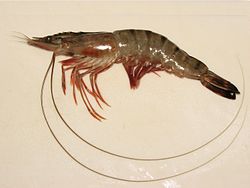
Picture of Penaeidae
- Source
- Wikipedia/Commons
- Credit
- self
- Licence
- CC BY-SA 3.0
- Commercial use
- the licence allows it
No 3D scan of Penaeidae was found in Sketchfab.
Smithsonian Open Access and MorphoSource were not reached for this taxon, so this list is what the others held rather than everything there is.
The description on this site
- Source
- Wikipedia, “Penaeidae”
- Licence
- CC BY-SA 4.0
This is what the site found, which is not the same as what exists.
Keep going
What may have been alongside itPenaeoidea through timeFormations of the Late CretaceousThe world it lived on
Occurrence data from the Paleobiology Database, CC BY 4.0. Rafinesque 1815