Perucetus colossus
Perucetus is an extinct genus of an early whale from Peru that lived during the Bartonian age of the middle Eocene. Perucetus is the largest Eocene whale, with length estimates varying from 15–16 meters (49–52 ft) to 17–20 meters (56–66 ft). It was initially claimed to have rivaled or exceeded the modern blue whale in weight, partly due to the incredibly thick and dense bones this animal possessed, coupled with its already great size, but subsequent studies argued that it was significantly lighter. The ecology of Perucetus also remains largely mysterious. Based on the fossils, it was likely a slow-moving inhabitant of shallow waters. Its diet can only be speculated, but one suggestion proposes that it may have fed on benthic animals like crustaceans and molluscs living on the ocean floor. Only a single species is currently known, P. colossus.

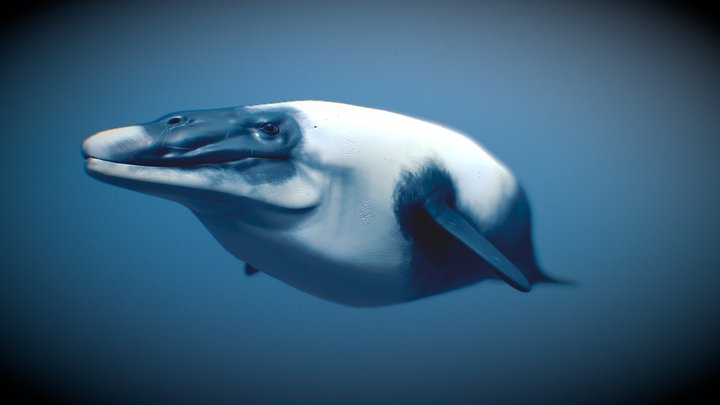
Ivan Iofrida · CC BY-SA 4.0 · via Wikipedia/Commons. May be a photograph of a specimen, or an artist’s reconstruction — an interpretation of a skeleton, since colour and soft tissue are almost never preserved.
On record
Recorded, not inferred- Sits inside
- PerucetusPBDB
- Diet
- carnivorePBDB, for Cetacea
- Life habit
- aquatic, depth=surfacePBDB, for Cetacea
- Motility
- actively mobilePBDB, for Cetacea
- Environment
- marinePBDB, for Cetacea
Time the record covers
At most 3.4 million years on record.
The one occurrence read is dated to somewhere between 41.03 Mya and 37.71 Mya, which is a dating window rather than a span.
1 occurrence of Perucetus colossus on record, most of them in the Eocene. Bar height is expected occurrences, not a count: each fossil is spread across the span it is dated to, so a tall narrow bar means tight dating and a low wide one means loose.
When
1 occurrences- Eocene100%
These are dates about fossils, not the animal: the record can only begin after it arose and end before it died out, so either end may reach further. Shares are expected occurrences: a fossil dated to a span is counted partly in each period it straddles. More on what this infers.
Found in
1 formation
Loading coastlines…
The named rock units Perucetus colossus has been recovered from, largest first. Drawn where the rock is now, not where it formed.
Perucetus colossus and its relatives
EoceneWhere Perucetus colossus and its relatives were recorded in the Eocene.
Found in the same rock
No other named taxon is catalogued from that site.
The Paleobiology Database records 1 site for Perucetus colossus, and this reads all of them.
Entered from
1 referenceEach of the 1 occurrence read was entered from one of these publications, ordered by how many each accounts for. This is not a search for papers mentioning the name. Each entry links to doi.org. Relayed as the Paleobiology Database holds them, not checked against what they resolve to.
Media and terms
Media content2

Picture of Perucetus colossus
- Source
- Wikipedia/Commons
- Credit
- Ivan Iofrida
- Licence
- CC BY-SA 4.0
- Commercial use
- the licence allows it
Smithsonian Open Access and MorphoSource were not reached for this taxon, so this list is what the others held rather than everything there is.
The description on this site
- Source
- Wikipedia, “Perucetus”
- Licence
- CC BY-SA 4.0
This is what the site found, which is not the same as what exists.
Keep going
What may have been alongside itPerucetus through timeFormations of the EoceneThe world it lived on
Occurrence data from the Paleobiology Database, CC BY 4.0. Bianucci et al. 2023