Phthiraptera
Louse is the common name for any member of the infraorder Phthiraptera, which contains nearly 5,000 species of wingless parasitic insects. Phthiraptera was previously recognized as an order, until a 2021 genetic study determined that they are a highly modified lineage of the order Psocodea, whose members are commonly known as booklice, barklice or barkflies.

photo by Vincent S. Smith · CC BY 2.5 · via Wikipedia/Commons. May be a photograph of a specimen, or an artist’s reconstruction — an interpretation of a skeleton, since colour and soft tissue are almost never preserved.
On record
Recorded, not inferred- Also called
- parasitic lousePBDB
- Sits inside
- TroctomorphaPBDB
- Motility
- actively mobilePBDB, for Arthropoda
- Environment
- terrestrialPBDB, for Insecta
Time the record covers
At least 201 million years on record.
The record covers at least 201.4 Mya to 129 ka. No occurrence read is dated outside 205.7 Mya to 11.7 ka.
5 occurrences of Phthiraptera on record, most of them in the Eocene. The Paleobiology Database records this as a living group. Bar height is expected occurrences, not a count: each fossil is spread across the span it is dated to, so a tall narrow bar means tight dating and a low wide one means loose.
When
5 occurrences- Late Triassic20%
- Late Cretaceous20%
- Eocene40%
- Pleistocene20%
These are dates about fossils, not the animal: the record can only begin after it arose and end before it died out, so either end may reach further. Shares are expected occurrences: a fossil dated to a span is counted partly in each period it straddles. More on what this infers.
Found in
3 formations
- Eifel Formation1
- Bagra Formation · Mahadeva Group1
- Green River Formation1
Loading coastlines…
The named rock units Phthiraptera has been recovered from, largest first. Drawn where the rock is now, not where it formed. 2 occurrences have no formation on record, which is common for older literature.
Phthiraptera and its relatives
EoceneWhere Phthiraptera and its relatives were recorded in the Eocene.
Found in the same rock
107 taxa- Acanthomantispa immaculata1 site
- Acanthomantispa maculata1 site
- Achlyoconis heptatrichia1 site
- Agoliinus plutonicus1 site
- Aleocharinae1 site
- Alienopterus brachyelytrus1 site
- Allopteroneura burmana1 site
- Alticinae1 site
- Amberathyreus beuteli1 site
- Anoplura1 site
- Archimenopon myanmarensis1 site
- Archiphthirus eidolon1 site
- Arctobyrrhus subcanus1 site
- Baissoptera burmana1 site
- Bembidion (Asioperyphus) bimaculatum1 site
- Bembidion (Neobembidion) constricticolle1 site
- Bembidion (Notaphus) coloradense1 site
- Bittacus lepiduscretaceus1 site
- Blattellidae1 site
- Burmaprosbole nervosa1 site
- Burmithone pennyi1 site
- Burmobabinskaia tenuis1 site
- Burmopsychops limoae1 site
- Burmopsylla maculata1 site
The Paleobiology Database records 5 sites for Phthiraptera, and this reads all of them. The number is how many of those sites it was catalogued from too. The 24 sharing the most are listed.
This is not a list of everything alive at the time. It is only what has come out of the same ground as this animal and been written down.
Entered from
5 references- A new genus and species of parasitic louse (Psocodea: Phthiraptera) from the Eocene Green River Formation of Colorado1
- Stem chewing lice on Cretaceous feathers preserved in amber1
- Environmental interpretation of fossil insect assemblages from MIS 5 at Ziegler Reservoir, Snowmass Village, Colorado1
- Scratching an ancient itch: an Eocene bird louse fossil1
- Phthirapterarn insect and larval Acanthocephala from the Late Triassic sediments of the Satpura Basin, India1
Each of the 5 occurrences read was entered from one of these publications, ordered by how many each accounts for. This is not a search for papers mentioning the name. Each entry links to doi.org. Relayed as the Paleobiology Database holds them, not checked against what they resolve to.
Media and terms
Media content1
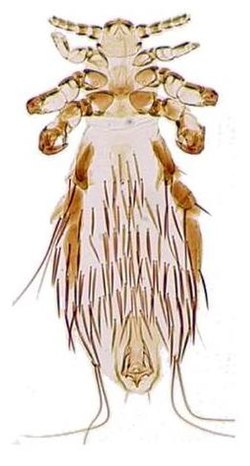
Picture of Phthiraptera
- Source
- Wikipedia/Commons
- Credit
- photo by Vincent S. Smith
- Licence
- CC BY 2.5
- Commercial use
- the licence allows it
No 3D scan of Phthiraptera was found in MorphoSource and Sketchfab.
Smithsonian Open Access was not reached for this taxon, so this list is what the others held rather than everything there is.
The description on this site
- Source
- Wikipedia, “Louse”
- Licence
- CC BY-SA 4.0
This is what the site found, which is not the same as what exists.
Keep going
What may have been alongside itTroctomorpha through timeFormations of the EoceneThe world it lived on
Occurrence data from the Paleobiology Database, CC BY 4.0. (Haeckel 1896)