Phyllostomidae
The New World leaf-nosed bats (Phyllostomidae) are bats found from southern North America to South America, specifically from the Southwest United States to northern Argentina. Both the scientific and common names derive from their often large, lance-shaped noses, though this is greatly reduced in some of the nectar- and pollen-feeders. Because these bats echolocate nasally, this "nose-leaf" is thought to serve some role in modifying and directing the echolocation call. Similar nose leaves are found in some other groups of bats, most notably the Old World leaf-nosed bats.

Leyo · CC BY 2.5 · via Wikipedia/Commons. May be a photograph of a specimen, or an artist’s reconstruction — an interpretation of a skeleton, since colour and soft tissue are almost never preserved.
On record
Recorded, not inferred- Also called
- leaf-nosed batPBDB
- Sits inside
- NoctilionoideaPBDB
- Diet
- omnivorePBDB
- Life habit
- volantPBDB, for Chiroptera
- Motility
- actively mobilePBDB, for Osteichthyes
- Environment
- terrestrialPBDB, for Chiroptera
Time the record covers
At least 29 million years on record.
The record covers at least 29.5 Mya to 11.7 ka. No occurrence read is dated outside 37.71 Mya to 0 Mya.
156 occurrences of Phyllostomidae on record, most of them in the Pleistocene. The Paleobiology Database records this as a living group. Bar height is expected occurrences, not a count: each fossil is spread across the span it is dated to, so a tall narrow bar means tight dating and a low wide one means loose.
When
156 occurrences- Eoceneunder 1%
- Oligocene2%
- Miocene10%
- Pleistocene60%
- Holocene28%
These are dates about fossils, not the animal: the record can only begin after it arose and end before it died out, so either end may reach further. Shares are expected occurrences: a fossil dated to a span is counted partly in each period it straddles. More on what this infers.
Found in
8 formations
- Villavieja Formation · Honda Group9
- MR Caliente Formation1
- Branch Canyon Formation1
- Wicomico Formation1
- Cucaracha Formation1
- Pozo Formation1
Loading coastlines…
The named rock units Phyllostomidae has been recovered from, largest first. Drawn where the rock is now, not where it formed. 140 occurrences have no formation on record, which is common for older literature.
Phyllostomidae and its relatives
PleistoceneWhere Phyllostomidae and its relatives were recorded in the Pleistocene.
Found in the same rock
1,080 taxa- Macrotus waterhousii17 sites
- Geocapromys12 sites
- Eptesicus fuscus11 sites
- Athene cunicularia10 sites
- Falco sparverius10 sites
- Odocoileus virginianus10 sites
- Puma concolor10 sites
- Capromys9 sites
- Dasypus bellus9 sites
- Puffinus lherminieri9 sites
- Tadarida brasiliensis9 sites
- Aenocyon dirus8 sites
- Anolis sagrei8 sites
- Colaptes auratus8 sites
- Cryptotis parva8 sites
- Equus8 sites
- Myotis8 sites
- Myotis austroriparius8 sites
- Sigmodon hispidus8 sites
- Tyto alba8 sites
- Zenaida macroura8 sites
- Desmodus stocki7 sites
- Lynx rufus7 sites
- Megascops asio7 sites
The Paleobiology Database records 60 sites for Phyllostomidae, and this reads all of them. The number is how many of those sites it was catalogued from too. The 24 sharing the most are listed.
This is not a list of everything alive at the time. It is only what has come out of the same ground as this animal and been written down.
Entered from
45 references- Fauna de mamíferos do Quaternário de Serra da Mesa (Goiás, Brasil)28
- Density, Productivity, and Distribution of Mammals in Two Venezuelan Habitats18
- Late Quaternary fossil vertebrates from the Cayman Islands17
- Sub-recent Insectivora and Chiroptera from Puerto Rico, with the description of a new bat of the genus Stenoderma9
- New genus and species of fossil bat (Chiroptera: Phyllostomidae) from Cuba5
- Additional bats from the middle Miocene La Venta fauna of Colombia5
- A new extinct primate among the Pleistocene megafauna of Bahia, Brazil5
- Mammalian fossils from Gruta do Ioiô cave and past of the Chapada Diamantina, northeastern Brazil, using taphonomy, radiocarbon dating and paleoecology4
- Holocene vertebrates from a dry cave on Eleuthera Island, Commonwealth of The Bahamas4
- Fossil bat (Mammalia: Chiroptera) remains from Inciarte tar pit, Sierra de Perijá, Venezuela.4
- A new fossil bat (Chiroptera: Phyllostomatidae) from a Quaternary cave deposit in Cuba4
- Chiroptera4
Each of the 156 occurrences read was entered from one of these publications, ordered by how many each accounts for. This is not a search for papers mentioning the name. 33 further references are not listed. Entries link to doi.org where the Paleobiology Database holds an identifier, and to its own record where it does not. Relayed as the Paleobiology Database holds them, not checked against what they resolve to.
Media and terms
Media content1
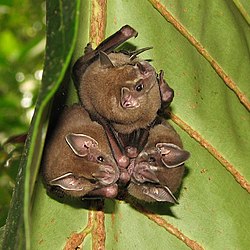
Picture of Phyllostomidae
- Source
- Wikipedia/Commons
- Credit
- Leyo
- Licence
- CC BY 2.5
- Commercial use
- the licence allows it
No 3D scan was found. Smithsonian Open Access, MorphoSource and Sketchfab were all searched.
The description on this site
- Licence
- CC BY-SA 4.0
This is what the site found, which is not the same as what exists.
Keep going
What may have been alongside itNoctilionoidea through timeFormations of the PleistoceneThe world it lived on
Occurrence data from the Paleobiology Database, CC BY 4.0. Gray 1825