Pipilo maculatus
The spotted towhee is a large New World sparrow. The taxonomy of the towhees has been debated in recent decades, and until 1995 this bird and the eastern towhee were considered a single species, then named rufous-sided towhee. Another outdated name for the spotted towhee is the Oregon towhee. The call may be harsher and more varied than for the eastern towhee.

Becky Matsubara from El Sobrante, California · CC BY 2.0 · via Wikipedia/Commons. May be a photograph of a specimen, or an artist’s reconstruction — an interpretation of a skeleton, since colour and soft tissue are almost never preserved.
On record
Recorded, not inferred- Also called
- spotted towheePBDB
- Sits inside
- PipiloPBDB
- Diet
- carnivorePBDB, for Coelurosauria
- Life habit
- ground dwelling, solitaryPBDB, for Theropoda
- Motility
- actively mobilePBDB, for Theropoda
- Environment
- terrestrialPBDB, for Theropoda
Time the record covers
At most 2.6 million years on record.
Every occurrence read is dated to somewhere between 2.58 Mya and 11.7 ka, and nothing in the dating separates them, so that window is what the record shows rather than a span.
5 occurrences of Pipilo maculatus on record, most of them in the Pleistocene. The Paleobiology Database records this as a living group. Bar height is expected occurrences, not a count: each fossil is spread across the span it is dated to, so a tall narrow bar means tight dating and a low wide one means loose.
When
5 occurrences- Pleistocene100%
These are dates about fossils, not the animal: the record can only begin after it arose and end before it died out, so either end may reach further. Shares are expected occurrences: a fossil dated to a span is counted partly in each period it straddles. More on what this infers.
Pipilo maculatus and its relatives
PleistoceneWhere Pipilo maculatus and its relatives were recorded in the Pleistocene.
Found in the same rock
194 taxa- Passerella iliaca5 sites
- Chondestes grammacus4 sites
- Falco sparverius4 sites
- Melospiza melodia4 sites
- Pheucticus melanocephalus4 sites
- Sturnella neglecta4 sites
- Turdus migratorius4 sites
- Zonotrichia leucophrys4 sites
- Athene cunicularia3 sites
- Aves3 sites
- Buteo jamaicensis3 sites
- Catharus guttatus3 sites
- Catharus ustulatus3 sites
- Cerorhinca monocerata3 sites
- Corvus corax3 sites
- Eremophila alpestris3 sites
- Haemorhous mexicanus3 sites
- Icterus bullockii3 sites
- Lanius ludovicianus3 sites
- Larus heermanni3 sites
- Larus occidentalis3 sites
- Oreoscoptes montanus3 sites
- Oreothlypis celata3 sites
- Passerculus sandwichensis3 sites
The Paleobiology Database records 5 sites for Pipilo maculatus, and this reads all of them. The number is how many of those sites it was catalogued from too. The 24 sharing the most are listed.
This is not a list of everything alive at the time. It is only what has come out of the same ground as this animal and been written down.
Entered from
3 references- Terminal Pleistocene–Holocene Avifauna of San Miguel and Santa Rosa Islands: Identifications of Previously Unidentified Avian Remains Recovered from Fossil Sites and Prehistoric Cave Deposits3
- Records of fringillids from the Pleistocene of Rancho La Brea1
- The fossil Birds of California1
Each of the 5 occurrences read was entered from one of these publications, ordered by how many each accounts for. This is not a search for papers mentioning the name. Entries link to doi.org where the Paleobiology Database holds an identifier, and to its own record where it does not. Relayed as the Paleobiology Database holds them, not checked against what they resolve to.
Media and terms
Media content2

Picture of Pipilo maculatus
- Source
- Wikipedia/Commons
- Credit
- Becky Matsubara from El Sobrante, California
- Licence
- CC BY 2.0
- Commercial use
- the licence allows it
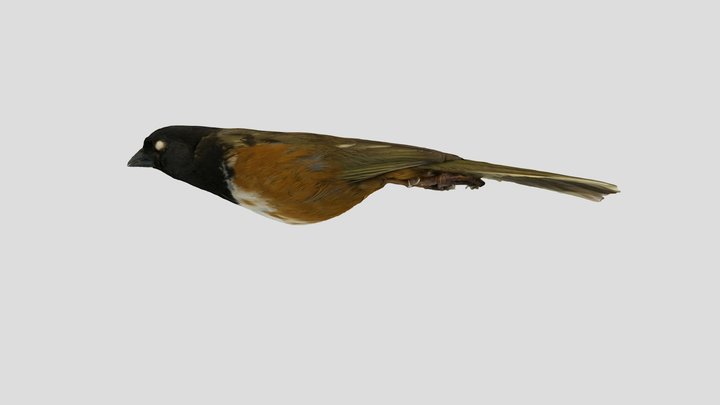
Smithsonian Open Access was not reached for this taxon, so this list is what the others held rather than everything there is.
The description on this site
- Licence
- CC BY-SA 4.0
This is what the site found, which is not the same as what exists.
Keep going
What may have been alongside itPipilo through timeFormations of the PleistoceneThe world it lived on
Occurrence data from the Paleobiology Database, CC BY 4.0. Swainson 1827