Planulina
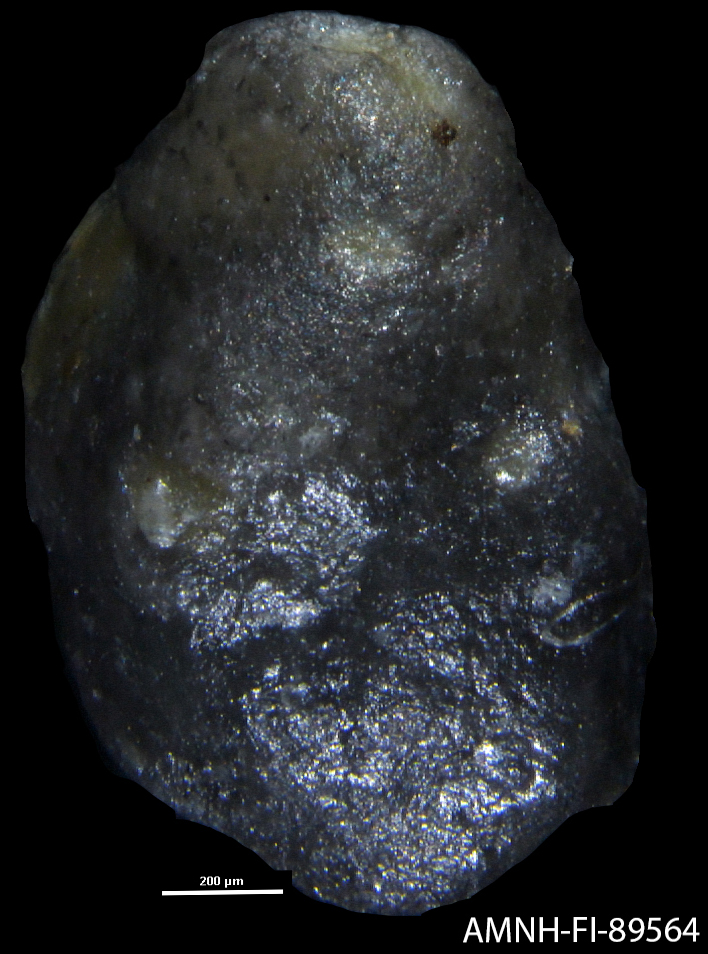
via iDigBio · CC BY-NC-SA · via iDigBio. May be a photograph of a specimen, or an artist’s reconstruction — an interpretation of a skeleton, since colour and soft tissue are almost never preserved.
On record
Recorded, not inferred- Sits inside
- PlanulininaePBDB
- Diet
- suspension feederPBDB
- Life habit
- semi-infaunalPBDB, for Foraminifera
- Motility
- stationaryPBDB, for Foraminifera
Time the record covers
At least 110 million years on record.
The record covers at least 110.1 Mya to 11.7 ka. No occurrence read is dated outside 113.2 Mya to 0 Mya.
716 occurrences of Planulina on record, most of them in the Pleistocene. The Paleobiology Database records this as a living group. Bar height is expected occurrences, not a count: each fossil is spread across the span it is dated to, so a tall narrow bar means tight dating and a low wide one means loose.
When
716 occurrences- Early Cretaceousunder 1%
- Late Cretaceous1%
- Paleoceneunder 1%
- Eocene2%
- Oligocene1%
- Miocene26%
- Pliocene16%
- Pleistocene52%
- Holoceneunder 1%
These are dates about fossils, not the animal: the record can only begin after it arose and end before it died out, so either end may reach further. Shares are expected occurrences: a fossil dated to a span is counted partly in each period it straddles. More on what this infers.
Found in
19 formations
- Roca Formation · Malargüe Group3
- Canepatch Formation2
- Seca Formation1
- Zapallo Formation1
- Yazoo Formation · Jackson Group1
- Bear Bluff Formation1
Loading coastlines…
The named rock units Planulina has been recovered from, largest first. Drawn where the rock is now, not where it formed. 694 occurrences have no formation on record, which is common for older literature.
Planulina and its relatives
PleistoceneWhere Planulina and its relatives were recorded in the Pleistocene.
Found in the same rock
1,008 taxa- Uvigerina156 sites
- Cibicidoides131 sites
- Pyrgo122 sites
- Sigmoilopsis116 sites
- Globocassidulina110 sites
- Dentalina104 sites
- Oridorsalis94 sites
- Laticarinina92 sites
- Gyroidinoides89 sites
- Melonis89 sites
- Quinqueloculina87 sites
- Stilostomella80 sites
- Lenticulina78 sites
- Sphaeroidina bulloides77 sites
- Lagena75 sites
- Pleurostomella73 sites
- Brizalina68 sites
- Hoeglundina67 sites
- Bulimina64 sites
- Eggerella64 sites
- Fissurina62 sites
- Ceratobulimina50 sites
- Nodosaria50 sites
- Cristellaria (Marginulina)45 sites
The Paleobiology Database records 681 sites for Planulina, and this reads 240 of them. The number is how many of those sites it was catalogued from too. The 24 sharing the most are listed.
This is not a list of everything alive at the time. It is only what has come out of the same ground as this animal and been written down.
Entered from
89 references- Site U148256
- Site U138735
- Site U138634
- Site U148331
- Neogene benthic foraminifera of the Hatton-Rockall Basin28
- Mid-slope Site U138027
- Die Fauna des marinen Miozäns von Kevelaer (Niederrhein). Band 1 Foraminiferen, Anthozoen.26
- Site U139122
- Site U152021
- Site U150620
- Upper slope Site U141320
- Site U150719
Each of the 716 occurrences read was entered from one of these publications, ordered by how many each accounts for. This is not a search for papers mentioning the name. 77 further references are not listed. Entries link to doi.org where the Paleobiology Database holds an identifier, and to its own record where it does not. Relayed as the Paleobiology Database holds them, not checked against what they resolve to.
Media and terms
Media content2
Picture of Planulina
- Source
- iDigBio
- Credit
- via iDigBio
- Licence
- CC BY-NC-SA
- Commercial use
- the licence does not allow it
CT scan
- Source
- MorphoSource
- Licence
- not stated by the source
- Commercial use
- cannot be read from the licence given — check the record
- Specimen
- Planulina sp. · l-cb
This is what the site found, which is not the same as what exists.
Keep going
What may have been alongside itPlanulininae through timeFormations of the PleistoceneThe world it lived on
Occurrence data from the Paleobiology Database, CC BY 4.0. d'Orbigny 1826