Plocoscyphia
Plocoscyphia is an extinct genus of sea sponges belonging to the family Callodictyonidae.

Hectonichus · CC BY-SA 3.0 · via Wikipedia/Commons. May be a photograph of a specimen, or an artist’s reconstruction — an interpretation of a skeleton, since colour and soft tissue are almost never preserved.
On record
Recorded, not inferred- Sits inside
- BecksinaePBDB
- Diet
- suspension feederPBDB, for Lychniscosa
- Life habit
- epifaunalPBDB, for Lychniscosa
- Motility
- stationary, attachedPBDB, for Lychniscosa
- Vision
- blindPBDB, for Hexactinellida
- Environment
- marinePBDB, for Hexactinellida
Time the record covers
At least 210 million years on record.
The record covers at least 251.902 Mya to 41.03 Mya. No occurrence read is dated outside 254.14 Mya to 37.71 Mya.
39 occurrences of Plocoscyphia on record, most of them in the Late Cretaceous. Bar height is expected occurrences, not a count: each fossil is spread across the span it is dated to, so a tall narrow bar means tight dating and a low wide one means loose.
When
39 occurrencesThese are dates about fossils, not the animal: the record can only begin after it arose and end before it died out, so either end may reach further. Shares are expected occurrences: a fossil dated to a span is counted partly in each period it straddles. More on what this infers.
Found in
11 formations
- Folkestone Formation · Lower Greensand Group2
- Hythe Formation · Lower Greensand Group1
- Woburn Sand Formation · Lower Greensand Group1
- Grès verts helvétiques Formation1
- Changxing Formation1
- "Scaphiten-Pläner" Formation1
Loading coastlines…
The named rock units Plocoscyphia has been recovered from, largest first. Drawn where the rock is now, not where it formed. 27 occurrences have no formation on record, which is common for older literature.
Plocoscyphia and its relatives
Late CretaceousWhere Plocoscyphia and its relatives were recorded in the Late Cretaceous.
Found in the same rock
452 taxa- Laocoetis virgatula6 sites
- Coscinopora infundibuliformis5 sites
- Leptophragma micropora5 sites
- Leptophragma murchisoni5 sites
- Aphrocallistes cylindrodactylus4 sites
- Becksia haugi4 sites
- Coeloptychium deciminum4 sites
- Coeloscyphia racemosa4 sites
- Doryderma (Brochodora) roemeri4 sites
- Jereica polystoma4 sites
- Periphragella plicata4 sites
- Polyopesia angustata4 sites
- Rhizopoterion4 sites
- Siphonia4 sites
- Tremabolites megastoma4 sites
- Verrucocoelia tubulata4 sites
- Xenoschrammenum fragile4 sites
- Amphithelion (Amphithelion) macrommata3 sites
- Aphrocallistes3 sites
- Aphrocallistes alveolites3 sites
- Astrocladia subramosa3 sites
- Callicylix eocenicus3 sites
- Callopegma acaule3 sites
- Coeloptychium (Lophoptychium) lobatum3 sites
The Paleobiology Database records 31 sites for Plocoscyphia, and this reads all of them. The number is how many of those sites it was catalogued from too. The 24 sharing the most are listed.
This is not a list of everything alive at the time. It is only what has come out of the same ground as this animal and been written down.
Entered from
12 references- Catalogue of the fossil sponges in the Geological Department of the British Museum (Natural History)11
- Contribution a l'etude des spongiaires siliceux du Cretace inferieur8
- Die Kieselspongien der oberen Kreide von Nordwestdeutschland, Teil 2 Triaxonia (Hexactinellida) [Upper Cretaceous sponges from north-western Germany, part 2 Triaxonia (Hexactinellida)]5
- The stratigraphical palaeontology of the Lower Greensand4
- Contribution a l'etude des spongiaires siliceux du Crétacé supérieur du nord de la France3
- Hexactinellid sponges from the Santonian deposits of the Krakow area (southern Poland)2
- La faune à rudistes, porifères et scléractiniaires du Crétacé superieur du mont Ptoon (Béotie septentrionale, Grèce continentale) [The fauna with rudists, porifers and corals of upper Cretaceous of mount Ptoon (Northern Beotia, central Greece)]1
- An inventory of the marine and transitional Middle/Upper Eocene deposits of the Southeastern Pyrenean Foreland Basin (NE Spain)1
- Les grès verts helvétiques (Aptien moyen-Albien supérieur) de Haute-Savoie, Valais et Vaud (Alpes occidentales franco-suisses)1
- Reefs through geological ages in China1
- An extension of Upper Cretaceous Rocks to the Swedish west coast at Särdal1
- Die Schwammfauna der Oberkreide von Neuburg (Donau) [The Upper Cretaceous sponge fauna from Neuburg (Donau)]1
Each of the 39 occurrences read was entered from one of these publications, ordered by how many each accounts for. This is not a search for papers mentioning the name. Entries link to doi.org where the Paleobiology Database holds an identifier, and to its own record where it does not. Relayed as the Paleobiology Database holds them, not checked against what they resolve to.
Media and terms
Media content1
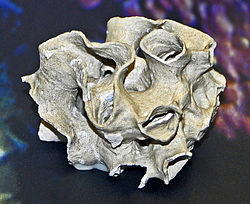
Picture of Plocoscyphia
- Source
- Wikipedia/Commons
- Credit
- Hectonichus
- Licence
- CC BY-SA 3.0
- Commercial use
- the licence allows it
No 3D scan was found. Smithsonian Open Access, MorphoSource and Sketchfab were all searched.
The description on this site
- Licence
- CC BY-SA 4.0
This is what the site found, which is not the same as what exists.
Keep going
What may have been alongside itBecksinae through timeFormations of the Late CretaceousThe world it lived on
Occurrence data from the Paleobiology Database, CC BY 4.0. Reuss 1846