Pollicipes
Pollicipes is a genus of goose barnacles, first described by William Elford Leach in 1817. It comprises four species of marine suspension-feeders.

Hans Hillewaert · CC BY-SA 4.0 · via Wikipedia/Commons. May be a photograph of a specimen, or an artist’s reconstruction — an interpretation of a skeleton, since colour and soft tissue are almost never preserved.
On record
Recorded, not inferred- Sits inside
- PollicipedidaePBDB
- Diet
- suspension feederPBDB, for Cirripedia
- Life habit
- epifaunalPBDB, for Cirripedia
- Motility
- stationary, attached, epibiontPBDB, for Cirripedia
- Vision
- limitedPBDB, for Cirripedia
Time the record covers
At least 106 million years on record.
The record covers at least 106.3 Mya to 11.7 ka. No occurrence read is dated outside 110.1 Mya to 0 Mya.
46 occurrences of Pollicipes on record, most of them in the Late Cretaceous. The Paleobiology Database records this as a living group. Bar height is expected occurrences, not a count: each fossil is spread across the span it is dated to, so a tall narrow bar means tight dating and a low wide one means loose.
When
46 occurrencesThese are dates about fossils, not the animal: the record can only begin after it arose and end before it died out, so either end may reach further. Shares are expected occurrences: a fossil dated to a span is counted partly in each period it straddles. More on what this infers.
Found in
11 formations
- Gault Formation12
- Teplice Formation7
- Peruc-Koryčany Formation4
- Teplitzer Formation3
- Upper Chalk Formation · Chalk Group2
- Bila Hora Formation1
Loading coastlines…
The named rock units Pollicipes has been recovered from, largest first. Drawn where the rock is now, not where it formed. 12 occurrences have no formation on record, which is common for older literature.
Pollicipes and its relatives
Late CretaceousWhere Pollicipes and its relatives were recorded in the Late Cretaceous.
Found in the same rock
257 taxa- Cretiscalpellum unguis13 sites
- Arcuatoscalpellum arcuatum11 sites
- Jaegerscalpellum comptum11 sites
- Pycnolepas rigida8 sites
- Cretiscalpellum striatum5 sites
- Diotascalpellum angustatum5 sites
- Scalpellum5 sites
- Zeugmatolepas mockleri5 sites
- Bairdia arcuata4 sites
- Bairdia subdeltoidea4 sites
- Decapoda4 sites
- Enoploclytia leachi4 sites
- Paracentrotus4 sites
- Spondylus4 sites
- Amphidonte (Ceratostreon) reticulata3 sites
- Ancistrocrania3 sites
- Anthophyllum3 sites
- Atreta3 sites
- Cheilostomata3 sites
- Cyclothyris3 sites
- Cythere ornatissima3 sites
- Cytherideis laevigata3 sites
- Glomerula3 sites
- Gryphaeostrea canaliculata3 sites
The Paleobiology Database records 37 sites for Pollicipes, and this reads all of them. The number is how many of those sites it was catalogued from too. The 24 sharing the most are listed.
This is not a list of everything alive at the time. It is only what has come out of the same ground as this animal and been written down.
Entered from
7 references- Die Crustaceen der böhmischen Kreideformation20
- Recent advances in the knowledge of Gault Cirripedia12
- Humans and marine resource interaction reappraised: Archaeofauna remains during the late Pleistocene and Holocene in Cantabrian Spain6
- Late Cretaceous nautilid beaks from near-shore/shallow water deposits of the Bohemian Cretaceous Basin (Czech Republic)3
- Taxonomy and palaeoecology of thoracican cirripedes (Crustacea) from a Campanian rocky shoreline at Ivö Klack, southern Sweden2
- Some cirripedes from the chalk of Salisbury, Wilts2
- Kalken paa Saltholm1
Each of the 46 occurrences read was entered from one of these publications, ordered by how many each accounts for. This is not a search for papers mentioning the name. Entries link to doi.org where the Paleobiology Database holds an identifier, and to its own record where it does not. Relayed as the Paleobiology Database holds them, not checked against what they resolve to.
Media and terms
Media content1
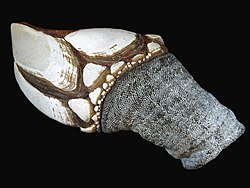
Picture of Pollicipes
- Source
- Wikipedia/Commons
- Credit
- Hans Hillewaert
- Licence
- CC BY-SA 4.0
- Commercial use
- the licence allows it
No 3D scan of Pollicipes was found in MorphoSource and Sketchfab.
Smithsonian Open Access was not reached for this taxon, so this list is what the others held rather than everything there is.
The description on this site
- Source
- Wikipedia, “Pollicipes”
- Licence
- CC BY-SA 4.0
This is what the site found, which is not the same as what exists.
Keep going
What may have been alongside itPollicipedidae through timeFormations of the Late CretaceousThe world it lived on
Occurrence data from the Paleobiology Database, CC BY 4.0. Leach 1817