Portunidae
Portunidae is a family of crabs which contains the swimming crabs. Its members include well-known shoreline crabs such as the blue crab and velvet crab.

Hans Hillewaert · CC BY-SA 4.0 · via Wikipedia/Commons. May be a photograph of a specimen, or an artist’s reconstruction — an interpretation of a skeleton, since colour and soft tissue are almost never preserved.
On record
Recorded, not inferred- Also called
- swimming crabPBDB
- Sits inside
- PortunoideaPBDB
- Diet
- carnivorePBDB, for Decapoda
- Life habit
- semi-infaunalPBDB, for Portunoidea
- Motility
- actively mobilePBDB, for Malacostraca
- Vision
- well-developedPBDB, for Malacostraca
Time the record covers
At least 158 million years on record.
The record covers at least 159 Mya to 11.7 ka. No occurrence read is dated outside 161.5 Mya to 0 Mya.
382 occurrences of Portunidae on record, most of them in the Miocene. The Paleobiology Database records this as a living group. Bar height is expected occurrences, not a count: each fossil is spread across the span it is dated to, so a tall narrow bar means tight dating and a low wide one means loose.
When
382 occurrences- Late Jurassicunder 1%
- Early Cretaceousunder 1%
- Late Cretaceousunder 1%
- Paleoceneunder 1%
- Eocene9%
- Oligocene7%
- Miocene55%
- Pliocene9%
- Pleistocene12%
- Holocene6%
These are dates about fossils, not the animal: the record can only begin after it arose and end before it died out, so either end may reach further. Shares are expected occurrences: a fossil dated to a span is counted partly in each period it straddles. More on what this infers.
Found in
97 formations
- Pirabas Formation35
- Sandakan Formation26
- Cercado Formation · Yaque Group18
- Gatun Formation8
- Gurabo Formation · Yaque Group7
- Talbot Formation6
Loading coastlines…
The named rock units Portunidae has been recovered from, largest first. Drawn where the rock is now, not where it formed. 73 further formations hold fewer occurrences each and are not listed. 117 occurrences have no formation on record, which is common for older literature.
Portunidae and its relatives
MioceneWhere Portunidae and its relatives were recorded in the Miocene.
Found in the same rock
2,231 taxa- Portunus27 sites
- Portunus woodwardi16 sites
- Scylla costata15 sites
- Callinectes12 sites
- Callinectes declivis12 sites
- Xanthias miocenicus12 sites
- Calappa10 sites
- Callianassa10 sites
- Persephona prepunctata10 sites
- Xantho moldavicus10 sites
- Portunus oblongus9 sites
- Calappa flammea8 sites
- Heikeopsis tuberculata8 sites
- Iphiculus sexspinosus8 sites
- Nucia platyspinosa8 sites
- Pilumnus mediterraneus8 sites
- Pinnixa microgranulosa8 sites
- Portunus obvallatus8 sites
- Clypeaster7 sites
- Euphylax maculatus7 sites
- Galathea weinfurteri7 sites
- Parthenope jugula7 sites
- Portunus monspeliensis7 sites
- Calappa heberti6 sites
The Paleobiology Database records 201 sites for Portunidae, and this reads all of them. The number is how many of those sites it was catalogued from too. The 24 sharing the most are listed.
This is not a list of everything alive at the time. It is only what has come out of the same ground as this animal and been written down.
Entered from
113 references- Localidades fossiliferas da Formacao Pirabas (Mioceno Inferior)35
- Miocene and Pleistocene Crabs (Crustacea, Decapoda) from Sabah and Sarawak31
- Fossil Crustacea of the Atlantic and Gulf Coastal Plain25
- Decapod crustaceans from the Neogene of the Caribbean: diversity, distribution and prospectus20
- Decapod crustacea of the Badenian17
- Neogene and Quaternary crabs (Crustacea, Decapoda) collected from Costa Rica and Panama by members of the Panama Paleontology Project16
- Oligocene and Miocene decapods (Thalassinidea and Brachyura) from the Caribbean15
- Notes on North American Crustacea, in the Museum of the Smithsonian Institution. No. II13
- Decapod crustaceans from the Panama region12
- Cenozoic Decapod Crustacea from Southwest Japan9
- West Indian Tertiary decapod crustaceans9
- Mesozoic and Cenozoic decapod crustaceans from Venezuela and related trace-fossil assemblages7
Each of the 382 occurrences read was entered from one of these publications, ordered by how many each accounts for. This is not a search for papers mentioning the name. 101 further references are not listed. Entries link to doi.org where the Paleobiology Database holds an identifier, and to its own record where it does not. Relayed as the Paleobiology Database holds them, not checked against what they resolve to.
Media and terms
Media content2

Picture of Portunidae
- Source
- Wikipedia/Commons
- Credit
- Hans Hillewaert
- Licence
- CC BY-SA 4.0
- Commercial use
- the licence allows it
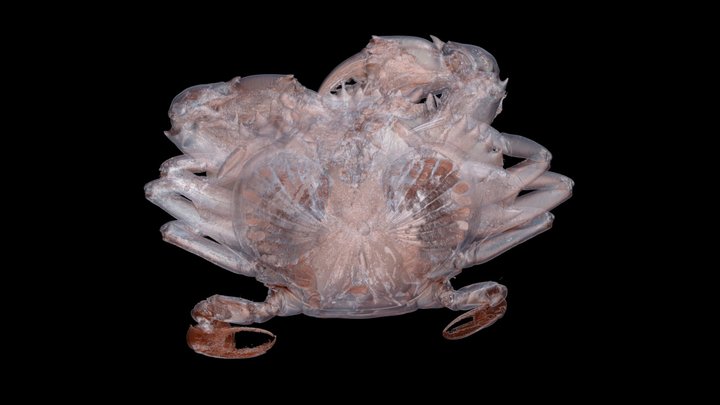
3D model
- Source
- Sketchfab
- Licence
- CC Attribution-NonCommercial-ShareAlike
- Commercial use
- the licence does not allow it
Smithsonian Open Access and MorphoSource were not reached for this taxon, so this list is what the others held rather than everything there is.
The description on this site
- Source
- Wikipedia, “Portunidae”
- Licence
- CC BY-SA 4.0
This is what the site found, which is not the same as what exists.
Keep going
What may have been alongside itPortunoidea through timeFormations of the MioceneThe world it lived on
Occurrence data from the Paleobiology Database, CC BY 4.0. Rafinesque 1815