Proteaceae
The Proteaceae form a family of flowering plants predominantly distributed in the Southern Hemisphere. The family comprises 83 genera with about 1,660 known species. Australia and South Africa have the greatest concentrations of diversity. Together with the Platanaceae, Nelumbonaceae and in the recent APG IV system the Sabiaceae, they make up the order Proteales. Well-known Proteaceae genera include Protea, Banksia, Embothrium, Grevillea, Hakea, and Macadamia. Species such as the New South Wales waratah, king protea, and various species of Banksia, Grevillea, and Leucadendron are popular cut flowers. The nuts of Macadamia integrifolia are widely grown commercially and consumed, as are those of Gevuina avellana on a smaller scale.

Stan Shebs · CC BY-SA 3.0 · via Wikipedia/Commons. May be a photograph of a specimen, or an artist’s reconstruction — an interpretation of a skeleton, since colour and soft tissue are almost never preserved.
On record
Recorded, not inferred- Sits inside
- ProtealesPBDB
- Diet
- "photoautotroph"PBDB, for Angiospermae
Time the record covers
At least 227 million years on record.
The record covers at least 227.3 Mya to 11.7 ka. No occurrence read is dated outside 241.464 Mya to 0 Mya.
1,818 occurrences of Proteaceae on record, most of them in the Eocene. The Paleobiology Database records this as a living group. Bar height is expected occurrences, not a count: each fossil is spread across the span it is dated to, so a tall narrow bar means tight dating and a low wide one means loose.
When
1,818 occurrences- Middle Triassicunder 1%
- Late Triassicunder 1%
- Middle Jurassicunder 1%
- Early Cretaceousunder 1%
- Late Cretaceous19%
- Paleocene22%
- Eocene33%
- Oligocene6%
- Miocene7%
- Plioceneunder 1%
- Pleistocene13%
- Holoceneunder 1%
These are dates about fossils, not the animal: the record can only begin after it arose and end before it died out, so either end may reach further. Shares are expected occurrences: a fossil dated to a span is counted partly in each period it straddles. More on what this infers.
Found in
147 formations
- Fort Union Formation117
- Lefipán Formation74
- Monte Chico Formation39
- Hidden Lake Formation · Gustav Group38
- Morwell Formation34
- La Colonia Formation32
Loading coastlines…
The named rock units Proteaceae has been recovered from, largest first. Drawn where the rock is now, not where it formed. 123 further formations hold fewer occurrences each and are not listed. 840 occurrences have no formation on record, which is common for older literature.
Proteaceae and its relatives
EoceneWhere Proteaceae and its relatives were recorded in the Eocene.
Found in the same rock
2,001 taxa- Tricolpites70 sites
- Cicatricosisporites dorogensis65 sites
- Liliacidites65 sites
- Gleicheniidites64 sites
- Triporopollenites61 sites
- Laevigatosporites57 sites
- Caryapollenites51 sites
- Proteacidites50 sites
- Taxodium50 sites
- Deltoidospora49 sites
- Pinuspollenites49 sites
- Thompsonipollis magnificus49 sites
- Coniferales48 sites
- Microreticulatisporites48 sites
- Casurinidites pulcher47 sites
- Pediastrum47 sites
- Momipites46 sites
- Margocolporites44 sites
- Lycopodiumsporites43 sites
- Tricolpopollenites43 sites
- Leiotriletes42 sites
- Osmundacidites42 sites
- Converrucosisporites41 sites
- Inapertisporites41 sites
The Paleobiology Database records 788 sites for Proteaceae, and this reads 240 of them. The number is how many of those sites it was catalogued from too. The 24 sharing the most are listed.
This is not a list of everything alive at the time. It is only what has come out of the same ground as this animal and been written down.
Entered from
183 references- Persistent near-tropical warmth on the Antarctic continent during the early Eocene epoch155
- Early Pleistocene vegetation change in upland south-eastern Australia139
- Distribution of pollen and spores in a subsurface marine Wilcox (Paleocene-Eocene) section in southwest Louisiana114
- Palynological data from the Fort Union and Wasatch formations, Powder River basin, Wyoming and Montana96
- Cretaceous/Paleogene Floral Turnover in Patagonia: Drop in Diversity, Low Extinction, and a Classopollis Spike68
- Palynological contribution to geologic mapping of coal-bearing upper Paleocene rocks in the lower Indus coal region, Pakistan62
- The Oligo-Miocene coal floras of southeastern Australia52
- Palinología del entorno cretácico/paleógeno del SO de la provincia de Santa Cruz: significado estratigráfico y paleoambiental45
- Biostratigraphy of selected K/T boundary sections in southwestern North Dakota, USA: toward a refinement of palynological identification criteria44
- Palinología de la Formación Hidden Lake (Coniaciano-Santoniano), Isla James Ross, Antártida43
- Palaeofloristic and palaeovegetational changes across the Paleocene/Eocene boundary in northern South America41
- A complete pollen record of the last 230 ka from Lynch's Crater, north-eastern Australia40
Each of the 1,818 occurrences read was entered from one of these publications, ordered by how many each accounts for. This is not a search for papers mentioning the name. 171 further references are not listed. Entries link to doi.org where the Paleobiology Database holds an identifier, and to its own record where it does not. Relayed as the Paleobiology Database holds them, not checked against what they resolve to.
Media and terms
Media content1
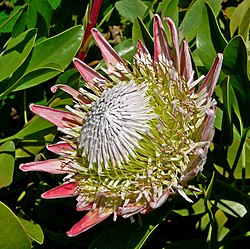
Picture of Proteaceae
- Source
- Wikipedia/Commons
- Credit
- Stan Shebs
- Licence
- CC BY-SA 3.0
- Commercial use
- the licence allows it
No 3D scan was found. Smithsonian Open Access, MorphoSource and Sketchfab were all searched.
The description on this site
- Source
- Wikipedia, “Proteaceae”
- Licence
- CC BY-SA 4.0
This is what the site found, which is not the same as what exists.
Keep going
What may have been alongside itProteales through timeFormations of the EoceneThe world it lived on
Occurrence data from the Paleobiology Database, CC BY 4.0. de Jussieu 1789