Pygope
Searched as Pygope aspasia. The Paleobiology Database treats Pygope as the accepted name.
Pygope is an extinct genus of brachiopods belonging to the family Pygopidae. These brachiopods lived in open sea from the Jurassic Period, Kimmeridgian age up to Cretaceous Period, Barremian age. Some of the species are characterised by a smaller or larger perforation through the entire shell in older specimens, while others just have a depression somewhere on the midline. Younger specimens of the perforated species develop a heart-shape and subsequently both extensions merge, thus encircling a central passage which is in fact entirely outside the shell.

Francisco Ruiz Contreras · CC BY-SA 4.0 · via Wikipedia/Commons. May be a photograph of a specimen, or an artist’s reconstruction — an interpretation of a skeleton, since colour and soft tissue are almost never preserved.
On record
Recorded, not inferred- Sits inside
- PygopinaePBDB
- Diet
- suspension feederPBDB, for Terebratulida
- Life habit
- low-level epifaunalPBDB, for Terebratulida
- Motility
- stationaryPBDB, for Terebratulida
- Vision
- blindPBDB, for Rhynchonellata
- Environment
- marinePBDB, for Lophophorata
Time the record covers
At most 16 million years on record.
The one occurrence read is dated to somewhere between 199.5 Mya and 184.2 Mya, which is a dating window rather than a span.
1 occurrence of Pygope on record, most of them in the Early Jurassic. Bar height is expected occurrences, not a count: each fossil is spread across the span it is dated to, so a tall narrow bar means tight dating and a low wide one means loose.
When
1 occurrences- Early Jurassic100%
These are dates about fossils, not the animal: the record can only begin after it arose and end before it died out, so either end may reach further. Shares are expected occurrences: a fossil dated to a span is counted partly in each period it straddles. More on what this infers.
Found in
1 formation
Loading coastlines…
The named rock units Pygope has been recovered from, largest first. Drawn where the rock is now, not where it formed.
Pygope and its relatives
Early JurassicWhere Pygope and its relatives were recorded in the Early Jurassic.
Found in the same rock
158 taxa- Monticlarella33 sites
- Nucleata bouei27 sites
- Nucleata nucleata24 sites
- Nucleata16 sites
- Karadagithyris15 sites
- Camerothyris14 sites
- Nucleata planulata12 sites
- Zittelina pinguicula12 sites
- Antinomia sima11 sites
- Lacunosella11 sites
- Triangope11 sites
- Karadagithyris bilimeki9 sites
- Karadagithyris carpathica8 sites
- Duvalia lata7 sites
- Lacunosella hoheneggeri7 sites
- Vjalovithyris rupicola7 sites
- Zittelina wahlenbergi6 sites
- Dictyothyropsis tatrica5 sites
- Spiticeras5 sites
- Berriasella4 sites
- Berriasellinae4 sites
- Aspidoceras3 sites
- Fauriella boissieri3 sites
- Fortunella capillata3 sites
The Paleobiology Database records 77 sites for Pygope, and this reads all of them. The number is how many of those sites it was catalogued from too. The 24 sharing the most are listed.
This is not a list of everything alive at the time. It is only what has come out of the same ground as this animal and been written down.
Entered from
1 referenceEach of the 1 occurrence read was entered from one of these publications, ordered by how many each accounts for. This is not a search for papers mentioning the name. Each entry links to doi.org. Relayed as the Paleobiology Database holds them, not checked against what they resolve to.
Media and terms
Media content2

Picture of Pygope
- Source
- Wikipedia/Commons
- Credit
- Francisco Ruiz Contreras
- Licence
- CC BY-SA 4.0
- Commercial use
- the licence allows it
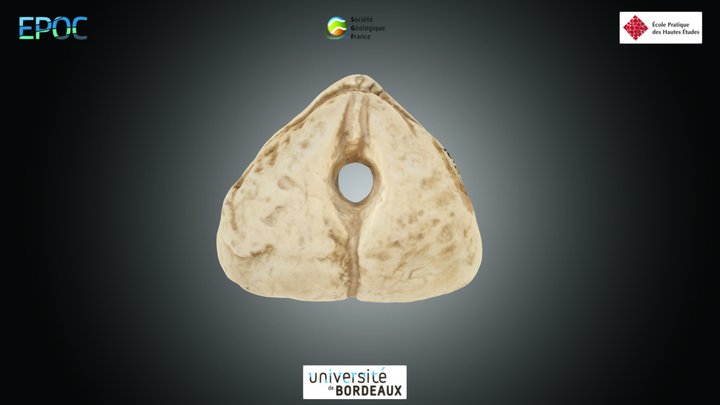
3D model
- Source
- Sketchfab
- Licence
- CC Attribution-NonCommercial-ShareAlike
- Commercial use
- the licence does not allow it
Smithsonian Open Access and MorphoSource were not reached for this taxon, so this list is what the others held rather than everything there is.
The description on this site
- Source
- Wikipedia, “Pygope”
- Licence
- CC BY-SA 4.0
This is what the site found, which is not the same as what exists.
Keep going
What may have been alongside itPygopinae through timeFormations of the Early JurassicThe world it lived on
Occurrence data from the Paleobiology Database, CC BY 4.0. Link 1830