Radiolaria
The Radiolaria, also called Radiozoa and informally called radiolarians, are unicellular eukaryotes of diameter 0.1–0.2 mm that produce intricate mineral skeletons, typically with a central capsule dividing the cell into the inner and outer portions of endoplasm and ectoplasm. The elaborate mineral skeleton is usually made of silica. They are found as zooplankton throughout the global ocean. As zooplankton, radiolarians are primarily heterotrophic, but many have photosynthetic endosymbionts and are, therefore, considered mixotrophs. The skeletal remains of some types of radiolarians make up a large part of the cover of the ocean floor as siliceous ooze. Due to their rapid change as species and intricate skeletons, radiolarians represent an important diagnostic fossil found from the Cambrian onwards.

Uncredited · Public Domain · via Wikipedia/Commons. May be a photograph of a specimen, or an artist’s reconstruction — an interpretation of a skeleton, since colour and soft tissue are almost never preserved.
On record
Recorded, not inferred- Also called
- radiolarianPBDB
- Sits inside
- ReticulareaPBDB
- Diet
- omnivorePBDB
- Life habit
- planktonicPBDB
- Motility
- passively mobilePBDB
- Environment
- marinePBDB
Time the record covers
At least 504 million years on record.
The record covers at least 504.5 Mya to 11.7 ka. No occurrence read is dated outside 508 Mya to 0 Mya.
12,000+ occurrences of Radiolaria on record. The Paleobiology Database records this as a living group. Bar height is expected occurrences, not a count: each fossil is spread across the span it is dated to, so a tall narrow bar means tight dating and a low wide one means loose.
When
12,000 occurrences read- Cambrianunder 1%
- Ordovicianunder 1%
- Silurianunder 1%
- Devonian3%
- Carboniferous1%
- Permian31%
- Early Triassic3%
- Middle Triassic10%
- Late Triassic9%
- Early Jurassic9%
- Middle Jurassic5%
- Late Jurassic8%
- Early Cretaceous5%
- Late Cretaceous2%
- Paleocene1%
- Eoceneunder 1%
- Oligoceneunder 1%
- Miocene1%
- Pliocene2%
- Pleistocene6%
- Holoceneunder 1%
These are dates about fossils, not the animal: the record can only begin after it arose and end before it died out, so either end may reach further. Shares are expected occurrences: a fossil dated to a span is counted partly in each period it straddles. The read hit its cap, so every figure above is a floor and the shares are of the occurrences read. More on what this infers.
Found in
at least 199 formations
- Dalong Formation1,087
- Sandilands Formation · Kunga Group811
- Hashikadani Formation595
- Maiolica Formation360
- Sapadere Formation284
- Taman Formation220
Loading coastlines…
The named rock units Radiolaria has been recovered from, largest first. Drawn where the rock is now, not where it formed. The read hit its cap, so each count is a floor. 175 further formations hold fewer occurrences each and are not listed. 4,595 occurrences have no formation on record, which is common for older literature.
Found in the same rock
1,155 taxa- Praeparvicingula87 sites
- Pantanellium73 sites
- Paronaella70 sites
- Tritrabs ewingi67 sites
- Emiluvia pessagnoi66 sites
- Sethocapsa leiostraca65 sites
- Acastea diaphorogona63 sites
- Hsuum62 sites
- Tethysetta boesii58 sites
- Napora57 sites
- Emiluvia chica56 sites
- Obesacapsula cetia55 sites
- Dicerosaturnalis dicranacanthos51 sites
- Podocapsa amphitreptera50 sites
- Acaeniotyle umbilicata49 sites
- Syringocapsa49 sites
- Gorgansium46 sites
- Acanthocircus trizonalis42 sites
- Perispyridium42 sites
- Acanthocircus41 sites
- Archaeodictyomitra41 sites
- Podobursa triacantha41 sites
- Praeconocaryomma39 sites
- Pseudoeucyrtis39 sites
The Paleobiology Database records at least 361 sites for Radiolaria, and this reads 240 of them. Of that, one read hit the database's own return limit, so every count below is a floor rather than a total. The number is how many of those sites it was catalogued from too. The 24 sharing the most are listed.
This is not a list of everything alive at the time. It is only what has come out of the same ground as this animal and been written down.
Entered from
at least 315 references- Stratigraphy and age of the Permian-Triassic boundary siliceous rocks of the Mino terrane in the Mt. Funabuseyama area, central Japan595
- Evolutionary patterns of Late Permian Albaillella (Radiolaria) as seen in bedded chert sections in the Mino Belt, Japan563
- Radiolarian evolution during the latest Permian in south China497
- Biostratigraphy and Systematics of late Middle to Late Triassic Radiolarians from the Taurus Mountains and Ankara Region, Turkey471
- Taxonomy of order Latentifistularia (Radiolaria) from the latest Permian in southern Guangxi, China445
- Biochronology and paleontology of Lower Jurassic (Hettangian and Sinemurian) radiolarians, Queen Charlotte Islands, British Columbia396
- Early Cretaceous Radiolarian Biostratigraphy of Umbria-Marche Apennines (Italy), Southern Alps (Italy and Switzerland) and Hawasina Nappes (Oman)360
- Biochronology and paleontology of uppermost Triassic (Rhaetian) radiolarians, Queen Charlotte Islands, British Columbia, Canada334
- Late Permian to Middle Triassic radiolarian faunas from northern Thailand287
- Lopingian (Upper Permian) radiolarian biostratigraphy of south China232
- Taxonomic studies of Upper Jurassic (Tithonian) Radiolaria from the Taman Formation, east-central Mexico210
- Site U1418186
Each of the 12,000 occurrences read was entered from one of these publications, ordered by how many each accounts for. This is not a search for papers mentioning the name. That read hit its cap, so each count is a floor. 302 further references are not listed. Entries link to doi.org where the Paleobiology Database holds an identifier, and to its own record where it does not. Relayed as the Paleobiology Database holds them, not checked against what they resolve to.
Media and terms
Media content2
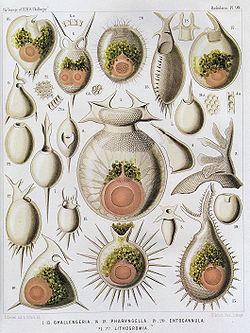
Picture of Radiolaria
- Source
- Wikipedia/Commons
- Credit
- nobody named on the record
- Licence
- Public Domain
- Commercial use
- the licence allows it
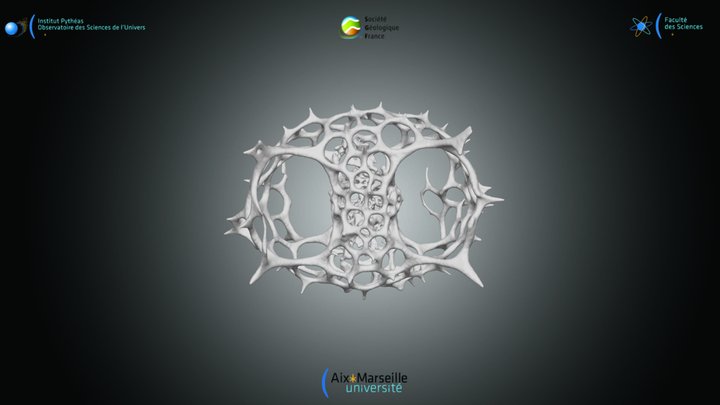
3D model
- Source
- Sketchfab
- Licence
- CC Attribution-NonCommercial-ShareAlike
- Commercial use
- the licence does not allow it
Smithsonian Open Access and MorphoSource were not reached for this taxon, so this list is what the others held rather than everything there is.
The description on this site
- Source
- Wikipedia, “Radiolaria”
- Licence
- CC BY-SA 4.0
This is what the site found, which is not the same as what exists.
Keep going
What may have been alongside itReticularea through timeThe world it lived on
Occurrence data from the Paleobiology Database, CC BY 4.0. (Müller 1858)