Raphictis
Raphictis is an extinct genus of placental mammals from extinct subfamily Didymictinae within extinct family Viverravidae, that lived in North America during late Paleocene.

M. Fox · CC0 · via Wikipedia/Commons. May be a photograph of a specimen, or an artist’s reconstruction — an interpretation of a skeleton, since colour and soft tissue are almost never preserved.
On record
Recorded, not inferred- Sits inside
- ViverravidaePBDB
- Diet
- carnivorePBDB, for Viverravidae
- Life habit
- ground dwellingPBDB, for Viverravidae
- Motility
- actively mobilePBDB, for Osteichthyes
- Environment
- terrestrialPBDB, for Eutheria
Time the record covers
At most 4.9 million years on record.
Every occurrence read is dated to somewhere between 60.9 Mya and 56 Mya, and nothing in the dating separates them, so that window is what the record shows rather than a span.
10 occurrences of Raphictis on record, most of them in the Paleocene. Bar height is expected occurrences, not a count: each fossil is spread across the span it is dated to, so a tall narrow bar means tight dating and a low wide one means loose.
When
10 occurrences- Paleocene100%
These are dates about fossils, not the animal: the record can only begin after it arose and end before it died out, so either end may reach further. Shares are expected occurrences: a fossil dated to a span is counted partly in each period it straddles. More on what this infers.
Found in
4 formations
Loading coastlines…
The named rock units Raphictis has been recovered from, largest first. Drawn where the rock is now, not where it formed.
Raphictis and its relatives
PaleoceneWhere Raphictis and its relatives were recorded in the Paleocene.
Found in the same rock
171 taxa- Ignacius frugivorus8 sites
- Bessoecetor septentrionalis6 sites
- Neoplagiaulax hazeni6 sites
- Thryptacodon australis6 sites
- Carpodaptes hazelae5 sites
- Ectocion cedrus5 sites
- Protictis paralus5 sites
- Ptilodus5 sites
- Ptilodus kummae5 sites
- Arctocyon acrogenius4 sites
- Ectypodus powelli4 sites
- Elpidophorus elegans4 sites
- Labidolemur soricoides4 sites
- Litocherus zygeus4 sites
- Neoplagiaulax hunteri4 sites
- Peradectes elegans4 sites
- Plesiadapis rex4 sites
- Adunator meizon3 sites
- Bessoecetor pilodontus3 sites
- Bisonalveus3 sites
- Chriacus oconostotae3 sites
- Cyriacotherium argyreum3 sites
- Elphidotarsius wightoni3 sites
- Leptacodon munusculum3 sites
The Paleobiology Database records 8 sites for Raphictis, and this reads all of them. The number is how many of those sites it was catalogued from too. The 24 sharing the most are listed.
This is not a list of everything alive at the time. It is only what has come out of the same ground as this animal and been written down.
Entered from
7 references- The succession of Paleocene mammals in western Canada3
- The Tiffanian Land-Mammal Age (middle and late Paleocene) in the northern Bighorn Basin, Wyoming2
- New late Paleocene (late middle Tiffanian) mammals from the Roche Percée local fauna, south-eastern Saskatchewan, Canada1
- Horolodectes sunae, an enigmatic mammal from the late Paleocene of Alberta, Canada1
- Paleocene mammals and faunal analysis of the Chappo Type Locality (Tiffanian), Green River Basin, Wyoming1
- Late Cretaceous and Paleocene mammal localities of southern Alberta1
- Systematics of Paleocene Viverravidae (Mammalia, Carnivora) in the Bighorn Basin and Clark's Fork Basin, Wyoming1
Each of the 10 occurrences read was entered from one of these publications, ordered by how many each accounts for. This is not a search for papers mentioning the name. Entries link to doi.org where the Paleobiology Database holds an identifier, and to its own record where it does not. Relayed as the Paleobiology Database holds them, not checked against what they resolve to.
Media and terms
Media content1
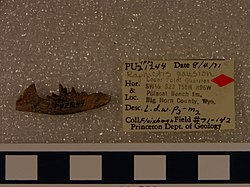
Picture of Raphictis
- Source
- Wikipedia/Commons
- Credit
- M. Fox
- Licence
- CC0
- Commercial use
- the licence allows it
No 3D scan of Raphictis was found in MorphoSource and Sketchfab.
Smithsonian Open Access was not reached for this taxon, so this list is what the others held rather than everything there is.
The description on this site
- Source
- Wikipedia, “Raphictis”
- Licence
- CC BY-SA 4.0
This is what the site found, which is not the same as what exists.
Keep going
What may have been alongside itViverravidae through timeFormations of the PaleoceneThe world it lived on
Occurrence data from the Paleobiology Database, CC BY 4.0. Gingerich and Winkler 1985