Raphidioptera
Snakeflies are a group of predatory insects comprising the order Raphidioptera, from Ancient Greek ῥαφίς (rhaphís), meaning "needle", and πτερόν (pterón), meaning "wing", with two extant families: Raphidiidae and Inocelliidae, consisting of roughly 260 species. In the past, the group had a much wider distribution than it does now; snakeflies are found in temperate regions worldwide but are absent from the tropics and the Southern Hemisphere. Recognizable representatives of the group first appeared during the Early Jurassic. They are a relict group, having reached their apex of diversity during the Cretaceous before undergoing substantial decline.

Beentree · CC BY-SA 3.0 · via Wikipedia/Commons. May be a photograph of a specimen, or an artist’s reconstruction — an interpretation of a skeleton, since colour and soft tissue are almost never preserved.
On record
Recorded, not inferred- Also called
- snakeflyPBDB
- Sits inside
- NeuropteridaPBDB
- Motility
- actively mobilePBDB, for Arthropoda
- Environment
- terrestrialPBDB, for Insecta
Time the record covers
At least 267 million years on record.
The record covers at least 274.4 Mya to 7.246 Mya. No occurrence read is dated outside 283.3 Mya to 5.09 Mya.
251 occurrences of Raphidioptera on record, most of them in the Early Cretaceous. The Paleobiology Database records this as a living group, and the chart stops with its fossils rather than at the present. Bar height is expected occurrences, not a count: each fossil is spread across the span it is dated to, so a tall narrow bar means tight dating and a low wide one means loose.
When
251 occurrences- Permian5%
- Early Jurassicunder 1%
- Middle Jurassic1%
- Late Jurassic6%
- Early Cretaceous57%
- Late Cretaceous12%
- Eocene14%
- Oligoceneunder 1%
- Miocene3%
- Plioceneunder 1%
These are dates about fossils, not the animal: the record can only begin after it arose and end before it died out, so either end may reach further. Shares are expected occurrences: a fossil dated to a span is counted partly in each period it straddles. More on what this infers.
Found in
42 formations
- Yixian Formation · Jehol Group40
- Zaza Formation39
- Florissant Formation14
- Crato Formation · Santana Group11
- Daohugou Formation9
- Karabastau Formation7
Loading coastlines…
The named rock units Raphidioptera has been recovered from, largest first. Drawn where the rock is now, not where it formed. 18 further formations hold fewer occurrences each and are not listed. 55 occurrences have no formation on record, which is common for older literature.
Raphidioptera and its relatives
Early CretaceousWhere Raphidioptera and its relatives were recorded in the Early Cretaceous.
Found in the same rock
4,317 taxa- Mesoraphidiidae7 sites
- Baissoptera martinsoni5 sites
- Anaxyelidae4 sites
- Aphaenogaster mayri4 sites
- Archeraphidia baisensis4 sites
- Archiinocellia protomaculata4 sites
- Aves4 sites
- Baissoptera grandis4 sites
- Coleoptera4 sites
- Coptoclava longipoda4 sites
- Cretanallachius magnificus4 sites
- Dolichoderus antiquus4 sites
- Liometopum miocenicum4 sites
- Lithoscarabaeus baissensis4 sites
- Miomyrmex impactus4 sites
- Neuroptera4 sites
- Okanagrion hobani4 sites
- Okanopteryx4 sites
- Protazteca elongata4 sites
- Psychopsidae4 sites
- Raphidiidae4 sites
- Vietocycla peregrina4 sites
- Adamsochrysa3 sites
- Alloraphidia asiatica3 sites
The Paleobiology Database records 117 sites for Raphidioptera, and this reads all of them. The number is how many of those sites it was catalogued from too. The 24 sharing the most are listed.
This is not a list of everything alive at the time. It is only what has come out of the same ground as this animal and been written down.
Entered from
85 references- Nizhnemelovye verblyudki Zabaykal'ya37
- The snakefly family Mesoraphidiidae (Insecta: Raphidioptera) from the Lower Cretaceous Yixian Formation, China: systematic revision and phylogenetic implications13
- A new and diverse paleofauna of the extinct snakefly family Baissopteridae from the mid-Cretaceous of Myanmar (Raphidioptera)11
- Studies on the late Mesozoic snake-flies of China (Raphidoiptera: Baissopteridae, Mesoraphidiidae, Alloraphidiidae)10
- Early Eocene snakeflies (Raphidioptera) of western North America from the Okanagan Highlands and Green River Formation9
- Novye Mezozojskie Nasekomye9
- Snakefly diversity in Early Cretaceous amber from Spain (Neuropterida, Raphidioptera)8
- Nouveaux Raphidioptères fossiles du Cénozoïque de France et d'Espagne7
- New genera and species of the minute snakeflies (Raphidioptera: Mesoraphidiidae: Nanoraphidiini) from the mid Cretaceous of Myanmar6
- Permian ancestors of Hymenoptera and Raphidioptera6
- A new discovery of snake-flies (Insecta) from Late Jurassic of Beipiao, Liaoning6
- Systematic revision of the fossil snakefly family Baissopteridae (Insecta: Raphidioptera) from the Lower Cretaceous of China, with description of a new genus and three new species5
Each of the 251 occurrences read was entered from one of these publications, ordered by how many each accounts for. This is not a search for papers mentioning the name. 73 further references are not listed. Entries link to doi.org where the Paleobiology Database holds an identifier, and to its own record where it does not. Relayed as the Paleobiology Database holds them, not checked against what they resolve to.
Media and terms
Media content1
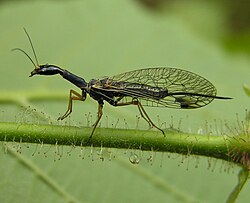
Picture of Raphidioptera
- Source
- Wikipedia/Commons
- Credit
- Beentree
- Licence
- CC BY-SA 3.0
- Commercial use
- the licence allows it
No 3D scan of Raphidioptera was found in Sketchfab.
Smithsonian Open Access and MorphoSource were not reached for this taxon, so this list is what the others held rather than everything there is.
The description on this site
- Source
- Wikipedia, “Snakefly”
- Licence
- CC BY-SA 4.0
This is what the site found, which is not the same as what exists.
Keep going
What may have been alongside itNeuropterida through timeFormations of the Early CretaceousThe world it lived on
Occurrence data from the Paleobiology Database, CC BY 4.0. (Handlirsch 1908)