Rattus norvegicus
The brown rat, also known as the common rat, street rat, sewer rat, wharf rat, Hanover rat, Norway rat and Norwegian rat, is a widespread, common species of rat. One of the largest muroids, it is a brown or grey rodent with a body length of up to 28 cm (11 in) long, and a tail slightly shorter than that. It weighs between 140 and 500 g. Thought to have originated in northern China and neighbouring areas, it has now spread to all continents except Antarctica, and is the dominant rat in Europe and much of North America, having become naturalised across the world. With rare exceptions, the brown rat lives wherever humans live, particularly in urban areas. It is omnivorous, reproduces rapidly, and can be a vector for several human diseases.

Dunpharlain · CC BY-SA 4.0 · via Wikipedia/Commons. May be a photograph of a specimen, or an artist’s reconstruction — an interpretation of a skeleton, since colour and soft tissue are almost never preserved.
On record
Recorded, not inferred- Also called
- brown ratPBDB
- Sits inside
- RattusPBDB
- Diet
- herbivore, insectivorePBDB, for Muridae
- Life habit
- ground dwellingPBDB, for Rattus
- Motility
- actively mobilePBDB, for Osteichthyes
- Environment
- terrestrialPBDB, for Eutheria
Time the record covers
At least 762 thousand years on record.
The record covers at least 774 ka to 11.7 ka. No occurrence read is dated outside 2.58 Mya to 0 Mya.
7 occurrences of Rattus norvegicus on record. The Paleobiology Database records this as a living group. Bar height is expected occurrences, not a count: each fossil is spread across the span it is dated to, so a tall narrow bar means tight dating and a low wide one means loose.
When
7 occurrences- Pleistocene43%
- Holocene57%
These are dates about fossils, not the animal: the record can only begin after it arose and end before it died out, so either end may reach further. Shares are expected occurrences: a fossil dated to a span is counted partly in each period it straddles. More on what this infers.
Found in the same rock
225 taxa- Crocidura4 sites
- Apus3 sites
- Sylviidae3 sites
- Apodemus2 sites
- Bufo2 sites
- Chalcomitra balfouri2 sites
- Chamaeleo monachus2 sites
- Chiropodomys2 sites
- Ditypophis vivax2 sites
- Emberiza2 sites
- Haemodracon riebeckii2 sites
- Haemodracon trachyrhinus2 sites
- Hipposideros2 sites
- Hypsugo lanzai2 sites
- Lanius excubitor2 sites
- Microtus2 sites
- Mus domesticus2 sites
- Oena capensis2 sites
- Oenanthe2 sites
- Passer insularis2 sites
- Passeriformes2 sites
- Rana2 sites
- Rhinolophus2 sites
- Rhinolophus clivosus2 sites
The Paleobiology Database records 7 sites for Rattus norvegicus, and this reads all of them. The number is how many of those sites it was catalogued from too. The 24 sharing the most are listed.
This is not a list of everything alive at the time. It is only what has come out of the same ground as this animal and been written down.
Entered from
6 references- Holocene vertebrate assemblages provide the first evidence for the presence of the barn owl (Tytonidae, Tyto alba) on Socotra Island (Yemen)2
- A newly discovered Gigantopithecus fauna from Sanhe Cave, Chongzuo, Guangxi, South China1
- Late Quaternary terrestrial vertebrates from Palawan Islad, Philippines1
- Quaternary fossil fauna of South Canterbury, South Island, New Zealand1
- I giacimenti Quaternari di vertebrati fossili nell'Italia Nord-Orientale1
- Quaternary vertebrates from Shiriya area, Shimokita Pininsula, northeastern Japan1
Each of the 7 occurrences read was entered from one of these publications, ordered by how many each accounts for. This is not a search for papers mentioning the name. Entries link to doi.org where the Paleobiology Database holds an identifier, and to its own record where it does not. Relayed as the Paleobiology Database holds them, not checked against what they resolve to.
Media and terms
Media content3

Picture of Rattus norvegicus
- Source
- Wikipedia/Commons
- Credit
- Dunpharlain
- Licence
- CC BY-SA 4.0
- Commercial use
- the licence allows it
CT scan
- Source
- MorphoSource
- Licence
- not stated by the source
- Commercial use
- cannot be read from the licence given — check the record
- Specimen
- Rattus norvegicus · hacb:RN2
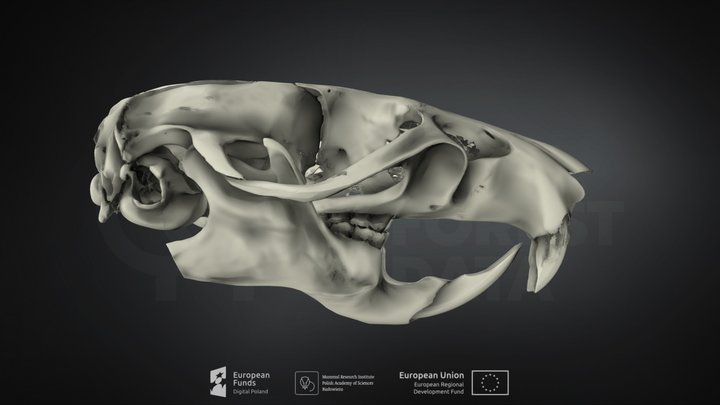
3D model
- Source
- Sketchfab
- Licence
- CC Attribution
- Commercial use
- cannot be read from the licence given — check the record
Smithsonian Open Access was not reached for this taxon, so this list is what the others held rather than everything there is.
The description on this site
- Source
- Wikipedia, “Brown rat”
- Licence
- CC BY-SA 4.0
This is what the site found, which is not the same as what exists.
Keep going
What may have been alongside itRattus through timeThe world it lived on
Occurrence data from the Paleobiology Database, CC BY 4.0. (Berkenhout 1769)