Requienia
Requienia is an extinct genus of fossil saltwater clam, a marine bivalve molluscs in the order Hippuritida, family Requieniidae. These rudists lived in the Cretaceous period, from the Valanginian age (136.4–140.2) to the Campanian age. They were stationary intermediate-level suspension feeders.

Hectonichus · CC BY-SA 3.0 · via Wikipedia/Commons. May be a photograph of a specimen, or an artist’s reconstruction — an interpretation of a skeleton, since colour and soft tissue are almost never preserved.
On record
Recorded, not inferred- Sits inside
- RequieniinaePBDB
- Diet
- suspension feederPBDB, for Hippuritida
- Life habit
- intermediate-level epifaunal, gregariousPBDB, for Hippuritida
- Motility
- stationary, attachedPBDB, for Hippuritida
- Vision
- blindPBDB, for Bivalvia
- Environment
- marinePBDB, for Hippuritida
Time the record covers
At least 70 million years on record.
The record covers at least 143.1 Mya to 72.2 Mya. No occurrence read is dated outside 154.8 Mya to 66 Mya.
34 occurrences of Requienia on record, most of them in the Early Cretaceous. Bar height is expected occurrences, not a count: each fossil is spread across the span it is dated to, so a tall narrow bar means tight dating and a low wide one means loose.
When
34 occurrencesThese are dates about fossils, not the animal: the record can only begin after it arose and end before it died out, so either end may reach further. Shares are expected occurrences: a fossil dated to a span is counted partly in each period it straddles. More on what this infers.
Found in
13 formations
- Trieste Karst Limestone Formation3
- Schrattenkalk Formation2
- Aqra Limestone Formation1
- Al Hassanat Formation1
- Cengellidere Formation1
- "Kanfanar" Formation1
Loading coastlines…
The named rock units Requienia has been recovered from, largest first. Drawn where the rock is now, not where it formed. 18 occurrences have no formation on record, which is common for older literature.
Requienia and its relatives
Early CretaceousWhere Requienia and its relatives were recorded in the Early Cretaceous.
Found in the same rock
324 taxa- Toucasia13 sites
- Monopleura8 sites
- Palorbitolina6 sites
- Agriopleura5 sites
- Bacinella irregularis4 sites
- Horiopleura4 sites
- Matheronia4 sites
- Nerinea4 sites
- Polystrata alba4 sites
- Sabaudia4 sites
- Salpingoporella4 sites
- Trocholina4 sites
- Chaetetopsis3 sites
- Choffatella decipiens3 sites
- Lithophaga3 sites
- Microsolena3 sites
- Miliolidae3 sites
- Nautiloculina3 sites
- Neithea3 sites
- Neotrocholina3 sites
- Orbitolina3 sites
- Orbitolinopsis3 sites
- Pachytraga3 sites
- Praeorbitolina3 sites
The Paleobiology Database records 27 sites for Requienia, and this reads all of them. The number is how many of those sites it was catalogued from too. The 24 sharing the most are listed.
This is not a list of everything alive at the time. It is only what has come out of the same ground as this animal and been written down.
Entered from
23 references- Lower Cretaceous Rudist faunas of Southeast Spain: an overview4
- Remarks on the morphological variability of Biradiolites angulosus D'Orbigny in a sector of the Trieste Karst (Italy)3
- Rudists of Mexico: Historical Aspects and Selected Areas of Research2
- Diptyxis Oppenheim (Nerineacea, Gastropoda) from the Lower Cretaceous of Albania. On the distribution of the genus Diptyxis2
- Bioherme und Biostrome im Allgäuer Schrattenkalk (Helvetikum, Unterkreide).2
- Les constructions a cnidaires des calcaires urgoniens (Barremien) de Provence, et leur environnement [Constructions of Cnidaria from the Urgonian Limestones (Barremian) from Provence, and their environment]2
- L'Urgonien de la partie mediane des Carpatho-Balkanides Yougoslaves (Serbie Orientale) [The Urgonian of the middle part of the Yugoslavian Carpatho-Balkanid area (East Serbia)]2
- Recherches géologiques sur le Crétacé inférieur de l'Estremadura (Portugal)2
- An Early Cretaceous mesophotic coral ecosystem built by platy corals (middle Aptian, Southern Carpathians, Romania)1
- Debrunia, a new Barremian genus of petalodontid Monopleuridae (Bivalvia, Hippuritoidea) from the Mediterranean region1
- Lower Aptian rudist faunas (Bivalvia, Hippuritoidea) from Croatia1
- Late Aprian rudist faunas from the Zonguldak region, western Black Sea, Turkey (taxonomy, biostratigraphy, palaeoenvironment and palaeobiogeography)1
Each of the 34 occurrences read was entered from one of these publications, ordered by how many each accounts for. This is not a search for papers mentioning the name. 11 further references are not listed. Entries link to doi.org where the Paleobiology Database holds an identifier, and to its own record where it does not. Relayed as the Paleobiology Database holds them, not checked against what they resolve to.
Media and terms
Media content2

Picture of Requienia
- Source
- Wikipedia/Commons
- Credit
- Hectonichus
- Licence
- CC BY-SA 3.0
- Commercial use
- the licence allows it
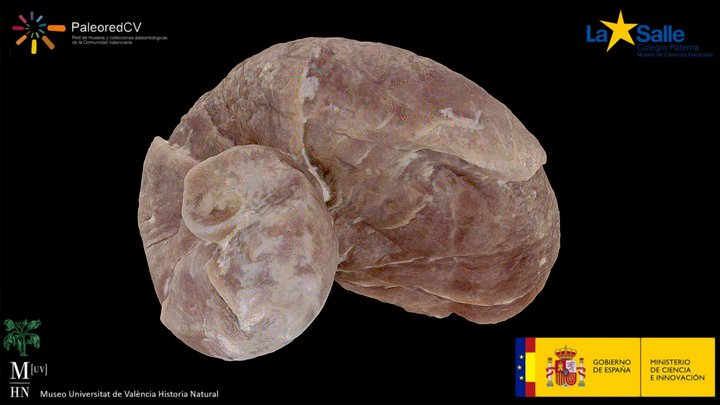
3D model
- Source
- Sketchfab
- Licence
- CC Attribution
- Commercial use
- cannot be read from the licence given — check the record
The description on this site
- Licence
- CC BY-SA 4.0
This is what the site found, which is not the same as what exists.
Keep going
What may have been alongside itRequieniinae through timeFormations of the Early CretaceousThe world it lived on
Occurrence data from the Paleobiology Database, CC BY 4.0. Matheron 1842