Ringicula (Ringicula) pinguis
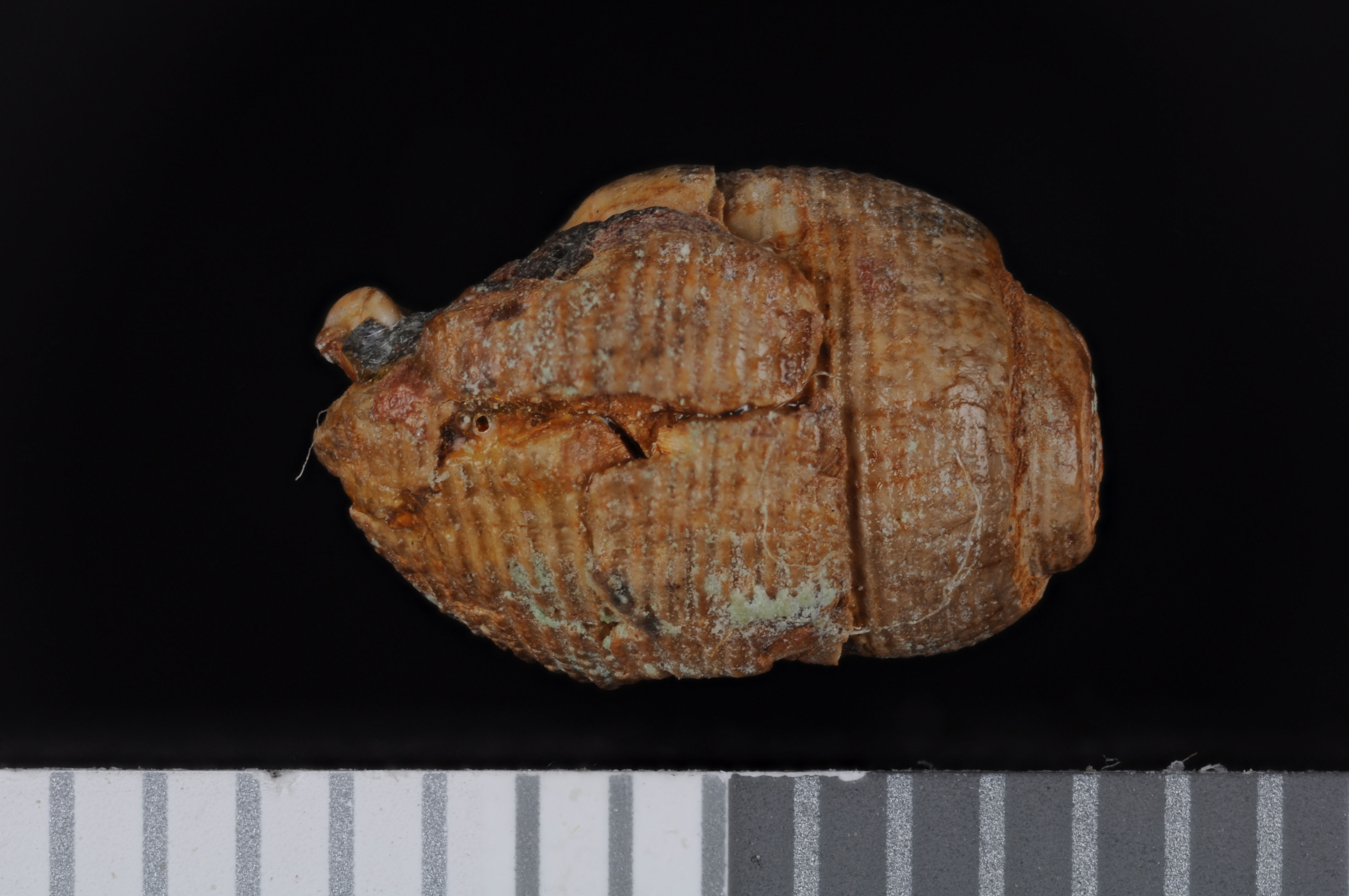
Not Ringicula (Ringicula) pinguis. This is Ringicula pinguis (Gabb, 1864), a relative — both are Acteonidae.
via GBIF · CC BY-NC 4.0 · via GBIF. May be a photograph of a specimen, or an artist’s reconstruction — an interpretation of a skeleton, since colour and soft tissue are almost never preserved.
On record
Recorded, not inferred- Sits inside
- Ringicula (Ringicula)PBDB
- Diet
- carnivorePBDB, for Ringicula
- Life habit
- epifaunalPBDB, for Ringiculidae
- Motility
- actively mobilePBDB, for Ringiculidae
- Vision
- limitedPBDB, for Gastropoda
Time the record covers
At least 29 million years on record.
The record covers at least 85.7 Mya to 56 Mya. No occurrence read is dated outside 89.8 Mya to 48.07 Mya.
24 occurrences of Ringicula (Ringicula) pinguis on record, most of them in the Paleocene. Bar height is expected occurrences, not a count: each fossil is spread across the span it is dated to, so a tall narrow bar means tight dating and a low wide one means loose.
When
24 occurrencesThese are dates about fossils, not the animal: the record can only begin after it arose and end before it died out, so either end may reach further. Shares are expected occurrences: a fossil dated to a span is counted partly in each period it straddles. More on what this infers.
Found in
7 formations
- Santa Susana Formation9
- Martinez Formation5
- Lodo Formation3
- San Francisquito Formation2
- Laguna Seca Formation1
- Calcaire de Mons Formation1
Loading coastlines…
The named rock units Ringicula (Ringicula) pinguis has been recovered from, largest first. Drawn where the rock is now, not where it formed. 2 occurrences have no formation on record, which is common for older literature.
Ringicula (Ringicula) pinguis and its relatives
PaleoceneWhere Ringicula (Ringicula) pinguis and its relatives were recorded in the Paleocene.
Found in the same rock
482 taxa- Cucullaea mathewsonii13 sites
- Turritella infragranulata pachecoensis10 sites
- Dentalium cooperi9 sites
- Polinices hornii8 sites
- Brachysphingus sinuatus7 sites
- Nemocardium (Nemocardium) linteum7 sites
- Nuculana (Saccella) gabbii7 sites
- Tellina (Saulella) undulifera7 sites
- Crassatella6 sites
- Surcula merriami6 sites
- Glycimeris major5 sites
- Glycymerita major5 sites
- Lacunaria striata5 sites
- Polinices susanaensis5 sites
- Scaphander (Mirascapha) costatus5 sites
- Sycum mucronatum5 sites
- Urosyca caudata5 sites
- Calyptraea diegoana4 sites
- Crassatella unioides4 sites
- Dentalium4 sites
- Flabellum cuneiforme4 sites
- Gastropoda4 sites
- Meretrix stantoni4 sites
- Mesalia martinezensis4 sites
The Paleobiology Database records 24 sites for Ringicula (Ringicula) pinguis, and this reads all of them. The number is how many of those sites it was catalogued from too. The 24 sharing the most are listed.
This is not a list of everything alive at the time. It is only what has come out of the same ground as this animal and been written down.
Entered from
8 references- A contribution to the paleontology of the Martinez Eocene of California8
- Fauna of the Martinez Eocene of California6
- Age, Correlation and Possible Tethyan Affinities of Mollusks from the Lodo Formation of Fresno County, California4
- Stratigraphy and Sedimentology of the San Francisquito Formation, Transverse Ranges, California2
- Upper Paleocene to Lower Eocene ("Meganos Stage") Marine Megafossils in the Uppermost Santa Susana Formation, Simi Valley, Southern California1
- Revision des Gastropoda du Danien et du Montien de la Belgique. I, Les Gastropoda du Calcaire de Mons1
- The Martinez and Tejon Eocene and associated formations of the Santa Ana Mountains1
- Description of the Cretaceous fossils1
Each of the 24 occurrences read was entered from one of these publications, ordered by how many each accounts for. This is not a search for papers mentioning the name. Entries link to doi.org where the Paleobiology Database holds an identifier, and to its own record where it does not. Relayed as the Paleobiology Database holds them, not checked against what they resolve to.
Media and terms
Media content1
Picture of Ringicula pinguis (Gabb, 1864)
- Source
- GBIF
- Credit
- via GBIF
- Licence
- CC BY-NC 4.0
- Commercial use
- the licence does not allow it
No 3D scan was found. Smithsonian Open Access, MorphoSource and Sketchfab were all searched.
This is what the site found, which is not the same as what exists.
Keep going
What may have been alongside itRingicula (Ringicula) through timeFormations of the PaleoceneThe world it lived on
Occurrence data from the Paleobiology Database, CC BY 4.0. (Gabb 1864)