Rotaliida
The Rotaliida are an order of Foraminifera, characterized by multilocular tests (shells) composed of bilamellar perforate hyaline lamellar calcite that may be optically radial or granular.

Hans Hillewaert · CC BY-SA 4.0 · via Wikipedia/Commons. May be a photograph of a specimen, or an artist’s reconstruction — an interpretation of a skeleton, since colour and soft tissue are almost never preserved.
On record
Recorded, not inferred- Sits inside
- GlobothalameaPBDB
- Diet
- omnivorePBDB, for Foraminifera
- Life habit
- semi-infaunalPBDB, for Foraminifera
- Motility
- stationaryPBDB, for Foraminifera
Time the record covers
At least 236 million years on record.
The record covers at least 237 Mya to 11.7 ka. No occurrence read is dated outside 241.464 Mya to 0 Mya.
12,000+ occurrences of Rotaliida on record. The Paleobiology Database records this as a living group. Bar height is expected occurrences, not a count: each fossil is spread across the span it is dated to, so a tall narrow bar means tight dating and a low wide one means loose.
When
12,000 occurrences read- Middle Triassicunder 1%
- Early Jurassicunder 1%
- Middle Jurassicunder 1%
- Late Jurassicunder 1%
- Early Cretaceous2%
- Late Cretaceous41%
- Paleocene14%
- Eocene9%
- Oligocene3%
- Miocene13%
- Pliocene5%
- Pleistocene13%
- Holoceneunder 1%
These are dates about fossils, not the animal: the record can only begin after it arose and end before it died out, so either end may reach further. Shares are expected occurrences: a fossil dated to a span is counted partly in each period it straddles. The read hit its cap, so every figure above is a floor and the shares are of the occurrences read. More on what this infers.
Found in
at least 280 formations
- El Haria Formation2,987
- Dakhla Formation1,223
- Plenus Marl Formation173
- White Chalk Formation170
- Corsicana Formation160
- Lindi Formation · Kilwa Group74
Loading coastlines…
The named rock units Rotaliida has been recovered from, largest first. Drawn where the rock is now, not where it formed. The read hit its cap, so each count is a floor. 256 further formations hold fewer occurrences each and are not listed. 5,498 occurrences have no formation on record, which is common for older literature.
Found in the same rock
2,147 taxa- Guembelitria cretacea60 sites
- Heterohelix globulosa56 sites
- Lenticulina56 sites
- Dentalina53 sites
- Pseudoguembelina costulata49 sites
- Heterohelix navarroensis48 sites
- Heterohelix dentata46 sites
- Heterohelix44 sites
- Anomalinoides43 sites
- Gyroidinoides43 sites
- Saracenaria43 sites
- Rugoglobigerina rugosa42 sites
- Cibicidoides41 sites
- Muricohedbergella monmouthensis41 sites
- Osangularia41 sites
- Gyroidina40 sites
- Anomalinoides acuta39 sites
- Coryphostoma39 sites
- Gaudryina39 sites
- Praebulimina39 sites
- Rugoglobigerina39 sites
- Rugoglobigerina macrocephala39 sites
- Anomalinoides welleri38 sites
- Gyroidinoides subangulata38 sites
The Paleobiology Database records at least 224 sites for Rotaliida, and this reads 224 of them. The number is how many of those sites it was catalogued from too. The 24 sharing the most are listed.
This is not a list of everything alive at the time. It is only what has come out of the same ground as this animal and been written down.
Entered from
at least 443 references- Guembelitria-dominated late Maastrichtian planktic foraminiferal assemblages mimic early Danian in central Egypt1,163
- Paleoecology of the Cretaceous-Tertiary mass extinction in planktonic foraminifera995
- The Cretaceous/Tertiary boundary stratotype section at El Kef, Tunisia: how catastrophic was the mass extinction?757
- The Late Campian and Maastrichtian in northwestern Tunisia: palaeoenvironmental inferences from lithology, macrofauna and benthic formainifera749
- High stress late Maastrichtian paleoenvironment: inference from planktonic foraminifera in Tunisia486
- Site U1508407
- Die Fauna des marinen Miozäns von Kevelaer (Niederrhein). Band 1 Foraminiferen, Anthozoen.396
- Palaeoenvironment of the Cenomanian-Turonian transition at Eastbourne, England382
- Site U1482277
- Site U1513240
- Site U1427224
- Neogene benthic foraminifera of the Hatton-Rockall Basin214
Each of the 12,000 occurrences read was entered from one of these publications, ordered by how many each accounts for. This is not a search for papers mentioning the name. That read hit its cap, so each count is a floor. 431 further references are not listed. Entries link to doi.org where the Paleobiology Database holds an identifier, and to its own record where it does not. Relayed as the Paleobiology Database holds them, not checked against what they resolve to.
Media and terms
Media content1
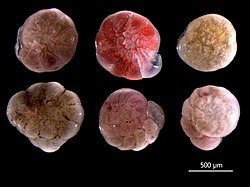
Picture of Rotaliida
- Source
- Wikipedia/Commons
- Credit
- Hans Hillewaert
- Licence
- CC BY-SA 4.0
- Commercial use
- the licence allows it
No 3D scan of Rotaliida was found in Sketchfab.
Smithsonian Open Access and MorphoSource were not reached for this taxon, so this list is what the others held rather than everything there is.
The description on this site
- Source
- Wikipedia, “Rotaliida”
- Licence
- CC BY-SA 4.0
This is what the site found, which is not the same as what exists.
Keep going
What may have been alongside itGlobothalamea through timeThe world it lived on
Occurrence data from the Paleobiology Database, CC BY 4.0. Delage and Herouard 1896