Schmidtites celatus
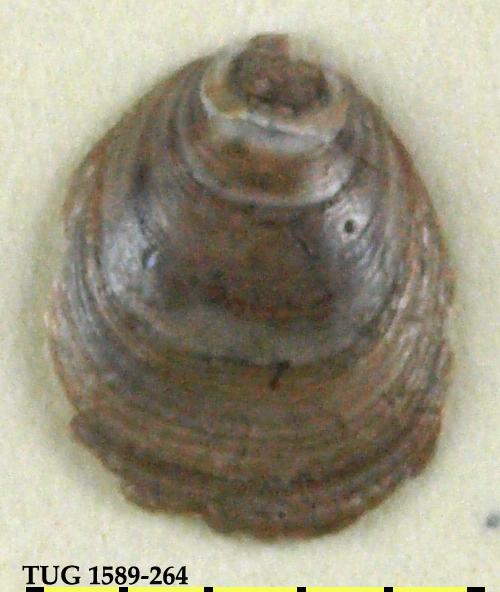
Öpik, Armin · CC BY-NC 4.0 · via GBIF. May be a photograph of a specimen, or an artist’s reconstruction — an interpretation of a skeleton, since colour and soft tissue are almost never preserved.
On record
Recorded, not inferred- Sits inside
- SchmidtitesPBDB
- Diet
- suspension feederPBDB, for Obolidae
- Life habit
- low-level epifaunalPBDB, for Obolidae
- Motility
- stationary, attachedPBDB, for Obolidae
- Vision
- blindPBDB, for Lingulata
- Environment
- marinePBDB, for Lophophorata
Time the record covers
At least 3 million years on record.
The record covers at least 486.85 Mya to 483.8 Mya. No occurrence read is dated outside 538.8 Mya to 477.1 Mya.
23 occurrences of Schmidtites celatus on record. Bar height is expected occurrences, not a count: each fossil is spread across the span it is dated to, so a tall narrow bar means tight dating and a low wide one means loose.
When
23 occurrences- Cambrian63%
- Ordovician37%
These are dates about fossils, not the animal: the record can only begin after it arose and end before it died out, so either end may reach further. Shares are expected occurrences: a fossil dated to a span is counted partly in each period it straddles. More on what this infers.
Found in
4 formations
Loading coastlines…
The named rock units Schmidtites celatus has been recovered from, largest first. Drawn where the rock is now, not where it formed. 15 occurrences have no formation on record, which is common for older literature.
Found in the same rock
25 taxa- Ungula ingrica19 sites
- Keyserlingia buchii13 sites
- Oepikites obtusus13 sites
- Marcusodictyon priscum3 sites
- Cordylodus2 sites
- Cordylodus angulatus2 sites
- Cordylodus rotundatus2 sites
- Oepikites2 sites
- Paroistodus2 sites
- Ungula convexa2 sites
- Westergaardodina bicuspidata2 sites
- Cordylodus intermedius1 site
- Drepanoistodus deltifer1 site
- Eoconodontus notchpeakensis1 site
- Furnishina1 site
- Iapetognathus1 site
- Keyserlingia reversa1 site
- Obolus1 site
- Obolus eichwaldi1 site
- Paterinidae1 site
- Pomeraniotreta1 site
- Prooneotodus gallatini1 site
- Quadrisonia1 site
- Rhabdinopora1 site
The Paleobiology Database records 23 sites for Schmidtites celatus, and this reads all of them. The number is how many of those sites it was catalogued from too. The 24 sharing the most are listed.
This is not a list of everything alive at the time. It is only what has come out of the same ground as this animal and been written down.
Entered from
4 references- Upper Cambrian Biostratigraphy of Estonia13
- Lingulate brachiopods from the Cambrian-Ordovician boundary beds in Sweden7
- The acrotretacean brachiopod Ceratreta tanneri (Metzger) from the Upper Cambrian of Baltoscandia2
- Legend of the Central European series of sheets of the State Geological Map of the Russian Federation, scale 1:1,000,000 (third generation)1
Each of the 23 occurrences read was entered from one of these publications, ordered by how many each accounts for. This is not a search for papers mentioning the name. Entries link to doi.org where the Paleobiology Database holds an identifier, and to its own record where it does not. Relayed as the Paleobiology Database holds them, not checked against what they resolve to.
Media and terms
Media content1
Picture of Schmidtites celatus
- Source
- GBIF
- Credit
- Öpik, Armin
- Licence
- CC BY-NC 4.0
- Commercial use
- the licence does not allow it
No 3D scan of Schmidtites celatus was found in Sketchfab.
Smithsonian Open Access and MorphoSource were not reached for this taxon, so this list is what the others held rather than everything there is.
This is what the site found, which is not the same as what exists.
Keep going
What may have been alongside itSchmidtites through timeThe world it lived on
Occurrence data from the Paleobiology Database, CC BY 4.0. (Volborth 1869)