Septifer
Septifer is a genus of saltwater clams, marine bivalve molluscs in the subfamily Septiferinae of the family Mytilidae, the mussels.

Philippe Bourjon · CC BY-SA 4.0 · via Wikipedia/Commons. May be a photograph of a specimen, or an artist’s reconstruction — an interpretation of a skeleton, since colour and soft tissue are almost never preserved.
On record
Recorded, not inferred- Sits inside
- MytilinaePBDB
- Diet
- suspension feederPBDB
- Life habit
- epifaunalPBDB
- Motility
- stationary, attachedPBDB
- Vision
- blindPBDB, for Bivalvia
- Environment
- lagoonal,coastal,inner shelf,outer shelf,oceanic,brackish,freshwaterPBDB, for Mytilidae
Time the record covers
At least 241 million years on record.
The record covers at least 241.464 Mya to 11.7 ka. No occurrence read is dated outside 247 Mya to 0 Mya.
193 occurrences of Septifer on record, most of them in the Pleistocene. The Paleobiology Database records this as a living group. Bar height is expected occurrences, not a count: each fossil is spread across the span it is dated to, so a tall narrow bar means tight dating and a low wide one means loose.
When
193 occurrences- Middle Triassic1%
- Late Jurassicunder 1%
- Early Cretaceous5%
- Late Cretaceous33%
- Paleocene2%
- Eocene9%
- Oligocene4%
- Miocene11%
- Pliocene1%
- Pleistocene33%
- Holocene1%
These are dates about fossils, not the animal: the record can only begin after it arose and end before it died out, so either end may reach further. Shares are expected occurrences: a fossil dated to a span is counted partly in each period it straddles. More on what this infers.
Found in
54 formations
- Moreno Formation · Great Valley Group27
- Waimanalo Formation12
- Roca Formation · Malargüe Group7
- Jagüel Formation · Malargüe Group7
- Maéjima Formation6
- opoka Formation4
Loading coastlines…
The named rock units Septifer has been recovered from, largest first. Drawn where the rock is now, not where it formed. 30 further formations hold fewer occurrences each and are not listed. 59 occurrences have no formation on record, which is common for older literature.
Septifer and its relatives
PleistoceneWhere Septifer and its relatives were recorded in the Pleistocene.
Found in the same rock
2,553 taxa- Anomia21 sites
- Californiconus californicus20 sites
- Callianax biplicata20 sites
- Leukoma staminea20 sites
- Epilucina californica19 sites
- Fissurella volcano19 sites
- Spondylus19 sites
- Thylacodes squamigerus19 sites
- Chlorostoma funebrale18 sites
- Littorina (Littorina) scutulata18 sites
- Lottia insessa18 sites
- Glans carpenteri17 sites
- Mexacanthina lugubris16 sites
- Mytilus californianus16 sites
- Diodora aspera15 sites
- Lottia limatula15 sites
- Modiolus15 sites
- Glycymerita veatchii14 sites
- Haliotis cracherodii14 sites
- Hipponix tumens14 sites
- Homalopoma (Homalopoma) luridum14 sites
- Lottia scabra14 sites
- Polinices14 sites
- Turritella chaneyi14 sites
The Paleobiology Database records 135 sites for Septifer, and this reads all of them. Of that, one read hit the database's own return limit, so every count below is a floor rather than a total. The number is how many of those sites it was catalogued from too. The 24 sharing the most are listed.
This is not a list of everything alive at the time. It is only what has come out of the same ground as this animal and been written down.
Entered from
77 references- Map and checklists of Jurassic and Cretaceous macrofossil localities within the San Jose 1:100,000 Quadrangle, California, and discussion of paleontological results27
- Late Maastrichtian-Danian Mytilids and Pinnids (Mollusca: Bivalvia) from Northern Patagonia, Argentina14
- Fossil mollusks of Oahu, Hawaii Islands12
- Stratigraphy and fossil bivalve assemblages of the mid-Cretaceous Goshoura Group, southwest Japan9
- Unpublished data on Cretaceous-Paleocene molluscan assemblages9
- Molluscan fauna of the "Miocene" Maéjima Formation in Maéjima Island, Okayama Prefecture, southwest Japan6
- Paleontology of the Pleistocene of Point Loma, San Diego County, California6
- Biostratigraphie et paleoecologie des gisements types du Stampian de la region d''Etampes (Essonne)5
- Late Pleistocene molluscan faunas from upper terraces of the Palos Verdes Hills, California5
- Late Pleistocene faunas from the northwestern coast of Baja California, Mexico5
- Maastrichtian non-cephalopod mollusks: Scaphopoda, Gastropoda and Bivalvia of the Middle Vistula Valley, central Poland4
- Geology of San Nicolas Island, California4
Each of the 193 occurrences read was entered from one of these publications, ordered by how many each accounts for. This is not a search for papers mentioning the name. 65 further references are not listed. Entries link to doi.org where the Paleobiology Database holds an identifier, and to its own record where it does not. Relayed as the Paleobiology Database holds them, not checked against what they resolve to.
Media and terms
Media content3

Picture of Septifer
- Source
- Wikipedia/Commons
- Credit
- Philippe Bourjon
- Licence
- CC BY-SA 4.0
- Commercial use
- the licence allows it
CT scan
- Source
- MorphoSource
- Licence
- not stated by the source
- Commercial use
- cannot be read from the licence given — check the record
- Specimen
- Septifer bilocularis · usnm:invertebrate zoology:661579
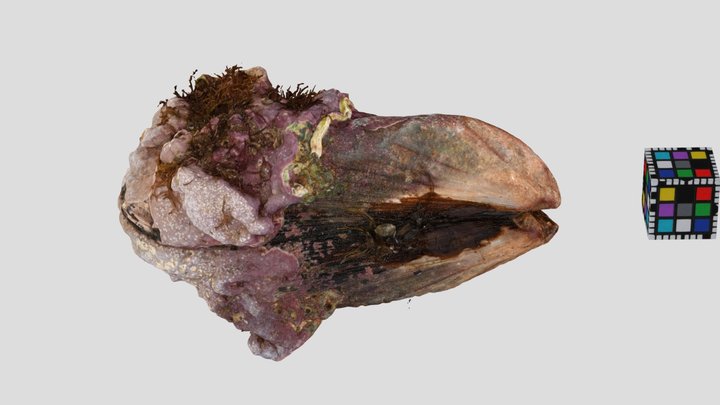
3D model
- Source
- Sketchfab
- Licence
- CC0 Public Domain
- Commercial use
- the licence allows it
The description on this site
- Source
- Wikipedia, “Septifer”
- Licence
- CC BY-SA 4.0
This is what the site found, which is not the same as what exists.
Keep going
Everything alive alongside itMytilinae through timeFormations of the PleistoceneThe world it lived on
Occurrence data from the Paleobiology Database, CC BY 4.0. (Récluz 1848)