Siderastrea conferta
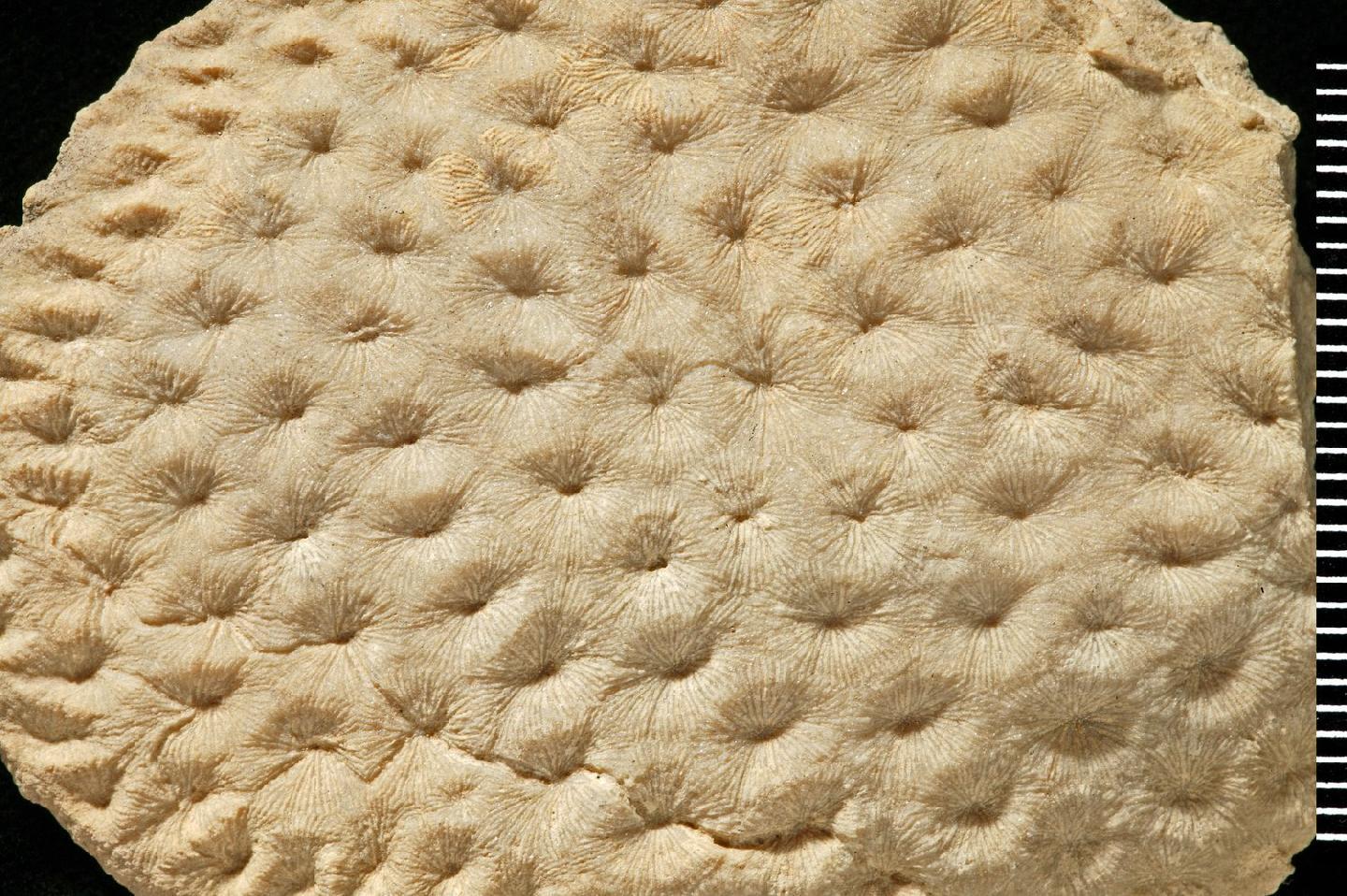
via iDigBio · CC BY · via iDigBio. May be a photograph of a specimen, or an artist’s reconstruction — an interpretation of a skeleton, since colour and soft tissue are almost never preserved.
On record
Recorded, not inferred- Sits inside
- SiderastreaPBDB
- Diet
- photosymbiotic, suspension feederPBDB, for Siderastreidae
- Life habit
- colonial, clonalPBDB, for Siderastreidae
- Motility
- stationary, attachedPBDB, for Scleractinia
- Vision
- blindPBDB, for Anthozoa
- Environment
- marinePBDB, for Scleractinia
Time the record covers
At least 35 million years on record.
The record covers at least 56 Mya to 20.45 Mya. No occurrence read is dated outside 66 Mya to 5.333 Mya.
25 occurrences of Siderastrea conferta on record, most of them in the Miocene. Bar height is expected occurrences, not a count: each fossil is spread across the span it is dated to, so a tall narrow bar means tight dating and a low wide one means loose.
When
25 occurrencesThese are dates about fossils, not the animal: the record can only begin after it arose and end before it died out, so either end may reach further. Shares are expected occurrences: a fossil dated to a span is counted partly in each period it straddles. More on what this infers.
Found in
12 formations
- Anguilla Formation6
- Culebra Formation4
- Antigua Formation3
- Moneague Formation · White Limestone Group2
- San Andres Formation2
- La Quinta Formation1
Loading coastlines…
The named rock units Siderastrea conferta has been recovered from, largest first. Drawn where the rock is now, not where it formed. 1 occurrence has no formation on record, which is common for older literature.
Siderastrea conferta and its relatives
MioceneWhere Siderastrea conferta and its relatives were recorded in the Miocene.
Found in the same rock
122 taxa- Montastraea endothecata13 sites
- Porites baracoaensis10 sites
- Porites macdonaldi9 sites
- Porites waylandi9 sites
- Montastrea imperatoris8 sites
- Porites portoricensis8 sites
- Goniopora imperatoris7 sites
- Acropora saludensis6 sites
- Leptoseris anguillensis6 sites
- Stylophora imperatoris6 sites
- Goniopora hilli5 sites
- Montastraea5 sites
- Pocillopora arnoldi5 sites
- Porites anguillensis5 sites
- Porites douvillei5 sites
- Acropora panamensis4 sites
- Agathiphyllia hilli4 sites
- Leptoseris walli4 sites
- Montastrea costata4 sites
- Montastrea endothecata4 sites
- Mycetophyllia bullbrooki4 sites
- Actinacis barretti3 sites
- Antiguastrea cellulosa3 sites
- Astreopora goethalsi3 sites
The Paleobiology Database records 14 sites for Siderastrea conferta, and this reads all of them. The number is how many of those sites it was catalogued from too. The 24 sharing the most are listed.
This is not a list of everything alive at the time. It is only what has come out of the same ground as this animal and been written down.
Entered from
9 references- Fossil corals from central America, Cuba, and Porto Rico, with an account of the American Tertiary, Pleistocene, and Recent coral reefs6
- The Oligocene-Miocene Transition on Coral Reefs in the Falcon Basin (NM Venezuela)3
- The Emperador Limestone rediscovered: early miocene corals from the Culebra Formation, Panama3
- Caribbean reef coral diversity during the Early to Middle Miocene: an Example from the Anguilla Formation3
- Cenozoic Reef Biofacies3
- Reef-coral diversity in the Late Oligocene Antigua Formation and temporal variation of local diversity on Caribbean Cenozoic Reefs2
- Reef corals of the White Limestone Group of Jamaica2
- Riffbau und geologische Entwicklungsgeschichte der Insel San Andres (westliches Karibisches Meer, Kolumbien) [Reef building and geological evolution of San Andres Island (western Caribbean Sea, Colombia)]2
- The Eocene and lower Oligocene coral faunas of the United States with descriptions of a few doubtfully Cretaceous species1
Each of the 25 occurrences read was entered from one of these publications, ordered by how many each accounts for. This is not a search for papers mentioning the name. Entries link to doi.org where the Paleobiology Database holds an identifier, and to its own record where it does not. Relayed as the Paleobiology Database holds them, not checked against what they resolve to.
Media and terms
Media content1
Picture of Siderastrea conferta
- Source
- iDigBio
- Credit
- via iDigBio
- Licence
- CC BY
- Commercial use
- the licence allows it
No 3D scan was found. Smithsonian Open Access, MorphoSource and Sketchfab were all searched.
This is what the site found, which is not the same as what exists.
Keep going
What may have been alongside itSiderastrea through timeFormations of the MioceneThe world it lived on
Occurrence data from the Paleobiology Database, CC BY 4.0. (Duncan 1863)