Spumellaria
Spumellaria is an order of radiolarians in the class Polycystinea. They are ameboid protists appearing in abundance in the world's oceans, possessing a radially-symmetrical silica (opal) skeleton that has ensured their preservation in fossil records. They are holoplanktonic, meaning they spend their whole lives classified as plankton. Spumellaria are globally distributed and a big part of our ocean’s silica biogeochemical cycle. Before diatoms, they were the main contributors to siliceous ocean sediments. They belong among the oldest Polycystine organisms, dating back to the lower Cambrian. Their skeletons are easily preserved and therefore are frequently used as tools in paleo-environmental reconstruction studies.

Picturepest · CC BY 2.0 · via Wikipedia/Commons. May be a photograph of a specimen, or an artist’s reconstruction — an interpretation of a skeleton, since colour and soft tissue are almost never preserved.
On record
Recorded, not inferred- Sits inside
- PolycystineaPBDB
Time the record covers
At least 468 million years on record.
The record covers at least 473.8 Mya to 5.333 Mya. No occurrence read is dated outside 486.85 Mya to 3.6 Mya.
12,000+ occurrences of Spumellaria on record. The Paleobiology Database records this as a living group, and the chart stops with its fossils rather than at the present. Bar height is expected occurrences, not a count: each fossil is spread across the span it is dated to, so a tall narrow bar means tight dating and a low wide one means loose.
When
12,000 occurrences read- Ordovicianunder 1%
- Silurianunder 1%
- Carboniferousunder 1%
- Permian1%
- Early Triassicunder 1%
- Middle Triassic2%
- Late Triassic17%
- Early Jurassic14%
- Middle Jurassic12%
- Late Jurassic22%
- Early Cretaceous25%
- Late Cretaceous6%
- Paleoceneunder 1%
- Eoceneunder 1%
- Mioceneunder 1%
- Plioceneunder 1%
These are dates about fossils, not the animal: the record can only begin after it arose and end before it died out, so either end may reach further. Shares are expected occurrences: a fossil dated to a span is counted partly in each period it straddles. The read hit its cap, so every figure above is a floor and the shares are of the occurrences read. More on what this infers.
Found in
at least 111 formations
- Maiolica Formation2,142
- Sandilands Formation · Kunga Group1,742
- Rail Cabin Argillite Formation670
- Taman Formation548
- Ameghino Formation535
- Oberalmer Schichten Formation449
Loading coastlines…
The named rock units Spumellaria has been recovered from, largest first. Drawn where the rock is now, not where it formed. The read hit its cap, so each count is a floor. 87 further formations hold fewer occurrences each and are not listed. 1,749 occurrences have no formation on record, which is common for older literature.
Found in the same rock
999 taxa- Paronaella37 sites
- Pseudoeucyrtis36 sites
- Gorgansium31 sites
- Orbiculiforma29 sites
- Pantanellium29 sites
- Praeparvicingula25 sites
- Tethysetta boesii25 sites
- Parvicingula24 sites
- Stichomitra24 sites
- Acastea diaphorogona22 sites
- Emiluvia pessagnoi22 sites
- Hsuum22 sites
- Windalia22 sites
- Zhamoidellum22 sites
- Napora bukryi21 sites
- Praeconocaryomma21 sites
- Spongiomma21 sites
- Tritrabs casmaliaensis21 sites
- Napora20 sites
- Sethocapsa leiostraca19 sites
- Thanarla brouweri19 sites
- Udalia plana19 sites
- Canoptum columbiaense18 sites
- Homoeoparonaella18 sites
The Paleobiology Database records at least 132 sites for Spumellaria, and this reads 132 of them. The number is how many of those sites it was catalogued from too. The 24 sharing the most are listed.
This is not a list of everything alive at the time. It is only what has come out of the same ground as this animal and been written down.
Entered from
at least 141 references- Early Cretaceous Radiolarian Biostratigraphy of Umbria-Marche Apennines (Italy), Southern Alps (Italy and Switzerland) and Hawasina Nappes (Oman)2,142
- Biochronology and paleontology of uppermost Triassic (Rhaetian) radiolarians, Queen Charlotte Islands, British Columbia, Canada941
- Biochronology and paleontology of Lower Jurassic (Hettangian and Sinemurian) radiolarians, Queen Charlotte Islands, British Columbia751
- Upper Triassic Capnuchosphaeridae and Capnodocinae (Radiolaria) from east-central Oregon672
- Palökologische Verwertbarkeit oberjurassisch-unterkretazischer Radiolarienfaunen mit Beispielen aus Antarktis, Oman und Südalpen658
- Systematik, Stratigraphie und Palökologie der Radiolarien des Oberjura-Unterkreide-Grenzbereiches im Osterhorn-Tirolikum (Nördliche Kalkalpen, Salzburg und Bayern)575
- Late Jurassic radiolarians from the Antarctic Peninsula521
- Taxonomic studies of Upper Jurassic (Tithonian) Radiolaria from the Taman Formation, east-central Mexico505
- Faunal change of Early - Middle Jurassic radiolarians449
- Biochronology an Paleontology of Mid-Cretaceous Radiolarians from Northern Apennines (Italy) and Betic Cordillera (Spain)410
- Upper Jurassic Tethyan and Southern Boreal radiolarians from western North America259
- Lower and Middle Jurassic radiolarian biostratigraphy and systematic paleontology, Queen Charlotte Islands, British Columbia238
Each of the 12,000 occurrences read was entered from one of these publications, ordered by how many each accounts for. This is not a search for papers mentioning the name. That read hit its cap, so each count is a floor. 129 further references are not listed. Entries link to doi.org where the Paleobiology Database holds an identifier, and to its own record where it does not. Relayed as the Paleobiology Database holds them, not checked against what they resolve to.
Media and terms
Media content2

Picture of Spumellaria
- Source
- Wikipedia/Commons
- Credit
- Picturepest
- Licence
- CC BY 2.0
- Commercial use
- the licence allows it
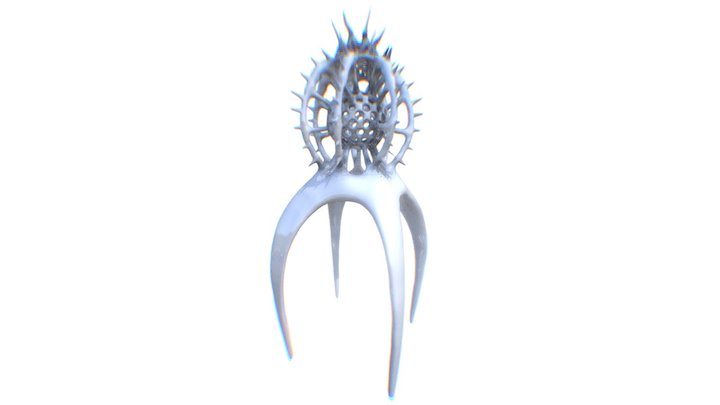
3D model
- Source
- Sketchfab
- Credit
- microbial gardens
- Licence
- CC Attribution
- Commercial use
- cannot be read from the licence given — check the record
Smithsonian Open Access and MorphoSource were not reached for this taxon, so this list is what the others held rather than everything there is.
The description on this site
- Source
- Wikipedia, “Spumellaria”
- Licence
- CC BY-SA 4.0
This is what the site found, which is not the same as what exists.
Keep going
What may have been alongside itPolycystinea through timeThe world it lived on
Occurrence data from the Paleobiology Database, CC BY 4.0. (Ehrenberg 1875)