Suminia
Suminia is an extinct genus of basal anomodont that lived during the Tatarian age of the late Permian, spanning approximately from 268–252 Ma. Suminia is recognized as the youngest non-dicynodont anomodont and was named in honor of Russian paleontologist D. L. Sumin. Its fossil localities are primarily derived from the Kotel’nich locality of the Kirov Oblast in Russia. However, there have been some isolated specimens found in a few different localities, all from eastern European regions of Russia.

Mojcaj · CC BY-SA 3.0 · via Wikipedia/Commons. May be a photograph of a specimen, or an artist’s reconstruction — an interpretation of a skeleton, since colour and soft tissue are almost never preserved.
On record
Recorded, not inferred- Sits inside
- VenyukovioideaPBDB
- Diet
- herbivorePBDB, for Anomodontia
- Motility
- actively mobilePBDB, for Osteichthyes
- Environment
- terrestrialPBDB, for Amniota
Time the record covers
At most 4.5 million years on record.
Every occurrence read is dated to somewhere between 264.28 Mya and 259.857 Mya, and nothing in the dating separates them, so that window is what the record shows rather than a span.
6 occurrences of Suminia on record, most of them in the Permian. Bar height is expected occurrences, not a count: each fossil is spread across the span it is dated to, so a tall narrow bar means tight dating and a low wide one means loose.
When
6 occurrences- Permian100%
These are dates about fossils, not the animal: the record can only begin after it arose and end before it died out, so either end may reach further. Shares are expected occurrences: a fossil dated to a span is counted partly in each period it straddles. More on what this infers.
Found in
3 formations
- Poldarsa Formation2
- Urpalov Formation · Kotelnich Group1
- Malokinelskaya Formation1
Loading coastlines…
The named rock units Suminia has been recovered from, largest first. Drawn where the rock is now, not where it formed. 2 occurrences have no formation on record, which is common for older literature.
Suminia and its relatives
PermianWhere Suminia and its relatives were recorded in the Permian.
Found in the same rock
29 taxa- Chroniosaurus dongusensis4 sites
- Microphon exiguus3 sites
- Suchogorgon golubevi2 sites
- Toyemia tverdochlebovi2 sites
- Deltavjatia rossicus1 site
- Dvinosaurus1 site
- Dvinosaurus primus1 site
- Emeroleter levis1 site
- Geryonichthys burchardi1 site
- Gorynychus masyutinae1 site
- Isadia aristoviensis1 site
- Karenites ornamentatus1 site
- Karpinskiosaurus secundus1 site
- Kotelcephalon viatkensis1 site
- Lapkosubia tokensis1 site
- Microphon1 site
- Microphon gracilis1 site
- Muchia microdenta1 site
- Niuksenitia sukhonensis1 site
- Nochnitsa geminidens1 site
- Perplexisaurus foveatus1 site
- Plotnikovichthys gorodokensis1 site
- Scalopodontes kotelnichi1 site
- Scutosaurus karpinskii1 site
The Paleobiology Database records 6 sites for Suminia, and this reads all of them. The number is how many of those sites it was catalogued from too. The 24 sharing the most are listed.
This is not a list of everything alive at the time. It is only what has come out of the same ground as this animal and been written down.
Entered from
3 references- Eotherapsids from the East European Placket (Late Permian)3
- Upper Permian vertebrates and their sedimentological context in the South Urals, Russia2
- A new Late Permian dromasaurian (Anomodontia) from Eastern Europe1
Each of the 6 occurrences read was entered from one of these publications, ordered by how many each accounts for. This is not a search for papers mentioning the name. Entries link to doi.org where the Paleobiology Database holds an identifier, and to its own record where it does not. Relayed as the Paleobiology Database holds them, not checked against what they resolve to.
Media and terms
Media content1
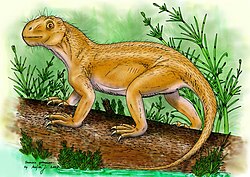
Picture of Suminia
- Source
- Wikipedia/Commons
- Credit
- Mojcaj
- Licence
- CC BY-SA 3.0
- Commercial use
- the licence allows it
No 3D scan of Suminia was found in Sketchfab.
Smithsonian Open Access and MorphoSource were not reached for this taxon, so this list is what the others held rather than everything there is.
The description on this site
- Source
- Wikipedia, “Suminia”
- Licence
- CC BY-SA 4.0
This is what the site found, which is not the same as what exists.
Keep going
What may have been alongside itVenyukovioidea through timeFormations of the PermianThe world it lived on
Occurrence data from the Paleobiology Database, CC BY 4.0. Ivakhnenko 1994