Tanystropheus
Tanystropheus is an extinct genus of archosauromorph reptile which lived during the Triassic Period in Europe, Asia, and North America. It is recognizable by its extremely elongated neck, longer than the torso and tail combined. The neck is composed of 13 vertebrae, strengthened by long cervical ribs. Tanystropheus is one of the most well-described non-archosauriform archosauromorphs. It is known from numerous fossils, including nearly complete skeletons. Some species within the genus may have reached a total length of 6 meters (20 ft), making Tanystropheus the longest non-archosauriform archosauromorph as well. Tanystropheus is the namesake of the family Tanystropheidae, a clade collecting many long-necked Triassic archosauromorphs previously described as "protorosaurs" or "prolacertiforms".

Ghedoghedo · CC BY-SA 3.0 · via Wikipedia/Commons. May be a photograph of a specimen, or an artist’s reconstruction — an interpretation of a skeleton, since colour and soft tissue are almost never preserved.
On record
Recorded, not inferred- Sits inside
- TanystropheidaePBDB
- Diet
- piscivorePBDB
- Life habit
- ground dwellingPBDB
- Motility
- actively mobilePBDB, for Osteichthyes
- Environment
- terrestrialPBDB, for Diapsida
Time the record covers
At least 37 million years on record.
The record covers at least 243.43 Mya to 205.7 Mya. No occurrence read is dated outside 247 Mya to 201.4 Mya.
19 occurrences of Tanystropheus on record, most of them in the Middle Triassic. Bar height is expected occurrences, not a count: each fossil is spread across the span it is dated to, so a tall narrow bar means tight dating and a low wide one means loose.
When
19 occurrencesThese are dates about fossils, not the animal: the record can only begin after it arose and end before it died out, so either end may reach further. Shares are expected occurrences: a fossil dated to a span is counted partly in each period it straddles. More on what this infers.
Found in
11 formations
- Erfurt Formation · Keuper Group2
- Besano Formation2
- Trossingen Formation · Keuper Group2
- Otter Sandstone Formation · Sherwood Sandstone Group1
- Falang Formation1
- Meride Formation1
Loading coastlines…
The named rock units Tanystropheus has been recovered from, largest first. Drawn where the rock is now, not where it formed. 5 occurrences have no formation on record, which is common for older literature.
Tanystropheus and its relatives
Middle TriassicWhere Tanystropheus and its relatives were recorded in the Middle Triassic.
Found in the same rock
95 taxa- Hybodus3 sites
- Nothosaurus3 sites
- Macrocnemus bassanii2 sites
- Mastodonsauridae2 sites
- Nothosauria2 sites
- Nothosaurus giganteus2 sites
- Acrodus1 site
- Acronemus tuberculatus1 site
- Actinistia1 site
- Aetosauridae1 site
- Amniota1 site
- Aneurolepis1 site
- Anomoiodon1 site
- Aphanerama sp.1 site
- Archosauria1 site
- Batrachotomus kupferzellensis1 site
- Belonorhynchus intermedius1 site
- Belonorhynchus stoppanii1 site
- Beneckeia1 site
- Blezingeria ichthyospondylus1 site
- Bystrowiella schumanni1 site
- Callistomordax kugleri1 site
- Ceresiosaurus lanzi1 site
- Chelyoposuchus crassisquamatus1 site
The Paleobiology Database records 18 sites for Tanystropheus, and this reads all of them. The number is how many of those sites it was catalogued from too. The 24 sharing the most are listed.
This is not a list of everything alive at the time. It is only what has come out of the same ground as this animal and been written down.
Entered from
17 references- Beiträge zur Keuperfauna von Halberstadt [Contributions to the Keuper fauna of Halberstadt]2
- Die Schwäbischen Trias-Saurier nach dem Material der Kgl. Naturalien-Sammlung in Stuttgart zusammengestellt [Swabian Triassic dinosaurs based on the material in the Royal Natural History Collection compiled in Stuttgart]2
- Aquatic habits and niche partitioning in the extraordinarily long-necked Triassic reptile Tanystropheus1
- Tanystropheus cf. T. longbardicus from the early Late Triassic of Guizhou Province, southwestern China1
- Exceptional preservation of embryos in the actinopterygian Saurichthys from the Middle Triassic of Monte San Giorgio, Switzerland1
- A new specimen of Tanystropheus (Reptilia Protorosauria) from the Middle Triassic of Switzerland and the ecology of the genus1
- The prosauropod dinosaur Plateosaurus Meyer, 1837 (Saurischia: Sauropodomorpha; Upper Triassic). II. Notes on the referred species1
- A new species of Tanystropheus (Reptilia: Protorosauria) from the Middle Triassic of Makhtesh Ramon, Israel1
- Comparative osteology of Mastodonsaurus giganteus (Jaeger, 1828) from the Middle Triassic (Lettenkeuper: Longobardian) of Germany (Baden-Württemberg, Bayern, Thüringen)1
- Vertebrates from the Middle Triassic Otter Sandstone Formation of Devon1
- Stop 11.1: Carrs Brook near Lower Economy, NS1
- Les reptiles du Trias moyen du Monte San Giorgio, Tessin [The reptiles from the Middle Triassic of Monte San Giorgio, Tessino]1
Each of the 19 occurrences read was entered from one of these publications, ordered by how many each accounts for. This is not a search for papers mentioning the name. 5 further references are not listed. Entries link to doi.org where the Paleobiology Database holds an identifier, and to its own record where it does not. Relayed as the Paleobiology Database holds them, not checked against what they resolve to.
Media and terms
Media content3
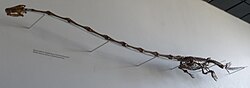
Picture of Tanystropheus
- Source
- Wikipedia/Commons
- Credit
- Ghedoghedo
- Licence
- CC BY-SA 3.0
- Commercial use
- the licence allows it
CT scan
- Source
- MorphoSource
- Licence
- not stated by the source
- Commercial use
- cannot be read from the licence given — check the record
- Specimen
- Tanystropheus sp. · smns:54628
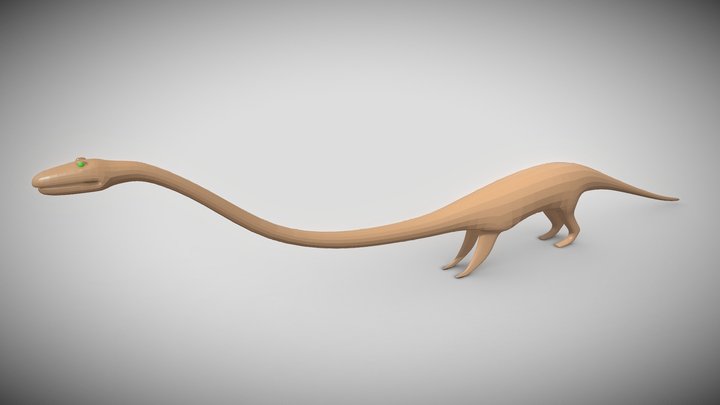
3D model
- Source
- Sketchfab
- Credit
- JD Web Programmer
- Licence
- CC Attribution
- Commercial use
- cannot be read from the licence given — check the record
Smithsonian Open Access was not reached for this taxon, so this list is what the others held rather than everything there is.
The description on this site
- Licence
- CC BY-SA 4.0
This is what the site found, which is not the same as what exists.
Keep going
What may have been alongside itTanystropheidae through timeFormations of the Middle TriassicThe world it lived on
Occurrence data from the Paleobiology Database, CC BY 4.0. von Meyer 1852