Terebralia bidentata

via iDigBio · CC BY · via iDigBio. May be a photograph of a specimen, or an artist’s reconstruction — an interpretation of a skeleton, since colour and soft tissue are almost never preserved.
On record
Recorded, not inferred- Sits inside
- TerebraliaPBDB
- Diet
- grazerPBDB, for Potamididae
- Life habit
- epifaunalPBDB, for Potamididae
- Motility
- actively mobilePBDB, for Potamididae
- Vision
- limitedPBDB, for Gastropoda
Time the record covers
At least 27 million years on record.
The record covers at least 41.03 Mya to 13.82 Mya. No occurrence read is dated outside 48.07 Mya to 12.8 Mya.
20 occurrences of Terebralia bidentata on record, most of them in the Miocene. Bar height is expected occurrences, not a count: each fossil is spread across the span it is dated to, so a tall narrow bar means tight dating and a low wide one means loose.
When
20 occurrencesThese are dates about fossils, not the animal: the record can only begin after it arose and end before it died out, so either end may reach further. Shares are expected occurrences: a fossil dated to a span is counted partly in each period it straddles. More on what this infers.
Found in
9 formations
- Eptachorion Formation2
- Gaj Formation2
- Faluns de la Touraine Formation2
- Turgut Formation1
- Falun de Saucats Formation1
- Warak Formation1
Loading coastlines…
The named rock units Terebralia bidentata has been recovered from, largest first. Drawn where the rock is now, not where it formed. 8 occurrences have no formation on record, which is common for older literature.
Terebralia bidentata and its relatives
MioceneWhere Terebralia bidentata and its relatives were recorded in the Miocene.
Found in the same rock
468 taxa- Ptychopotamides papaveraceus7 sites
- Granulolabium plicatum6 sites
- Turritella bicarinata6 sites
- Cochlis tigrina5 sites
- Haustator eryna5 sites
- Melanopsis impressa5 sites
- Sandbergeria5 sites
- Agapilia pachii4 sites
- Clavatula4 sites
- Euspira helicina4 sites
- Hydrobia4 sites
- Polinices redemptus4 sites
- Alvania3 sites
- Bittium reticulatum3 sites
- Caecum (Brochina) banoni3 sites
- Calyptraea (Calyptraea) depressa3 sites
- Calyptraea chinensis3 sites
- Cochlis neglecta3 sites
- Dorsanum3 sites
- Fossarus3 sites
- Granulolabium bicinctum3 sites
- Hespererato transiens3 sites
- Neverita josephinia3 sites
- Perrona3 sites
The Paleobiology Database records 11 sites for Terebralia bidentata, and this reads all of them. The number is how many of those sites it was catalogued from too. The 24 sharing the most are listed.
This is not a list of everything alive at the time. It is only what has come out of the same ground as this animal and been written down.
Entered from
15 references- Marine und brachyhaline Gastropoden aus dem Karpatium des Korneubuger Beckens und der Kreuzstettener Bucht (Österreich, Untermiozän)4
- Oligocene gastropod faunas for the Eastern Mediterranean (Mesohellenic Trough/Greece and Esfahan-Sirjan Basin/Central Iran)2
- Les Mesogastropoda Fossiles du Cenozoïque étranger des Collections de L'Institute Royale des Sciences Naturelles de Belgique: Cyclophoridae à Stilifetidae2
- Stromatolites in the Paratethys Sea during the Middle Miocene climate transition as witness of the Badenian salinity crisis1
- Die molluskenfauna (Hermmorium, Untermiozän) aus der Kiesgrube kirnke bei Werder (Nordwest-Niedersachsen)1
- Molluscan biostratigraphy and paleoenvironmental reconstruction of Oligocene deposits in the Denizli and Kale-Tavas subbasins (SW Turkey)1
- Oligocene and Aquitanian gastropod faunas from the Sultanate of Oman and their biogeographic implications for the western Indo-Pacific.1
- Commets on the Badenian Fauna (Middle Miocene) from Bahna (Southern Carpathians, Romania)1
- Geology of the Ören and Surrounding Areas, SW Anatolia1
- Early Miocene brackish-water Mollusca from the Eastern Mediterranean and from the Central Paratethys - a faunistic and ecological comparison by selected faunas1
- Révision des Gastropoda (Mollusca) du stratotype de L'Aquitanien (Miocéne inf.) site de Saucats "Lariey", Gironde, France1
- Lithofazielle Entwicklung und Molluskenfauna des oberen Badeniens (Miozän M4d) in dem Gebiet Bratislava-Devinska Nova Ves [Lithofacies and mollusc fauna of the Upper Badenian in the Bratislava-Devinska Nova Ves area]1
Each of the 20 occurrences read was entered from one of these publications, ordered by how many each accounts for. This is not a search for papers mentioning the name. 3 further references are not listed. Entries link to doi.org where the Paleobiology Database holds an identifier, and to its own record where it does not. Relayed as the Paleobiology Database holds them, not checked against what they resolve to.
Media and terms
Media content2
Picture of Terebralia bidentata
- Source
- iDigBio
- Credit
- via iDigBio
- Licence
- CC BY
- Commercial use
- the licence allows it
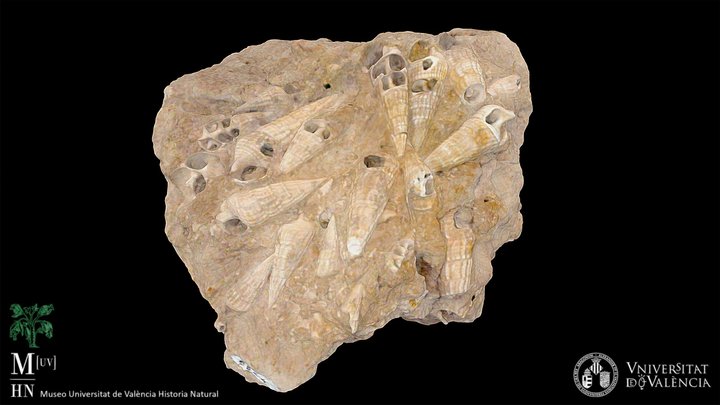
3D model
- Source
- Sketchfab
- Licence
- CC Attribution
- Commercial use
- cannot be read from the licence given — check the record
Smithsonian Open Access and MorphoSource were not reached for this taxon, so this list is what the others held rather than everything there is.
This is what the site found, which is not the same as what exists.
Keep going
What may have been alongside itTerebralia through timeFormations of the MioceneThe world it lived on
Occurrence data from the Paleobiology Database, CC BY 4.0. (Defrance 1832)