Terebratellidae
Terebratellidae is an extant family of brachiopods with a fossil record dating back to the Jurassic.

Luis Ruiz Berti · CC BY-SA 4.0 · via Wikipedia/Commons. May be a photograph of a specimen, or an artist’s reconstruction — an interpretation of a skeleton, since colour and soft tissue are almost never preserved.
On record
Recorded, not inferred- Sits inside
- TerebratelloideaPBDB
- Diet
- suspension feederPBDB
- Life habit
- low-level epifaunalPBDB
- Motility
- stationaryPBDB
- Vision
- blindPBDB, for Rhynchonellata
- Environment
- marinePBDB, for Lophophorata
Time the record covers
At least 174 million years on record.
The record covers at least 174.7 Mya to 11.7 ka. No occurrence read is dated outside 180.4 Mya to 0 Mya.
410 occurrences of Terebratellidae on record, most of them in the Miocene. The Paleobiology Database records this as a living group. Bar height is expected occurrences, not a count: each fossil is spread across the span it is dated to, so a tall narrow bar means tight dating and a low wide one means loose.
When
410 occurrences- Early Jurassicunder 1%
- Middle Jurassicunder 1%
- Late Jurassicunder 1%
- Early Cretaceous3%
- Late Cretaceous3%
- Paleoceneunder 1%
- Eocene27%
- Oligocene13%
- Miocene40%
- Pliocene1%
- Pleistocene10%
- Holoceneunder 1%
These are dates about fossils, not the animal: the record can only begin after it arose and end before it died out, so either end may reach further. Shares are expected occurrences: a fossil dated to a span is counted partly in each period it straddles. More on what this infers.
Found in
60 formations
- Ascot Formation35
- Wilson Bluff Formation34
- Abrakurrie Limestone Formation24
- El Chacay Formation19
- Kokoamu Greensand Formation14
- La Meseta Formation · Seymour Island Group14
Loading coastlines…
The named rock units Terebratellidae has been recovered from, largest first. Drawn where the rock is now, not where it formed. 36 further formations hold fewer occurrences each and are not listed. 111 occurrences have no formation on record, which is common for older literature.
Terebratellidae and its relatives
MioceneWhere Terebratellidae and its relatives were recorded in the Miocene.
Found in the same rock
1,096 taxa- Magasella neozelandica55 sites
- Terebratella28 sites
- Notosaria antipoda25 sites
- Anakinetica recta21 sites
- Magadinella woodsiana16 sites
- Aldingia furculifera13 sites
- Magadina browni13 sites
- Pachymagas13 sites
- Epacrothyris pectoralis11 sites
- Aliquantula insolita10 sites
- Bryozoa10 sites
- Chlamys10 sites
- Ostrea10 sites
- Victorithyris tateana10 sites
- Agariciidae9 sites
- Magellania antarctica9 sites
- Spondylus9 sites
- Terebratulina suessi9 sites
- Austrothyris grandis8 sites
- Liothyrella subcarnea8 sites
- Phyllacanthus8 sites
- Serpula8 sites
- Aliquantula tapirina7 sites
- Bouchardia antarctica7 sites
The Paleobiology Database records 270 sites for Terebratellidae, and this reads 240 of them. The number is how many of those sites it was catalogued from too. The 24 sharing the most are listed.
This is not a list of everything alive at the time. It is only what has come out of the same ground as this animal and been written down.
Entered from
60 references- Early Miocene brachiopods of the Waitemata and Waitakere groups, Auckland and Northland, New Zealand77
- The Cenozoic Brachiopoda of the Bremer and Eucla Basins, southwest Western Australia67
- The brachiopod fauna of the Plio-Pleistocene Ascot Formation, Perth Basin, Western Australia36
- A reappraisal of the systematics of the Stethothyris group of brachiopods from the Cenozoic of New Zealand and Australia26
- Geology of the Western Australian part of the Eucla basin23
- Observaciones estratigraficas en el Paleogeno del noroeste de la Provincia de Santa Cruz (Republica Argentina). Parte II: Invertebrados marinos de la Formacion El Chacy (Eoceno), Provincia de Santa Cruz, Argentina. Systematica y bioestratigrafia19
- Cretaceous-Cenozoic geology and biostratigraphy of the Chatham Islands, New Zealand17
- Brachiopod fauna of the Kokoamu Greensand (Oligocene), New Zealand16
- Brachiopods from the Eocene La Meseta Formation of Seymour Island, Antarctic Peninsula12
- Fossil communities in an Early Miocene transgressive sequence, Mathesons Bay, Leigh, Auckland10
- Invertibrados fósiles marinos de la Formación Guadal (Oligoceno superio-Mioceno inferior) en Pampa, Castillo region, región de Aisén, Chile8
- Note sur la géologie et la paléontologie de la Patagonie7
Each of the 410 occurrences read was entered from one of these publications, ordered by how many each accounts for. This is not a search for papers mentioning the name. 48 further references are not listed. Entries link to doi.org where the Paleobiology Database holds an identifier, and to its own record where it does not. Relayed as the Paleobiology Database holds them, not checked against what they resolve to.
Media and terms
Media content1
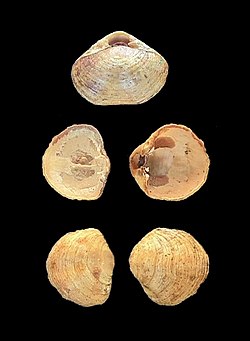
Picture of Terebratellidae
- Source
- Wikipedia/Commons
- Credit
- Luis Ruiz Berti
- Licence
- CC BY-SA 4.0
- Commercial use
- the licence allows it
No 3D scan of Terebratellidae was found in Sketchfab.
Smithsonian Open Access and MorphoSource were not reached for this taxon, so this list is what the others held rather than everything there is.
The description on this site
- Licence
- CC BY-SA 4.0
This is what the site found, which is not the same as what exists.
Keep going
What may have been alongside itTerebratelloidea through timeFormations of the MioceneThe world it lived on
Occurrence data from the Paleobiology Database, CC BY 4.0. King 1850