Tetraclaenodon
Tetraclaenodon was a genus of small and early ungulate mammals that was part of the Phenacodontidae family. It is the oldest and most primitive phenacodontid. Its fossils known from the Nacimiento Formation, New Mexico. In 2012, Tetraclaenodon was defined as the basalmost member of the clade containing "Phenacodontidae" and Altungulata.

Skye McDavid · CC BY-SA 4.0 · via Wikipedia/Commons. May be a photograph of a specimen, or an artist’s reconstruction — an interpretation of a skeleton, since colour and soft tissue are almost never preserved.
On record
Recorded, not inferred- Sits inside
- PhenacodontidaePBDB
- Diet
- herbivorePBDB
- Life habit
- ground dwellingPBDB
- Motility
- actively mobilePBDB, for Osteichthyes
- Environment
- terrestrialPBDB, for Eutheria
Time the record covers
At most 5.9 million years on record.
Every occurrence read is dated to somewhere between 63.4 Mya and 57.5 Mya, and nothing in the dating separates them, so that window is what the record shows rather than a span.
50 occurrences of Tetraclaenodon on record, most of them in the Paleocene. Bar height is expected occurrences, not a count: each fossil is spread across the span it is dated to, so a tall narrow bar means tight dating and a low wide one means loose.
When
50 occurrences- Paleocene100%
These are dates about fossils, not the animal: the record can only begin after it arose and end before it died out, so either end may reach further. Shares are expected occurrences: a fossil dated to a span is counted partly in each period it straddles. More on what this infers.
Found in
7 formations
- Nacimiento Formation21
- Fort Union Formation7
- "Fort Union" (= Lebo) Formation6
- Hanna Formation5
- "Fort Union No. 3" (= Melville) Formation3
- Porcupine Hills Formation2
Loading coastlines…
The named rock units Tetraclaenodon has been recovered from, largest first. Drawn where the rock is now, not where it formed. 5 occurrences have no formation on record, which is common for older literature.
Tetraclaenodon and its relatives
PaleoceneWhere Tetraclaenodon and its relatives were recorded in the Paleocene.
Found in the same rock
264 taxa- Anisonchus sectorius21 sites
- Periptychus carinidens20 sites
- Promioclaenus acolytus20 sites
- Tricentes subtrigonus20 sites
- Protictis haydenianus15 sites
- Mioclaenus turgidus14 sites
- Psittacotherium multifragum14 sites
- Arctocyon ferox13 sites
- Goniacodon levisanus13 sites
- Chriacus baldwini12 sites
- Protoselene opisthacus12 sites
- Chriacus pelvidens10 sites
- Promioclaenus lemuroides10 sites
- Deltatherium fundaminis9 sites
- Mixodectes malaris9 sites
- Pantolambda cavirictus9 sites
- Acmeodon secans8 sites
- Litomylus dissentaneus8 sites
- Coriphagus encinensis7 sites
- Dissacus navajovius7 sites
- Baiotomeus douglassi6 sites
- Bryanictis microlestes6 sites
- Haplaletes disceptatrix6 sites
- Haploconus angustus6 sites
The Paleobiology Database records 50 sites for Tetraclaenodon, and this reads all of them. The number is how many of those sites it was catalogued from too. The 24 sharing the most are listed.
This is not a list of everything alive at the time. It is only what has come out of the same ground as this animal and been written down.
Entered from
19 references- Paleocene vertebrate paleontology of the San Juan Basin, New Mexico10
- Synonymies and reidentifications of North American fossil mammals6
- Paleocene mammalian biostratigraphy of the Carbon Basin, southeastern Wyoming, and age constraints on local phases of tectonism5
- The Kutz Canyon Local Fauna, Torrejonian (Middle Paleocene) of the San Juan Basin, New Mexico;5
- Evolution of Paleocene and Eocene Phenacodontidae (Mammalia, Condylarthra)3
- Notes on Paleocene and Lower Eocene mammal horizons of northern New Mexico and southern Colorado3
- Paleontology and biostratigraphy of lower part of Polecat Bench Formation, southern Bighorn Basin, Wyoming2
- The Clarkforkian Land-Mammal Age and Mammalian Faunal Composition Across the Paleocene-Eocene Boundary2
- Tetraclaenodon puercensis (Mammalia: Phenacodontidae), Goler Formation, Paleocene of California, and distribution of the genus2
- Miocene Formations and Vertebrate Biostratigraphic Units, Texas Coastal Plain2
- The Fort Union of the Crazy Mountain field, Montana and its mammalian faunas2
- First mammals from the Paleocene Porcupine Hills Formation of southwestern Alberta, Canada1
Each of the 50 occurrences read was entered from one of these publications, ordered by how many each accounts for. This is not a search for papers mentioning the name. 7 further references are not listed. Entries link to doi.org where the Paleobiology Database holds an identifier, and to its own record where it does not. Relayed as the Paleobiology Database holds them, not checked against what they resolve to.
Media and terms
Media content2

Picture of Tetraclaenodon
- Source
- Wikipedia/Commons
- Credit
- Skye McDavid
- Licence
- CC BY-SA 4.0
- Commercial use
- the licence allows it
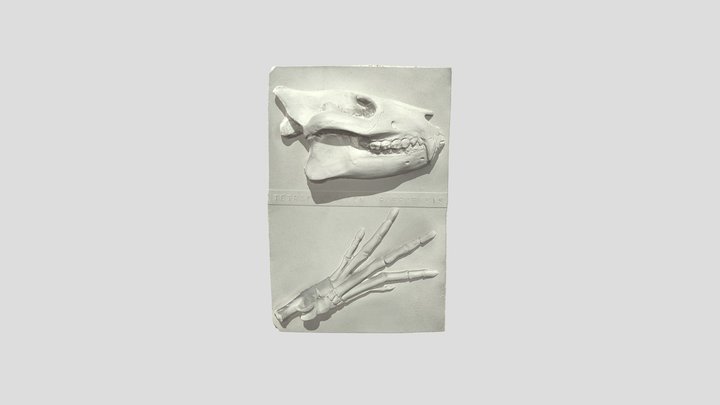
3D model
- Source
- Sketchfab
- Credit
- UIPaleoRepository
- Licence
- CC Attribution
- Commercial use
- cannot be read from the licence given — check the record
Smithsonian Open Access and MorphoSource were not reached for this taxon, so this list is what the others held rather than everything there is.
The description on this site
- Licence
- CC BY-SA 4.0
This is what the site found, which is not the same as what exists.
Keep going
What may have been alongside itPhenacodontidae through timeFormations of the PaleoceneThe world it lived on
Occurrence data from the Paleobiology Database, CC BY 4.0. Scott 1892