Trachyceras
Trachyceras is a genus of ammonoid cephalopods belonging to the order Ceratitida. The type species is Trachyceras aon, which was first described by Georg zu Münster in 1834 as a species of Ceratites. The genus includes many species found in Afghanistan, Bosnia and Herzegovina, Canada, China, Germany, Hungary, India, Indonesia, Italy, the Russian Federation, Slovenia, and the United States.

Kent G. Budge · CC BY-SA 4.0 · via Wikipedia/Commons. May be a photograph of a specimen, or an artist’s reconstruction — an interpretation of a skeleton, since colour and soft tissue are almost never preserved.
On record
Recorded, not inferred- Sits inside
- TrachyceratinaePBDB
- Diet
- carnivorePBDB, for Ceratitida
- Life habit
- nektonicPBDB, for Ceratitida
- Motility
- actively mobilePBDB, for Ceratitida
- Vision
- well-developedPBDB, for Cephalopoda
- Environment
- marinePBDB, for Cephalopoda
Time the record covers
At least 14 million years on record.
The record covers at least 241.464 Mya to 227.3 Mya. No occurrence read is dated outside 247 Mya to 201.4 Mya.
165 occurrences of Trachyceras on record, most of them in the Late Triassic. Bar height is expected occurrences, not a count: each fossil is spread across the span it is dated to, so a tall narrow bar means tight dating and a low wide one means loose.
When
165 occurrencesThese are dates about fossils, not the animal: the record can only begin after it arose and end before it died out, so either end may reach further. Shares are expected occurrences: a fossil dated to a span is counted partly in each period it straddles. More on what this infers.
Found in
23 formations
- San Cassian Formation39
- Cassian Formation28
- San Cassiano Formation11
- Liard Formation5
- Muschelkalk Formation5
- Xiaowa Formation4
Loading coastlines…
The named rock units Trachyceras has been recovered from, largest first. Drawn where the rock is now, not where it formed. 39 occurrences have no formation on record, which is common for older literature.
Trachyceras and its relatives
Late TriassicWhere Trachyceras and its relatives were recorded in the Late Triassic.
Found in the same rock
1,201 taxa- Lecanites glaucus19 sites
- Zestoceras lorigae17 sites
- Joannites16 sites
- Protrachyceras archelaus13 sites
- Zestoceras12 sites
- Lobites ellipticus11 sites
- Daonella lommeli10 sites
- Monophyllites wengensis10 sites
- Trematoceras elegans10 sites
- Sirenotrachyceras furcatum9 sites
- Zestoceras barwicki9 sites
- Frankites regoledanus8 sites
- Joannites cymbiformis8 sites
- Megaphyllites jarbas8 sites
- Joannites klipsteini7 sites
- Protrachyceras ladinum7 sites
- Echinoidea6 sites
- Falsanolcites doleriticum6 sites
- Klipsteinia achelous6 sites
- Orthoceratoidea6 sites
- Proarcestes bicarinatus6 sites
- Asklepioceras5 sites
- Atractites5 sites
- Badiotites eryx5 sites
The Paleobiology Database records 101 sites for Trachyceras, and this reads all of them. The number is how many of those sites it was catalogued from too. The 24 sharing the most are listed.
This is not a list of everything alive at the time. It is only what has come out of the same ground as this animal and been written down.
Entered from
33 references- Selected ammonoid fauna from Prati Di Stuores/Stuores Wiesen and related sections across the Ladinian-Carnian boundary (southern Alps, Italy)39
- Die Cephalopoden der Mediterranen Triasprovinz35
- Beschreibung neuer Versteinerungen von St. Cassian und einiger anderer Localitäten, Erster Abschnitt. Mollusken17
- The Prati di Stuores/Stuores Wiesen Section (Dolomites, Italy): a candidate Global Stratotype Section and Point for the base of the Carnian stage.11
- Canadian Triassic Ammonoid Faunas6
- Das Westliche Süd-Tirol: geologisch dargestellt5
- The Late Triassic black shales of the Guanling area, Guizhou province, south-west China: a unique marine reptile and pelagic crinoid fossil lagerstätte4
- Geologische und palaeontologische Studien uber die Marmolata4
- Beiträge zur Geognosie und Petrefacten-Kunde des südöstlichen Tirols vorzüglich der Schichten von St. Cassian4
- Ammonoids from the Zhuganpo Member of the Falang Formation at Nimaigu and their relevance for dating the Xingyi fossil-Lagerstätte (late Ladinian, Guizhou, China)3
- Il Trias in Lombardia, 23: Cefalopodi e gasteropodi dello Julico in Lombardia [Triassic in Lombardy, 23: Julian cephalopods and gastropods in Lombardy]3
- Catalogue of Fossil Cephalopoda in the British Museum (Natural History), Part IV, The Ammonoidea of the Trias3
Each of the 165 occurrences read was entered from one of these publications, ordered by how many each accounts for. This is not a search for papers mentioning the name. 21 further references are not listed. Entries link to doi.org where the Paleobiology Database holds an identifier, and to its own record where it does not. Relayed as the Paleobiology Database holds them, not checked against what they resolve to.
Media and terms
Media content2

Picture of Trachyceras
- Source
- Wikipedia/Commons
- Credit
- Kent G. Budge
- Licence
- CC BY-SA 4.0
- Commercial use
- the licence allows it
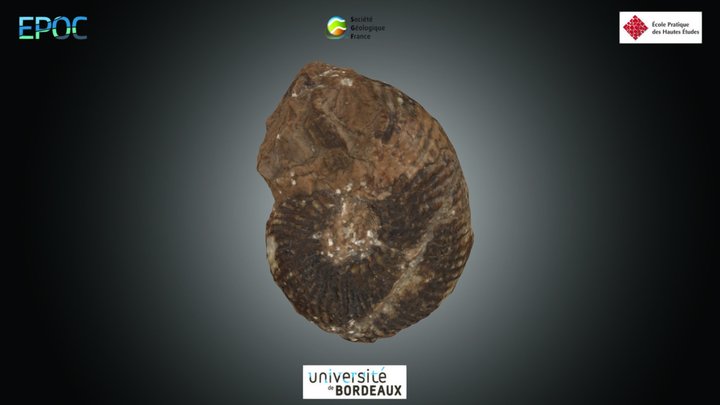
3D model
- Source
- Sketchfab
- Licence
- CC Attribution-NonCommercial-ShareAlike
- Commercial use
- the licence does not allow it
Smithsonian Open Access was not reached for this taxon, so this list is what the others held rather than everything there is.
The description on this site
- Source
- Wikipedia, “Trachyceras”
- Licence
- CC BY-SA 4.0
This is what the site found, which is not the same as what exists.
Keep going
What may have been alongside itTrachyceratinae through timeFormations of the Late TriassicThe world it lived on
Occurrence data from the Paleobiology Database, CC BY 4.0. (Laube 1869)