Tragulidae
Chevrotains, or mouse-deer, are small, even-toed ungulates that make up the family Tragulidae, and are the only living members of the infraorder Tragulina. The 10 extant species are placed in three genera, but several species also are known only from fossils. The extant species are found in forests in South and Southeast Asia; a single species, the water chevrotain, is found in the rainforests of Central and West Africa. In November 2019, conservation scientists announced that they had photographed silver-backed chevrotains in a Vietnamese forest for the first time since the last confirmed sightings in 1990.

Uncredited · via Wikipedia/Commons. May be a photograph of a specimen, or an artist’s reconstruction — an interpretation of a skeleton, since colour and soft tissue are almost never preserved.
On record
Recorded, not inferred- Also called
- chevrotainPBDB
- Sits inside
- TragulinaPBDB
- Diet
- frugivore, grazerPBDB
- Life habit
- ground dwellingPBDB
- Motility
- actively mobilePBDB, for Osteichthyes
- Environment
- terrestrialPBDB, for Artiodactyla
Time the record covers
At least 37 million years on record.
The record covers at least 37.71 Mya to 129 ka. No occurrence read is dated outside 41.03 Mya to 11.7 ka.
267 occurrences of Tragulidae on record, most of them in the Miocene. The Paleobiology Database records this as a living group. Bar height is expected occurrences, not a count: each fossil is spread across the span it is dated to, so a tall narrow bar means tight dating and a low wide one means loose.
When
267 occurrences- Eocene4%
- Oligocene12%
- Miocene82%
- Plioceneunder 1%
- Pleistocene2%
These are dates about fossils, not the animal: the record can only begin after it arose and end before it died out, so either end may reach further. Shares are expected occurrences: a fossil dated to a span is counted partly in each period it straddles. More on what this infers.
Found in
46 formations
- Maboko Formation13
- Manchar Formation11
- Kizilirmak Formation10
- Chinji Formation · Siwalik Group9
- Vihowa Formation7
- Lothidok Formation6
Loading coastlines…
The named rock units Tragulidae has been recovered from, largest first. Drawn where the rock is now, not where it formed. 22 further formations hold fewer occurrences each and are not listed. 130 occurrences have no formation on record, which is common for older literature.
Tragulidae and its relatives
MioceneWhere Tragulidae and its relatives were recorded in the Miocene.
Found in the same rock
2,012 taxa- Dorcatherium44 sites
- Rhinocerotidae34 sites
- Bovidae26 sites
- Anchitherium aurelianense23 sites
- Trionyx22 sites
- Aceratherium21 sites
- Gomphotherium angustidens20 sites
- Dorcabune19 sites
- Dorcatherium crassum19 sites
- Palaeomeryx19 sites
- Dorcatherium naui18 sites
- Mustelidae18 sites
- Testudo18 sites
- Bunolistriodon17 sites
- Hyotherium soemmeringi17 sites
- Proboscidea17 sites
- Procervulus dichotomus17 sites
- Soricidae17 sites
- Brachypotherium brachypus16 sites
- Martes16 sites
- Prodeinotherium bavaricum16 sites
- Prolagus oeningensis16 sites
- Steneofiber depereti16 sites
- Copemys15 sites
The Paleobiology Database records 175 sites for Tragulidae, and this reads all of them. The number is how many of those sites it was catalogued from too. The 24 sharing the most are listed.
This is not a list of everything alive at the time. It is only what has come out of the same ground as this animal and been written down.
Entered from
118 references- A comparison of larger fossil mammals in the stratotypes of the Chinji, Nagri and Dhok Pathan Formations (Punjab, Pakistan)13
- Will Downs and the Zinda Pir Dome12
- Preliminary report on the geology and vertebrate fauna of the Miocene Manchar Formation, Sind, Pakistan11
- Oligocene ruminants from the Kızılırmak Formation, Çankırı-Çorum Basin, Central Anatolia, Turkey9
- Les fossiles de mammifères miocènes de la colletion de J.-P. Hartmann conservés dans le Musée du Savignéen9
- The Artiodactyla of Ramapithecus site, Lufeng, Yunnan9
- Cryptomerix Schlosser, 1886, Tragulidé de l'oligocène d'Europe; relations du genre et considérations sur l'origine des ruminants7
- Iberomeryx minor (Mammalia, Artiodactyla) from the Early Oligocene of Soulce (Canton Jura, NW Switzerland): systematics and palaeodiet6
- Stratigraphy and mammal faunas of the Brackwassermolasse in the surroundings of Ulm (Southwest Germany)6
- Siwalik mammals of the Jammu Sub-Himalaya, India: an appraisal of their diversity and habitats.5
- Les ruminants de Pech Desse et de Pech du Fraysse (Quercy; MP28); évolution des ruminants de l'oligocène d'Europe5
- La succession des faunes de mammiferes miocenes de Pontigne (Maine-et-Loire, France)5
Each of the 267 occurrences read was entered from one of these publications, ordered by how many each accounts for. This is not a search for papers mentioning the name. 106 further references are not listed. Entries link to doi.org where the Paleobiology Database holds an identifier, and to its own record where it does not. Relayed as the Paleobiology Database holds them, not checked against what they resolve to.
Media and terms
Media content2
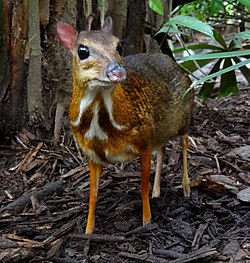
Picture of Tragulidae
- Source
- Wikipedia/Commons
- Credit
- nobody named on the record
- Licence
- not stated by the source
- Commercial use
- cannot be read from the licence given — check the record
Structured light scan
- Source
- MorphoSource
- Licence
- In Copyright
- Commercial use
- cannot be read from the licence given — check the record
- Specimen
- Tragulidae sp. · pu:vpl:RM40
Smithsonian Open Access was not reached for this taxon, so this list is what the others held rather than everything there is.
The description on this site
- Source
- Wikipedia, “Chevrotain”
- Licence
- CC BY-SA 4.0
This is what the site found, which is not the same as what exists.
Keep going
What may have been alongside itTragulina through timeFormations of the MioceneThe world it lived on
Occurrence data from the Paleobiology Database, CC BY 4.0. Milnes-Edwards 1864