Triceratops
Triceratops is a genus of chasmosaurine ceratopsian dinosaur that lived during the late Maastrichtian age of the Late Cretaceous period, about 69 to 66 million years ago on the island continent of Laramidia, now forming western North America. It was one of the last-known non-avian dinosaurs and lived until the Cretaceous–Paleogene extinction event 66 million years ago. The name Triceratops, which means 'three-horned face', is derived from Ancient Greek trí-, meaning 'three', kéras, meaning 'horn', and ṓps, meaning 'face'.

Source: Allie_Caulfield Derivative: User:MathKnight · CC BY-SA 3.0 · via Wikipedia/Commons. May be a photograph of a specimen, or an artist’s reconstruction — an interpretation of a skeleton, since colour and soft tissue are almost never preserved.
On record
Recorded, not inferred- Sits inside
- TriceratopsiniPBDB
- Diet
- herbivorePBDB, for Ceratopsia
- Life habit
- ground dwellingPBDB, for Ceratopsia
- Motility
- actively mobilePBDB, for Ornithischia
- Environment
- terrestrialPBDB, for Ceratopsia
- Length
- 9 mWikidata
- Mass
- 12 tonneWikidata
Time the record covers
At most 18 million years on record.
Every occurrence read is dated to somewhere between 83.6 Mya and 66 Mya, and nothing in the dating separates them, so that window is what the record shows rather than a span.
166 occurrences of Triceratops on record, most of them in the Late Cretaceous. Bar height is expected occurrences, not a count: each fossil is spread across the span it is dated to, so a tall narrow bar means tight dating and a low wide one means loose.
When
166 occurrences- Late Cretaceous100%
These are dates about fossils, not the animal: the record can only begin after it arose and end before it died out, so either end may reach further. Shares are expected occurrences: a fossil dated to a span is counted partly in each period it straddles. More on what this infers.
Found in
12 formations
- Lance Formation68
- Hell Creek Formation · Montana Group65
- Frenchman Formation14
- Ojo Alamo Formation6
- Laramie Formation3
- Scollard Formation · Edmonton Group2
Loading coastlines…
The named rock units Triceratops has been recovered from, largest first. Drawn where the rock is now, not where it formed.
Triceratops and its relatives
Late CretaceousWhere Triceratops and its relatives were recorded in the Late Cretaceous.
Found in the same rock
344 taxa- Champsosaurus21 sites
- Edmontosaurus19 sites
- Myledaphus bipartitus18 sites
- Theropoda18 sites
- Brachychampsa montana16 sites
- Tyrannosaurus rex16 sites
- Hadrosauridae15 sites
- Borealosuchus sternbergii14 sites
- Lepisosteus14 sites
- Lepisosteus occidentalis14 sites
- Trionychidae14 sites
- Crocodylia13 sites
- Didelphodon vorax12 sites
- Meniscoessus robustus12 sites
- Baenidae11 sites
- Scapherpeton tectum11 sites
- Tyrannosauridae11 sites
- Basilemys10 sites
- Dromaeosauridae10 sites
- Cimolodon nitidus9 sites
- Gypsonictops hypoconus9 sites
- Habrosaurus dilatus9 sites
- Mesodma thompsoni9 sites
- Opisthotriton kayi9 sites
The Paleobiology Database records 160 sites for Triceratops, and this reads all of them. The number is how many of those sites it was catalogued from too. The 24 sharing the most are listed.
This is not a list of everything alive at the time. It is only what has come out of the same ground as this animal and been written down.
Entered from
83 references- The Munich specimen of Triceratops with a revision of the genus14
- Fossil vertebrates from the Late Cretaceous Lance Formation, eastern Wyoming10
- The Ceratopsia8
- The paleontology, geology and taphonomy of the Tooth Draw Deposit; Hell Creek Formation (Maastrictian), Butte County, South Dakota6
- Roloson, 20225
- Taxonomic composition of the Alamo Wash local fauna from the Upper Cretaceous Ojo Alamo Formation (Naashoibito Member), San Juan Basin, New Mexico5
- Fossil Vertebrate Collections5
- A revision of the Ceratopsia or horned dinosaurs5
- The mammals and horned dinosaurs of the Lance Formation of Niobrara County, Wyoming5
- History of the ceratopsian dinosaur Triceratops in the Science Museum of Minnesota, 1960–present4
- Contributions to the stratigraphy and palaeontology of the Goshen Hole area, Wyoming. II. The Torrington Member of the Lance Formation and a study of a new Triceratops4
- A stratigraphic survey of Triceratops localities in the Hell Creek Formation, northeastern Montana (2006–2010)3
Each of the 166 occurrences read was entered from one of these publications, ordered by how many each accounts for. This is not a search for papers mentioning the name. 71 further references are not listed. Entries link to doi.org where the Paleobiology Database holds an identifier, and to its own record where it does not. Relayed as the Paleobiology Database holds them, not checked against what they resolve to.
Media and terms
Media content4

Picture of Triceratops
- Source
- Wikipedia/Commons
- Credit
- Source: Allie_Caulfield Derivative: User:MathKnight
- Licence
- CC BY-SA 3.0
- Commercial use
- the licence allows it
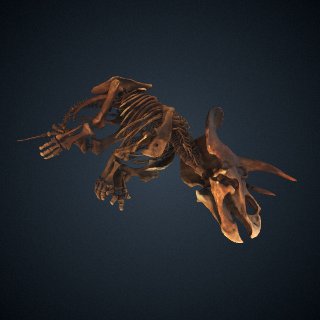
3D scan
- Source
- Smithsonian
- Licence
- CC0 — this site’s default, not the record’s
- Commercial use
- the licence allows it
- Specimen
- Triceratops horridus Marsh, 1889
Laser scan
- Source
- MorphoSource
- Licence
- In Copyright
- Commercial use
- cannot be read from the licence given — check the record
- Specimen
- Triceratops sp. · CF:MCFO-0506
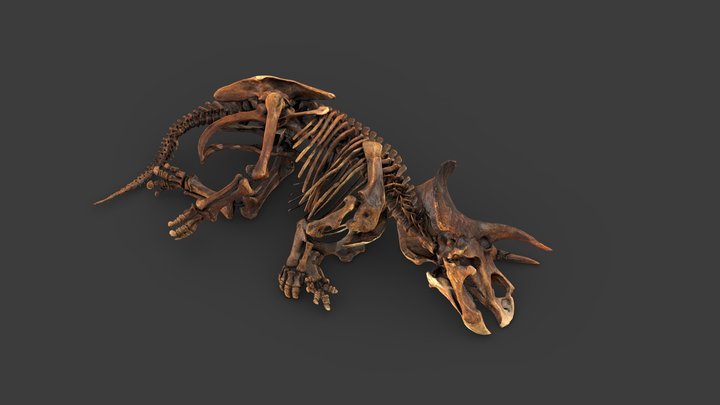
3D model
- Source
- Sketchfab
- Licence
- CC0 Public Domain
- Commercial use
- the licence allows it
The description on this site
- Source
- Wikipedia, “Triceratops”
- Licence
- CC BY-SA 4.0
This is what the site found, which is not the same as what exists.
Keep going
What may have been alongside itTriceratopsini through timeFormations of the Late CretaceousThe world it lived on
Occurrence data from the Paleobiology Database, CC BY 4.0. Marsh 1889