Vetulicola
Vetulicola is an extinct genus of marine animal discovered from the Cambrian of China. It is the eponymous member of the enigmatic taxon Vetulicolia, which is of uncertain affinities but may belong to the deuterostomes. The name was derived from Vetulicola cuneata, the first species described by Hou Xian-guang in 1987 from the Lower Cambrian Chiungchussu Formation in Chengjiang, China.

Masahiro miyasaka · CC BY-SA 4.0 · via Wikipedia/Commons. May be a photograph of a specimen, or an artist’s reconstruction — an interpretation of a skeleton, since colour and soft tissue are almost never preserved.
On record
Recorded, not inferred- Sits inside
- VetulicolidaePBDB
- Motility
- actively mobilePBDB, for Chordata
- Vision
- blindPBDB, for Vetulicolida
Time the record covers
At most 8.9 million years on record.
Every occurrence read is dated to somewhere between 521 Mya and 512.1 Mya, and nothing in the dating separates them, so that window is what the record shows rather than a span.
29 occurrences of Vetulicola on record, most of them in the Cambrian. Bar height is expected occurrences, not a count: each fossil is spread across the span it is dated to, so a tall narrow bar means tight dating and a low wide one means loose.
When
29 occurrences- Cambrian100%
These are dates about fossils, not the animal: the record can only begin after it arose and end before it died out, so either end may reach further. Shares are expected occurrences: a fossil dated to a span is counted partly in each period it straddles. More on what this infers.
Found in
4 formations
Loading coastlines…
The named rock units Vetulicola has been recovered from, largest first. Drawn where the rock is now, not where it formed.
Vetulicola and its relatives
CambrianWhere Vetulicola and its relatives were recorded in the Cambrian.
Found in the same rock
273 taxa- Diandongia pista12 sites
- Heliomedusa orienta11 sites
- Isoxys auritus11 sites
- Kunmingella douvillei11 sites
- Misszhouia longicaudata11 sites
- Branchiocaris yunnanensis10 sites
- Leanchoilia illecebrosa10 sites
- Eoredlichia intermediata9 sites
- Mafangscolex sinensis9 sites
- Paraleptomitella dictyodroma9 sites
- Amplectobelua symbrachiata8 sites
- Naraoia8 sites
- Naraoia spinosa8 sites
- Eoglossa chengjiangensis7 sites
- Houcaris saron7 sites
- Isoxys paradoxus7 sites
- Lingulellotreta malongensis7 sites
- Redlichia7 sites
- Saetaspongia densa7 sites
- Yunnanocephalus yunnanensis7 sites
- Choiaella radiata6 sites
- Chuandianella ovata6 sites
- Cricocosmia jinningensis6 sites
- Fuxianhuia protensa6 sites
The Paleobiology Database records 24 sites for Vetulicola, and this reads all of them. The number is how many of those sites it was catalogued from too. The 24 sharing the most are listed.
This is not a list of everything alive at the time. It is only what has come out of the same ground as this animal and been written down.
Entered from
9 references- Luo et al., 20087
- Taphonomy and Palaeoecology of the Early Cambrian Chengjiang Biota from Eastern Yunnan, China6
- Diversity and species abundance patterns of the early Cambrian (Series 2, Stage 3) Chengjiang Biota from China4
- Community palaeoecology of the early Cambrian Maotianshan Shale biota: Ecological dominance of priapulid worms4
- Spatial variation in the diversity and composition of the Lower Cambrian (Series 2, Stage 3) Chengjiang Biota, Southwest China3
- Lower Cambrian Burgess Shale-type fossil associations of South China2
- Soft-bodied fossils from the Shipai Formation, Lower Cambrian of the Three Gorge area, South China1
- Early Cambrian Chengjiang fauna in eastern Yunnan, CHina1
- Lower Cambrian pediculate lingulids from Yunnan, China1
Each of the 29 occurrences read was entered from one of these publications, ordered by how many each accounts for. This is not a search for papers mentioning the name. Entries link to doi.org where the Paleobiology Database holds an identifier, and to its own record where it does not. Relayed as the Paleobiology Database holds them, not checked against what they resolve to.
Media and terms
Media content2

Picture of Vetulicola
- Source
- Wikipedia/Commons
- Credit
- Masahiro miyasaka
- Licence
- CC BY-SA 4.0
- Commercial use
- the licence allows it
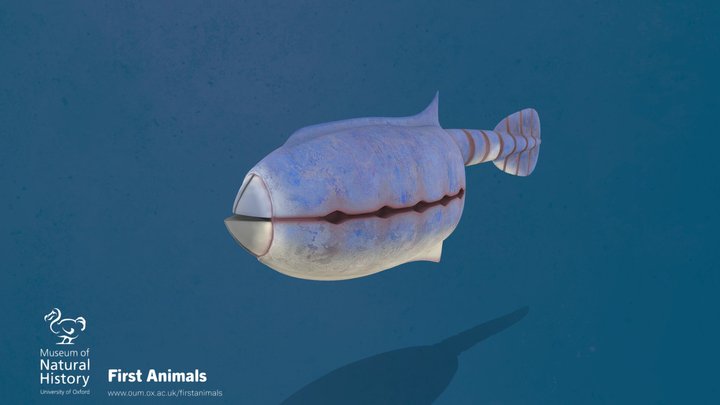
3D model
- Source
- Sketchfab
- Licence
- CC Attribution-NonCommercial
- Commercial use
- the licence does not allow it
Smithsonian Open Access and MorphoSource were not reached for this taxon, so this list is what the others held rather than everything there is.
The description on this site
- Source
- Wikipedia, “Vetulicola”
- Licence
- CC BY-SA 4.0
This is what the site found, which is not the same as what exists.
Keep going
What may have been alongside itVetulicolidae through timeFormations of the CambrianThe world it lived on
Occurrence data from the Paleobiology Database, CC BY 4.0. Hou 1987