Adansonia digitata
Adansonia digitata, the African baobab, is the most widespread tree species of the genus Adansonia, the baobabs, and is native to the African continent and the southern Arabian Peninsula. These are long-lived pachycauls; radiocarbon dating has shown at least one individual to be 1,275 years old. They are typically found in dry, hot savannas of sub-Saharan Africa, where they dominate the landscape and reveal the presence of a watercourse from afar. They have traditionally been valued as sources of food, water, health remedies or places of shelter and are a key food source for many animals. They are steeped in legend and superstition. In recent years, many of the largest, oldest trees have died, for unknown reasons. Other common names for the baobab include monkey-bread tree, upside-down tree, and cream of tartar tree.

Ferdinand Reus from Arnhem, Holland · CC BY-SA 2.0 · via Wikipedia/Commons. May be a photograph of a specimen, or an artist’s reconstruction — an interpretation of a skeleton, since colour and soft tissue are almost never preserved.
On record
Recorded, not inferred- Sits inside
- AdansoniaPBDB
Time the record covers
At most 1.1 million years on record.
The one occurrence read is dated to somewhere between 1.8 Mya and 774 ka, which is a dating window rather than a span.
1 occurrence of Adansonia digitata on record, most of them in the Pleistocene. The Paleobiology Database records this as a living group, and the chart stops with its fossils rather than at the present. Bar height is expected occurrences, not a count: each fossil is spread across the span it is dated to, so a tall narrow bar means tight dating and a low wide one means loose.
When
1 occurrences- Pleistocene100%
These are dates about fossils, not the animal: the record can only begin after it arose and end before it died out, so either end may reach further. Shares are expected occurrences: a fossil dated to a span is counted partly in each period it straddles. More on what this infers.
Found in
1 formation
Loading coastlines…
The named rock units Adansonia digitata has been recovered from, largest first. Drawn where the rock is now, not where it formed.
Adansonia digitata and its relatives
PleistoceneWhere Adansonia digitata and its relatives were recorded in the Pleistocene.
Found in the same rock
34 taxa- Achyranthes1 site
- Alchornea1 site
- Amaranthaceae1 site
- Artemisia1 site
- Asteraceae1 site
- Chenopodiaceae1 site
- Combretaceae-Melastomaceae indet.1 site
- Commelina1 site
- Crocodylus1 site
- Crocodylus niloticus1 site
- Croton1 site
- Cyperaceae1 site
- Dodnaea sp.1 site
- Ebenaceae1 site
- Euphorbia1 site
- Hagenia1 site
- Heliotropium1 site
- Hypericum1 site
- Indet. indet.1 site
- Juniperus1 site
- Ormocarpum sp.1 site
- Papilionoideae indet.1 site
- Plantae1 site
- Plantago1 site
The Paleobiology Database records 1 site for Adansonia digitata, and this reads all of them. The number is how many of those sites it was catalogued from too. The 24 sharing the most are listed.
This is not a list of everything alive at the time. It is only what has come out of the same ground as this animal and been written down.
Entered from
1 referenceEach of the 1 occurrence read was entered from one of these publications, ordered by how many each accounts for. This is not a search for papers mentioning the name. Each entry links to doi.org. Relayed as the Paleobiology Database holds them, not checked against what they resolve to.
Media and terms
Media content1
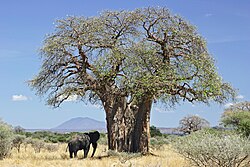
Picture of Adansonia digitata
- Source
- Wikipedia/Commons
- Credit
- Ferdinand Reus from Arnhem, Holland
- Licence
- CC BY-SA 2.0
- Commercial use
- the licence allows it
No 3D scan of Adansonia digitata was found in Sketchfab.
Smithsonian Open Access and MorphoSource were not reached for this taxon, so this list is what the others held rather than everything there is.
The description on this site
- Licence
- CC BY-SA 4.0
This is what the site found, which is not the same as what exists.
Keep going
What may have been alongside itAdansonia through timeFormations of the PleistoceneThe world it lived on
Occurrence data from the Paleobiology Database, CC BY 4.0. Linnaeus 1753